Weekend Times


Google Workspace

Business News

Time after time, tragedies like the Titan disaster occur because leaders ignore red flags

  • Written by Tony Jaques, Senior Research Associate, RMIT University
Time after time, tragedies like the Titan disaster occur because leaders ignore red flags

The loss of the OceanGate submersible Titan appears to be an example of warnings ignored.

“We have heard the baseless cries of ‘you are going to kill someone’ way too often,” OceanGate chief executive Stockton Rush wrote in 2018[1], after being told he was putting lives at risk using his experimental submersible Titan to ferry customers to view the wreck of the Titanic almost 4,000 metres below sea level. “I take this as a serious personal insult.”

Rush, who died along with four others with the Titan’s “catastrophic failure” last week, was warned by marine technology experts as well as atleast one employee[2] (subsequently dismissed) that the carbon-fibre vessel risked potentially “catastrophic” problems without rigorous testing and assessments.

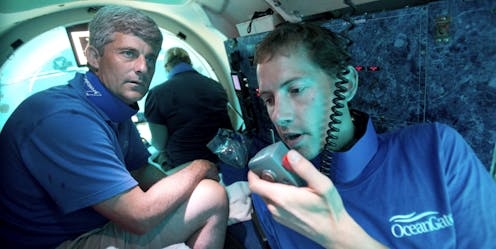
OceanGate Expeditions chief executive Stockton Rush photographed on board the Titan in May 2023.
OceanGate Expeditions chief executive Stockton Rush photographed on board the Titan in May 2023. Travel Weekly/AP

Those boarding the Titan had to sign[3] a waiver stating it was “an experimental submersible vessel that has not been approved or certified by any regulatory body which could result in physical injury, emotional trauma or death”. That should have been warning enough.

But this is not about being wise after the event. Consulting firm Institute for Crisis Management[4] compiles statistics[5] on crises across the globe every year. It rates 46% of these as “smoldering” in nature – that is, likely to have occurred after red flags or warning signs.

ICM annual crisis report, 2021
ICM annual crisis report 2021, CC BY[6][7] “In every crisis I have every studied,” says[8] United States crisis management expert Ian Mitroff[9] who has authored more than 20 books on the subject, “there were always a few key people on the inside of an organisation, or on its edge, who saw the early warning signs and tried to warn their superiors.” “In every case, the signals were either ignored or blocked from getting to the top or having any effect.” US academics Erika James and Lynn Wooten agree[10]: Smouldering crises nearly always leave a trail of red flags and warning signs that something is wrong. These signals often go unheeded by management. Read more: Why PR agencies and their spin should be the subject of greater scrutiny[11] Why are red flags not always acted on? Sometimes the warning signs simply aren’t recognised. This happened with French bank Société Générale, which in 2009 lost about €4.9 billion through unauthorised transactions by a single rogue futures trader, who created fictitious trades to cover losses on a falling market. An independent inquiry found the bank failed[12] to act on 75 red flags over a period of 18 months. Sometimes the problem gets reported but is blocked from moving up to management. In one of Australia’s worst disasters, the Black Saturday bushfires in Victoria in 2009 that killed 173 people, some of the fires were caused by fallen power lines sparking fires in hot windy weather. Subsequent inquiries revealed clear warnings[13] about the risk of fires. A memorial to the Black Saturday bushfires at Marysville, Victoria.
A memorial to the Black Saturday bushfires at Marysville, Victoria. David Crosling/AAP

Sometimes top decision-makers are aware of the problem but don’t see it as a priority.

This appeared to be the case at the Pike River coal mine in New Zealand, where a gas explosion in 2010 caused a mine collapse, killing 29. The ensuing royal commission[14] found that in the previous seven weeks the financially stressed company had “failed to heed numerous warnings of a potential catastrophe at the mine”.

The commission concluded:

In the drive towards coal production the directors and executive managers paid insufficient attention to health and safety and exposed the company’s workers to unacceptable risks. Mining should have stopped until the risks could be properly managed.

Flowers for the 29 victims of the Pike River mine disaster in New Zealand. Iain McGregor/AP

And sometimes warning alarms are literally turned off.

Following the disastrous explosion and fire on the ill-fated Deepwater Horizon oil rig in the Gulf of Mexico, killing 11 workers, in 2010, a US government investigation was told vital safety warning systems had been deliberately disabled[15] to spare workers being awoken by false alarms.

Experts will try to resolve exactly how and why the Titan joined the Titanic on the bottom of the Atlantic Ocean – and whether the disaster could have been avoided if the many prior safety concerns had not been “explained away”.

The best crisis management is to prevent the crisis in the first place. Whether it is companies or governments or communities or individuals, when there are warning signs of impending disaster speak up, and keep speaking up, until someone takes action.

Read more: 3 crisis-leadership lessons from Abraham Lincoln[16]

References

  1. ^ wrote in 2018 (thenewdaily.com.au)
  2. ^ least one employee (www.bbc.com)
  3. ^ had to sign (www.bbc.com)
  4. ^ Institute for Crisis Management (crisisconsultant.com)
  5. ^ compiles statistics (crisisconsultant.com)
  6. ^ ICM annual crisis report 2021 (crisisconsultant.com)
  7. ^ CC BY (creativecommons.org)
  8. ^ says (assets.ctfassets.net)
  9. ^ Ian Mitroff (mitroff.net)
  10. ^ agree (assets.ctfassets.net)
  11. ^ Why PR agencies and their spin should be the subject of greater scrutiny (theconversation.com)
  12. ^ the bank failed (www.nytimes.com)
  13. ^ clear warnings (www.theage.com.au)
  14. ^ royal commission (pikeriver.royalcommission.govt.nz)
  15. ^ deliberately disabled (www.theguardian.com)
  16. ^ 3 crisis-leadership lessons from Abraham Lincoln (theconversation.com)

Authors: Tony Jaques, Senior Research Associate, RMIT University

Read more https://theconversation.com/time-after-time-tragedies-like-the-titan-disaster-occur-because-leaders-ignore-red-flags-208370

The Weekend Times Magazine

The Future of the Sales Handoff: From AI SDR to Human Closer

Artificial intelligence is altering the sales process at lightning speed. For many firms, AI is their Sales Development Representative. This class of SDRs completes the initial stage of the sales...

How To Gain Financial Freedom In Retirement

Planning for retirement? Retired already? Discover how you can gain financial independence during your golden years. Hitting retirement is a joyous milestone - a just reward for a lifetime of hard...

Let's talk about nits!

My daughter struggled with nits for 8 years until I found this miracle cure Nits. The one-word granted to strike fear into mums everywhere … and have them immediately scratching their...

How Retractable Awnings Enhance Comfort, Outdoor Living, and Sun Protection

Outdoor areas are valuable parts of any home or commercial property, offering space for relaxation, dining, and entertainment. However, harsh sunlight, UV exposure, rain, and fluctuating temperatures can make outdoor...

Catch a Flight to Broome for a Tropical Adventure

If you’re dreaming of a getaway that combines tropical beauty, rich culture, and a sense of adventure, look no further than Broome. Tucked away in Western Australia’s Kimberley region, Broome...

Building Designer in Melbourne: Crafting Innovative, Functional, and Sustainable Spaces

In a city celebrated for its architectural excellence and diverse urban character, the role of a building designer Melbourne has never been more important. Melbourne’s built environment is a dynamic blend...

Microbes living on air a global phenomenon

UNSW researchers have found their previous discovery of bacteria living on air in Antarctica is likely a process that occurs globally, further supporting the potential existence of microbial life on...

Essential Packaging Materials That Support Business Efficiency in Melbourne

Reliable access to packaging materials is a key factor in how smoothly businesses operate across storage, shipping, and distribution processes. Companies that depend on packaging supplies Melbourne understand that packaging is...

How Homeowners Can Prepare for Asbestos Removal in Melbourne

If you own an older home in Melbourne, there’s a chance asbestos-containing materials may be present somewhere on your property. That’s why professional asbestos removal Melbourne services are necessary, but as...