Weekend Times


Google Workspace

Business News

Australians need good financial advice more than ever to pay for soaring interest rates. Here's how to get it

  • Written by Peter Martin, Visiting Fellow, Crawford School of Public Policy, Australian National University

Australians need good financial advice more than ever to pay for soaring interest rates. Here's how to get it

Hundreds of thousands of us who took out fixed-rate mortgages in 2020 and 2021 are about to be hit with massive[1] increases in payments.

After nine successive interest rate increases and at least two more[2] to come, even those of us on variable rates will soon be paying as much as A$1,000[3] a month more.

With such an uncertain economic outlook, should we switch our super fund’s investment strategies from “growth” to “conservative”? Should we rent rather than buy while home prices fall?

We need answers to our financial questions – but they’re now much harder to get.

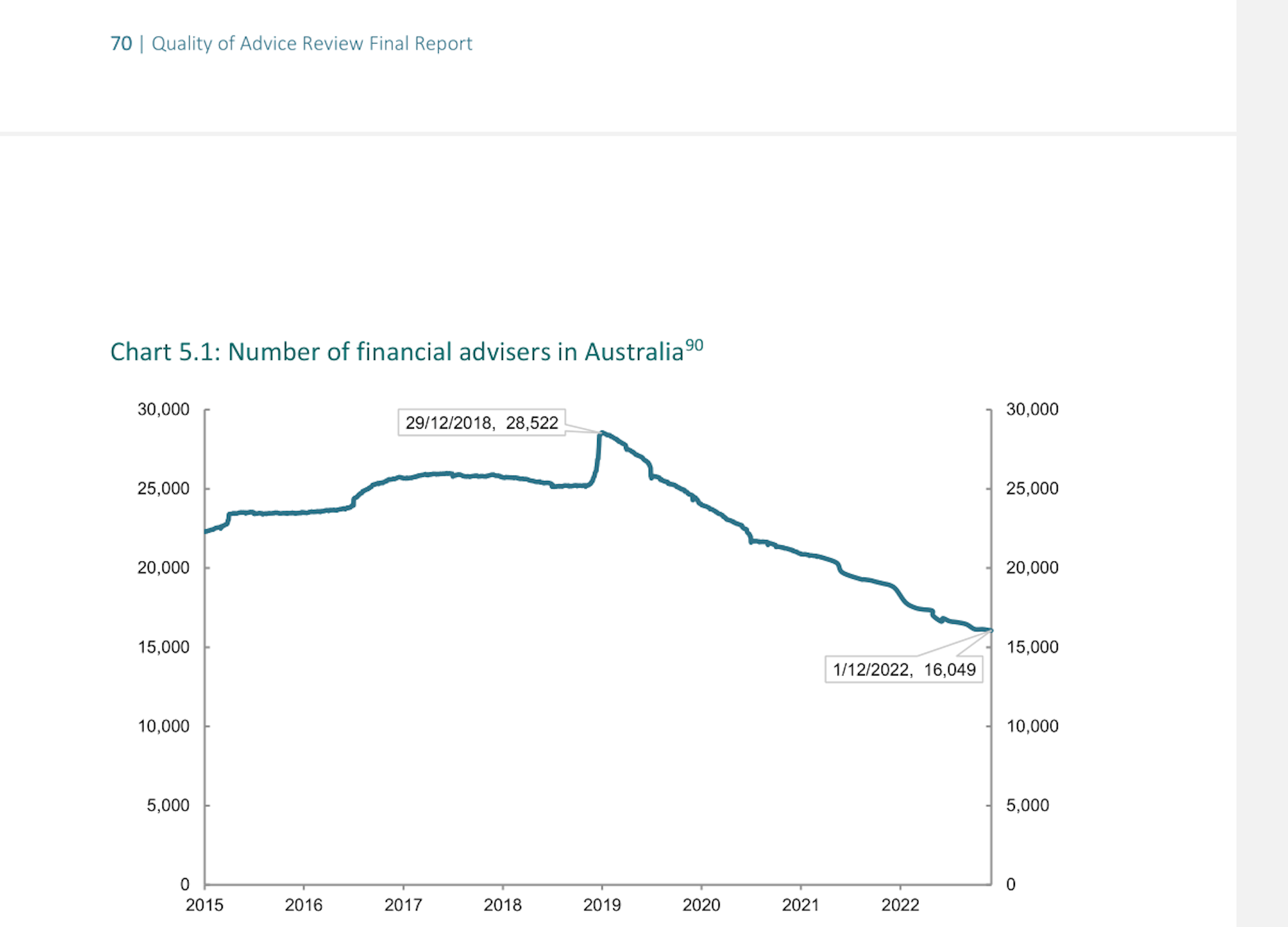
Five years ago, Australia had 28,000 financial advisers. Today there are 16,000[4]. That’s according to a review of financial advice[5] commissioned by the previous government and released by the Albanese government last week.

Thousands of advisers are leaving the industry[6] each year. The ones that remain are charging far more than they used to – $3,710 is said to be common, up 48% in five years, and enough to turn many people away.

So how did it come to this? And what does the new report recommend we do to make it easier for more Australians to get good, more affordable financial help?

Fixing rorts, where even dead people paid a price

This is a story about how Australia, under successive Labor and Coalition governments, let aiming for what’s perfect get in the way of what’s good. Up until I read the Quality of Advice Review[7] last week, I was guilty of doing it too.

For years, I argued we should make financial advice perfect[8]: delivered by genuinely professional advisers, who weren’t receiving kickbacks from firms wanting access to our money. I also argued we should pay for that advice in full upfront, because, whatever the cost, the advice will save us money in the long run.

We needed to do something. Back before a series of explosive Four Corners[9] reports and the 2019 Hayne royal commission[10] into the financial services industry, advisers and the funds they pushed us towards sucked money out of our accounts and presented us with options that made money for them – rather than us.

Read more: Royal commission scandals the result of poor regulation, not literacy[11]

The consequences were shocking. Dead people were being charged for financial advice, and even for life insurance. Gym instructors and other “introducers[12]” were used to lure people into products that charged unnecessarily high fees.

The professionals we now call investment advisers used to be called insurance salesmen. They were paid through commissions to beguile us into signing up for products that charged high fees and paid them high ongoing commissions[13].

Unintended results of tougher standards

Ahead of the Hayne royal commission, things began to change.

The Rudd Labor government outlawed commissions and introduced legislation requiring advisers to “place clients’ interests ahead of their own[14]”. After winning government, the Coalition tried to undo[15] the changes, before adopting just about the lot[16] after Hayne reported.

It’s now illegal for financial advisers to accept commissions (although mortgage brokers and people who sell insurance still can) and illegal to offer advice that isn’t in the “best interests[17]” of the customer taking almost everything into account. This makes it all but impossible for bank tellers and super funds to offer advice.

So I have been having second thoughts about the arguments I once made for no commissions, best interests, and lots of disclosure documents – especially after reading the Quality of Advice Review[18]. Ironically, its release was largely drowned out by coverage of Australians’ growing financial stress.
The report’s author Michelle Levy is a senior lawyer[19] and expert on superannuation, life insurance, distribution and financial services law. As well as being a partner at Allens, she’s also a parent – and knows more than most how vile predatory financial advisers can be. During the royal commission, we heard about a man with Down syndrome who was signed up for life insurance over the phone, even though he lived on a pension, had no dependants and could not afford the premiums. In her review, Levy discloses that she has a daughter who, “like this gentleman”, lives with a disability and has bank accounts, but does not know the difference between $10 and $1,000, does not know how to use a credit card, or what superannuation is. Levy writes that her daughter ought to be able to rely on her bank and super fund to assist her. She says by stopping firms from providing advice that isn’t perfect, we’ve inadvertently stopped our financial institutions from providing advice that is “good”. We have made it hard for human beings to help each other. Why ‘good’ might be a better benchmark than ‘best’ So Levy wants to allow super funds and banks to offer advice which is “good[20]” but isn’t comprehensive, in the same way as sales assistants are able to offer advice on clothes and mechanics are able to offer advice on cars. Good advice does not mean “okay advice” or “good enough” advice, she says. It is unlikely to be good advice to recommend a poorly performing superannuation product. It will not be good advice to recommend that a person who is unable to pay their mortgage open a term deposit. If the advice isn’t good, the full force of the existing law will come down on the person who provides it (the maximum penalty for an individual is $1.11 million). But it needn’t be comprehensive; not every piece of financial advice needs to be a lifetime plan. What Levy is proposing, and what the government is now considering, is more subtle than what we are doing at the moment – which is simply banning self-interested parties from giving advice. Levy wants to allow the self-interested to give advice, while ensuring it “also serves the interests of their customers”. In the meantime, if you need financial advice, the National Debt Helpline[21] is one of a number of places that can help. You can request a free, confidential meeting with a financial counsellor on 1800 007 007. Read more: Why would you dump a requirement for financial advisers to give advice that's in their client's best interests?[22] References^ massive (www.smh.com.au)^ two more (theconversation.com)^ A$1,000 (theconversation.com)^ 16,000 (images.theconversation.com)^ review of financial advice (treasury.gov.au)^ leaving the industry (www.afr.com)^ Quality of Advice Review (treasury.gov.au)^ perfect (www.smh.com.au)^ Four Corners (www.abc.net.au)^ Hayne royal commission (www.royalcommission.gov.au)^ Royal commission scandals the result of poor regulation, not literacy (theconversation.com)^ introducers (www.smh.com.au)^ ongoing commissions (www.smh.com.au)^ place clients’ interests ahead of their own (www.theage.com.au)^ tried to undo (www.smh.com.au)^ just about the lot (cdn.treasury.gov.au)^ best interests (www.afr.com)^ Quality of Advice Review (treasury.gov.au)^ senior lawyer (www.allens.com.au)^ good (treasury.gov.au)^ National Debt Helpline (ndh.org.au)^ Why would you dump a requirement for financial advisers to give advice that's in their client's best interests? (theconversation.com)Authors: Peter Martin, Visiting Fellow, Crawford School of Public Policy, Australian National University

Read more https://theconversation.com/australians-need-good-financial-advice-more-than-ever-to-pay-for-soaring-interest-rates-heres-how-to-get-it-199739

The Weekend Times Magazine

Building Designer in Melbourne: Crafting Innovative, Functional, and Sustainable Spaces

In a city celebrated for its architectural excellence and diverse urban character, the role of a building designer Melbourne has never been more important. Melbourne’s built environment is a dynamic blend...

Unit and construction market looks towards a new era of stability

The peak strata industry body in New South Wales representing the interests of all strata industry stakeholders says it is confident the era of construction and certifier cowboys will come...

Planting The Seed To Health Living Top tips on planting for wellbeing

With the family home full time and a need to keep everyone busy, it is the ideal time to plant a seed to a healthier lifestyle. Tuscan Path Product Manager...

Wedding DJ vs Live Band: Which Is the Right Choice for Your Wedding?

Choosing the right music for your wedding is one of your most important decisions. Music has the power to set the mood, create memorable moments, and ensure your guests have...

Rodent Control: Effective Strategies to Protect Your Home and Health

Rodent control is an essential part of maintaining a safe and healthy environment in both residential and commercial properties. Rodents, including rats and mice, are not only a nuisance but...

How to work from home and not get divorced

Covid has triggered life-changing decisions for some people and has put a lot of relationship strain on couples. The stress of working from home and having to home school the...

Brisbane Compensation Lawyers for Work Injury Damages

Suffering a work-related injury can turn your life upside down. The physical pain, emotional stress, and financial uncertainty can feel overwhelming. If you’re in Brisbane and facing this situation, finding...

The Importance of Quality Paint Protection for Brisbane Drivers

Shielding Your Vehicle with the Right Protection Every car owner appreciates that fresh showroom finish—the gleam of the paintwork, the smoothness of brand new panels. But once you drive out of...

Stylish and Sustainable Comfort with Ceiling Fans Adelaide

For Adelaide homeowners, finding the right balance between comfort, style, and energy efficiency is always a priority. With hot, dry summers and mild winters, it’s important to have cooling solutions...