Weekend Times


Google Workspace

Business News

Australia's new pay equality law risks failing women – unless we make this simple fix

  • Written by Mark Humphery-Jenner, Associate Professor of Finance, UNSW Sydney
Australia's new pay equality law risks failing women – unless we make this simple fix

The Albanese government’s efforts to address the gender pay gap are laudable. Despite all the attention given to the issue over the past decade or so, sectoral pay discrimination is very real and workplace biases persist[1].

But the federal government’s new tool to address the problem, the Workplace Gender Equality Amendment Bill, may not achieve much.

The amendment[2] to the Workplace Gender Equality Act[3] (enacted by the Gillard Labor government in 2012) requires all companies with more than 100 employees to report their “gender pay gap”.

Read more: How the jobs summit shifted gender equality from the sidelines to the mainstream[4]

Much like the Modern Slavery Act[5], the idea[6] is that public reporting will concentrate employers’ attention on the problem, leading to greater gender equality.

But will it?

The problem is the type of data companies must report to the Workplace Gender Equality Agency[7], which has been publishing pay-gap statistics since being established by the Workplace Gender Equality Act in 2012.

As with the other statistics the agency has published over the past decade, the new amendment[8] requires only publishing simple aggregates:

The Agency must publish aggregate information, for each relevant employer for each reporting period, for the purpose of showing the employer’s performance and progress in achieving gender equality in relation to remuneration for the employer’s workforce"

This may seem like a positive step. But aggregate numbers – which in practice translates into reporting summary statistics – do not help us to either identify or understand the pay gap. Those aggregates also don’t help us come up with the right fixes.

To do that requires better data that enables more precise analysis for the factors affecting pay disparities.

The problem with averages

Averages are ubiquitous in statistics. They can serve a important service, such as identifying trends. I’ll even be using averages to illustrate a few points.

But their limitations should be understood. They are particularly problematic when it comes to areas of endemic inequality, such as income.

Consider a company with 101 employees, one being the founder and chief executive. The other 100 employees, split 50/50 between men and women, are all paid the same salary.

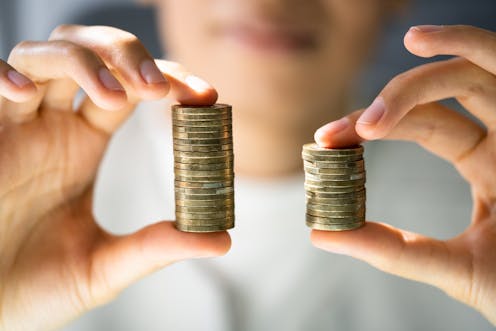
But suppose the chief executive pays himself ten times as much as the other employees. This isn’t ridiculous; the average CEO of a listed company in Australia is paid 132 times[9] the average income. This creates a 17.6% gender pay gap.

Now consider a similar company, run by a “tech bro” who doesn’t draw a salary but does pay every single women 2% less than every man. The aggregate numbers will show no gender pay gap.

In the first case, where there’s no explicit gender discrimination, aggregate numbers can be misread as indicating there is. In the second case, actual gender discrimination is obscured.

The WGEA’s pay gap results

Workplace Gender Equality Agency's pay gap results, 2013-14 to 2021-22
Workplace Gender Equality Agency, CC BY[10][11] Poor data leads to poor analysis The widespread use of averages often skew our sense of things. If you compare your own income to the Australian average (A$90,324 a year in 2021[12]), the probability is you’ll feel left behind. But if you compare yourself to the median income – the income at which half the population earns more, and half less – you’ll feel much better: it’s only $62,868 a year. Bad data leads to bad analysis, and bad policy responses. Here’s another scenario. Consider our first company again. The CEO is concerned about the publicity from reporting a 17% gender pay gap to the agency. So he employs his wife as deputy CEO, paying her five times the rest of the staff, and cuts his own salary by half. He no longer has a gender pay gap to report. This is progress of a kind, but not the progress needed to address the complex causes of gender pay inequality for ordinary people. Read more: Women are as likely as men to accept a gender pay gap if they benefit from it[13] How to fix this problem So how then to improve the reporting of gender pay statistics generally? Reporting median statistics would help mitigate the skewing problem with averages. Unless the government demands this, the agency will more than likely keeping taking the same approach as over the past decade – relying on averages. There’s also a case for companies to report other relevant factors that could influence pay, such as qualifications, skill, tenure, seniority and productivity. This would enable the Workplace Gender Equality Agency to provide more sophisticated analysis, breaking down the factors contributing to the figures that get the headlines. The agency defines equal pay[14] as “men and women performing the same work are paid the same amount”. To achieve this, it is essential to ensure apples are being compared with apples. This is only possible if we control for the factors that can influence pay, and don’t lose the necessary nuance. Blunt data does not properly inform us about the pay gap, why it arises, nor how to solve it. This risks policy responses that focus on the wrong issues and which achieve little. Decision-makers, both in public and private sectors, risk making bad decisions on poor-quality data. The wrong fixes could even make things worse[15]. We will not eradicate the gender pay gap using bad statistics.

References

  1. ^ workplace biases persist (danielle-li.github.io)
  2. ^ amendment (parlinfo.aph.gov.au)
  3. ^ Workplace Gender Equality Act (www.legislation.gov.au)
  4. ^ How the jobs summit shifted gender equality from the sidelines to the mainstream (theconversation.com)
  5. ^ Modern Slavery Act (www.legislation.gov.au)
  6. ^ the idea (parlinfo.aph.gov.au)
  7. ^ Workplace Gender Equality Agency (www.wgea.gov.au)
  8. ^ new amendment (parlinfo.aph.gov.au)
  9. ^ paid 132 times (thenewdaily.com.au)
  10. ^ Workplace Gender Equality Agency (www.wgea.gov.au)
  11. ^ CC BY (creativecommons.org)
  12. ^ A$90,324 a year in 2021 (www.abs.gov.au)
  13. ^ Women are as likely as men to accept a gender pay gap if they benefit from it (theconversation.com)
  14. ^ defines equal pay (www.wgea.gov.au)
  15. ^ make things worse (papers.ssrn.com)

Authors: Mark Humphery-Jenner, Associate Professor of Finance, UNSW Sydney

Read more https://theconversation.com/australias-new-pay-equality-law-risks-failing-women-unless-we-make-this-simple-fix-199587

The Weekend Times Magazine

Film Review: Why Casablanca Still Captivates Audiences Eight Decades On

Few films have endured in the public imagination quite like Casablanca. Released in 1942 during the height of World War II, the film was not expected to become a cultural...

The Aussie Man Launches Debut Range of Men’s Grooming Products

Brand new Australian made men’s skincare company The Aussie Man has today announced the launch of their new range of organic skincare.  The Aussie Man uses hero natural ingredients such as...

What Happens During a Rental Property Inspection?

The rental property inspection is one main factor that sometimes leaves tenants wondering a lot of things. Though it might occasionally feel like a scary procedure, it is a lot...

The Psychology of Your Floor Plan: How Layout Shapes the Way You Live

When most people think about designing a new home, they focus on finishes, colours, or even the kitchen benchtop. But the quiet hero of liveability is the floor plan. A...

A Fantastic Trip To Melbourne, Australia With Minimal Spending? Here’s How?

Famed for the iconic Melbourne cup horse race, Melbourne, Australia ranks as one of the best travel destinations worldwide. It offers tourists an escape from the hustle and bustle of...

5 Bars You Cannot Miss While Visiting Sydney

One of the best things about visiting Sydney is the nightlife. While there are a lot of touristic gems for visitors to see throughout the day, Sydney is also widely...

House Builders in Melbourne Delivering Homes Built for Modern Living

Choosing the right house builders Melbourne is one of the most important steps in creating a home that feels comfortable, functional, and built to last. House builders play a central role...

5 Ways to Make Maths Fun

For many students, maths can seem like a daunting subject, but with the right approach, it can become one of the most enjoyable and rewarding parts of learning. Whether you’re...

6 things that can go wrong if your iron isn't adequate before falling pregnant

Preconception care involves making sure you have adequate supply of all the nutrients essential to the health of the sperm and ova (egg) and to fetal development. Preconception also involves...