why consumers don't punish big polluters for greenwashing lies
- Written by: Adam Austen Kay, Lecturer, School of Business, The University of Queensland
Stigma is an awful burden for business. But what if – for some companies – stigma is an asset?
That’s what I and an international team of researchers set out to investigate in a new paper published in the Journal of Management Studies[1].
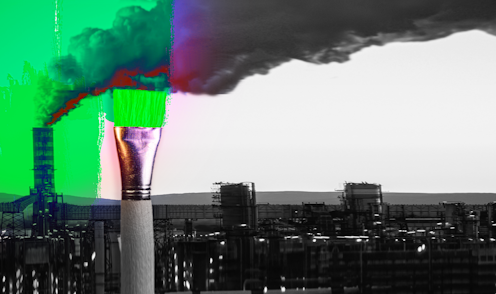
We examined how consumers around the world responded to firms in stigmatised industries like oil and gas that are found “greenwashing[2]”, meaning they claim to do more for the environment than they really do.
We anticipated that the market would punish greenwashers, but we thought it would treat firms seen to be “dirty” rather differently.
Specifically, we thought the market would either
punish dirty firms more, as might the judge of a repeat offender in court; or
punish dirty firms less, as might parents who overlook poor behaviour by their child with outdated excuses like “boys will be boys”.
What we discovered has important implications for greenwashing and important implications more broadly.
What we found
In a study tracking 7,365 companies in 47 countries over 15 years, we found that consumers financially penalised firms for greenwashing – but not if those firms were stigmatised[3] as dirty.
In other words, the market imposed a kind of tax on companies for greenwashing, unless they were already regarded as big polluters.
In order to find out why stigmatised greenwashers were exempt from this market tax, we conducted a follow-up experiment.
Read more: 'Toxic cover-up': 6 lessons Australia can draw from the UN's scathing report on greenwashing[4]
After a pre-study to determine which industries are most regarded as “dirty”, “clean” or “neutral” (the answers were oil and gas, solar and wind power, and stationery and office supplies), we presented 458 consumers with a statement from the corporate citizenship report of a firm in one of these three industries.
In the statement, the firm professed its core values of honesty, integrity, and environmental sustainability. The only difference between the three versions of the statement was the industry the firm was in.

 Results showed that greenwashing took much less of a toll on the perceived trustworthiness of the oil and gas company. As a result, consumers said they were significantly more likely to purchase its products and services.
Taken together, these two studies suggest that consumers have a “boys will be boys” attitude to greenwashing by dirty firms. They even expect it.
Why this matters for greenwashing
Our findings have important implications for how to regulate greenwashing.
First, it’s often assumed that consumers punish greenwashers, but data supporting this assumption is hard to come by. We demonstrate empirically that this assumption is true. For many firms, greenwashing results in real financial costs.
Second, we find the market penalty for greenwashing is much weaker for firms that are regarded as dirty. Those who expect the market to punish greenwashing by firms in the oil and gas industry and other heavy polluters should reconsider.
Third, our findings suggest governments and international organisations that have a “zero tolerance[5]” approach to greenwashing should focus their limited resources on dirty industries and let the market take care of the rest.
Why this matters more broadly
The “boys will be boys” attitude that we uncovered in this research is likely to play out in other fields in which people respond to the misdeeds of “bad boys”, including politics.
An example might be former US President Donald Trump. Having survived scandal after scandal, Trump once famously declared that he could shoot someone[6] on Fifth Avenue and not lose votes.
Read more:
Out of bounds: how much does greenwashing cost fossil-fuel sponsors of Australian sport?[7]
The more deplorable the media has made him out to be – the greater the stigma attached to the Trump name – the less his misdeeds seem to have hurt him. Our research offers new clues as to why.
As consumers and voters, we need to recognise that our “boys will be boys” attitude enables bad behaviour. Unless we do, and until we regulate with this psychological bias in mind, we will continue to be part of the problem.
References^ Journal of Management Studies (onlinelibrary.wiley.com)^ greenwashing (www.investopedia.com)^ stigmatised (managementstudiesinsights.com)^ 'Toxic cover-up': 6 lessons Australia can draw from the UN's scathing report on greenwashing (theconversation.com)^ zero tolerance (www.un.org)^ shoot someone (www.cbsnews.com)^ Out of bounds: how much does greenwashing cost fossil-fuel sponsors of Australian sport? (theconversation.com)Authors: Adam Austen Kay, Lecturer, School of Business, The University of Queensland
Results showed that greenwashing took much less of a toll on the perceived trustworthiness of the oil and gas company. As a result, consumers said they were significantly more likely to purchase its products and services.
Taken together, these two studies suggest that consumers have a “boys will be boys” attitude to greenwashing by dirty firms. They even expect it.
Why this matters for greenwashing
Our findings have important implications for how to regulate greenwashing.
First, it’s often assumed that consumers punish greenwashers, but data supporting this assumption is hard to come by. We demonstrate empirically that this assumption is true. For many firms, greenwashing results in real financial costs.
Second, we find the market penalty for greenwashing is much weaker for firms that are regarded as dirty. Those who expect the market to punish greenwashing by firms in the oil and gas industry and other heavy polluters should reconsider.
Third, our findings suggest governments and international organisations that have a “zero tolerance[5]” approach to greenwashing should focus their limited resources on dirty industries and let the market take care of the rest.
Why this matters more broadly
The “boys will be boys” attitude that we uncovered in this research is likely to play out in other fields in which people respond to the misdeeds of “bad boys”, including politics.
An example might be former US President Donald Trump. Having survived scandal after scandal, Trump once famously declared that he could shoot someone[6] on Fifth Avenue and not lose votes.
Read more:
Out of bounds: how much does greenwashing cost fossil-fuel sponsors of Australian sport?[7]
The more deplorable the media has made him out to be – the greater the stigma attached to the Trump name – the less his misdeeds seem to have hurt him. Our research offers new clues as to why.
As consumers and voters, we need to recognise that our “boys will be boys” attitude enables bad behaviour. Unless we do, and until we regulate with this psychological bias in mind, we will continue to be part of the problem.
References^ Journal of Management Studies (onlinelibrary.wiley.com)^ greenwashing (www.investopedia.com)^ stigmatised (managementstudiesinsights.com)^ 'Toxic cover-up': 6 lessons Australia can draw from the UN's scathing report on greenwashing (theconversation.com)^ zero tolerance (www.un.org)^ shoot someone (www.cbsnews.com)^ Out of bounds: how much does greenwashing cost fossil-fuel sponsors of Australian sport? (theconversation.com)Authors: Adam Austen Kay, Lecturer, School of Business, The University of Queensland