the lesson for everyone in FTX's collapse
- Written by: Paul Mazzola, Lecturer Banking and Finance, Faculty of Business and Law, University of Wollongong
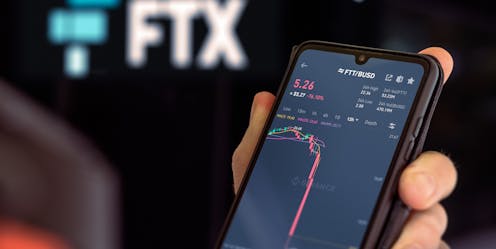
Anthony* (a friend) called a few weeks ago, deeply worried.
A deputy principal of a high school in Queensland, over the past year he spent hundreds of thousands of dollars buying cryptocurrencies, borrowing money using his home as equity.
But now all his assets, valued at A$600,000, were stuck in an account he couldn’t access.
He’d bought through FTX, the world’s third-biggest cryptocurrency exchange, endorsed by celebrities such as Seinfeld co-creator Larry David, basketball champions Steph Curry and Shaquille O’Neal, and tennis ace Naomi Osaka.
With FTX’s spectacular collapse, he’s now awaiting the outcome of the liquidation process that is likely to see him, 30,000 other Australians and more than 1.2 million customers worldwide[1] lose everything.
“I thought these exchanges were safe,” Anthony said.
He was wrong.
Not like stock exchanges
Cryptocurrency exchanges are sometimes described as being like stock exchanges. But they are very different to the likes of the London or New York stock exchanges, institutions that have weathered multiple financial crises.
Stock exchanges are both highly regulated and help regulate share trading. Cryptocurrency exchanges, on the other hand, are virtually unregulated and serve no regulatory function.
They’re just private businesses that make money by helping “mum and dad” investors to get into crypto trading, profiting from the commission charged on each transaction.
Indeed, the crypto exchanges that have grown to dominate the market – such as Binance, Coinbase and FTX – arguably undermine the whole vision that drove the creation of Bitcoin and blockchains – because they centralise control in a system meant to decentralise and liberate finance from the power of governments, banks and other intermediaries.
These centralised exchanges are not needed to trade cryptocurrency, and are pretty much the least safe way to buy and hold crypto assets.
Trading before exchanges
In the early days of Bitcoin (all the way back in 2008) the only way to acquire it was to “mine” it – earning new coins by performing the complex computations required to verify and record transactions on a digital ledger (called a blockchain).
The coins would be stored in a digital “wallet”, an application similar to a private bank account, accessible only by a password or “private key”.
A wallet can be virtual or physical, on a small portable device similar in appearance to a USB stick or small phone. Physical wallets are the safest because they can be unplugged from the internet when not being used, minimising the risk of being hacked.
Before exchanges emerged, trading involved owners selling directly to buyers via online forums, transferring coins from one wallet to another like any electronic funds transfer.
Decentralised vs centralised
All this, however, required some technical knowledge.
Cryptocurrency exchanges reduced the need for such knowledge. They made it easy for less tech-savvy investors to get into the market, in the same way web browsers have made it easy to navigate the Internet.
Two types of exchanges emerged: decentralised (DEX) and centralised (CEX).
Decentralised exchanges are essentially online platforms to connect the orders of buyers and sellers of cryptocurrencies. They are just there to facilitate trading. You still need to hold cryptocurrencies in your own wallet (known as “self-custody”).
Centralised exchanges go much further, eliminating wallets by offering a one-stop-shop service. They aren’t just an intermediary between buyers and sellers. Rather than self-custody, they act as custodian, holding cryptocurrency on customers’ behalf.
Exchange, broker, bank
Centralised exchanges have proven most popular. Seven of the world’s ten biggest crypto exchanges by trading volume are centralised[2].
But what customers gain in simplicity they lose in control.
You don’t give your money to a stock exchange, for example. You trade through a broker, who uses your trading account when you buy and deposits money back into your account when you sell.
A CEX, on the other hand, acts as an exchange, a brokerage (taking customers’ fiat money and converting it into crypto or vice versa), and as a bank (holding customer’s crypto assets as custodian).
This is why FTX was holding cash and crypto assets worth US$10-50 billion[3]. It also acted like a bank by borrowing and lending cryptocurrencies – though without customers’ knowledge or agreement, and without any of the regulatory accountability imposed on banks.
Holding both wallets and keys, founder-owner Sam Bankman-Fried “borrowed” his customers’ funds to prop up his other businesses. Customers realised too late they had little control. When it ran into trouble, FTX simply stopped letting customers withdraw their assets.
The power of marketing
Like stockbrokers, crypto exchanges make their money by charging a commission on every trade. They are therefore motivated to increase trading volumes.
FTX did this most through celebrity and sports marketing. Since it was founded in 2019 it has spent an estimated US$375 million[4] on advertising and endorsements, including buying the naming rights to the stadium used by the Miami Heat basketball team.
Such marketing has helped to create the illusion that FTX and other exchanges were as safe as mainstream institutions. Without such marketing, it’s debatable the value of the cryptocurrency market would have risen from US$10 billion in 2014 to US$876 billion in 2022[5].
Read more: Why sports sponsorship is unlikely to save cryptocurrency firms from 'crypto winter'[6]
Not your key, not your coins
There’s an adage among crypto investors: “Not your key, not your coins, it’s that simple.”
What this means is that your crypto isn’t safe unless you have self-custody, storing your own coins in your own wallet to which you alone control the private key.
The bottom line: crypto exchanges are not like stock exchanges, and CEXs are not safe. If the worst eventuates, whether it be an exchange collapse or cyber attack, you risk losing everything.
All investments carry risks, and the unregulated crypto market carries more risk than most. So follow three golden rules.
First, do some homework. Understand the process of trading crypto. Learn how to use a self-custody wallet. Until governments regulate crypto markets, especially exchanges, you’re largely on your own.
Second, if you’re going to use an exchange, a DEX is more secure. There is no evidence to date that any DEX has been hacked.
Lastly, in this world of volatility, only risk what you can afford to lose.
Read more: Crypto: what could more regulation mean for the future of digital currencies?[7]
*Name has been changed.
References
- ^ 1.2 million customers worldwide (www.businessofapps.com)
- ^ are centralised (coinmarketcap.com)
- ^ US$10-50 billion (www.ft.com)
- ^ US$375 million (decrypt.co)
- ^ US$876 billion in 2022 (coinmarketcap.com)
- ^ Why sports sponsorship is unlikely to save cryptocurrency firms from 'crypto winter' (theconversation.com)
- ^ Crypto: what could more regulation mean for the future of digital currencies? (theconversation.com)
Authors: Paul Mazzola, Lecturer Banking and Finance, Faculty of Business and Law, University of Wollongong