Why giving the Commerce Commission the power to set 'fair' fuel prices is unfair on NZ’s climate targets
- Written by: Timothy Welch, Senior Lecturer in Urban Planning, University of Auckland
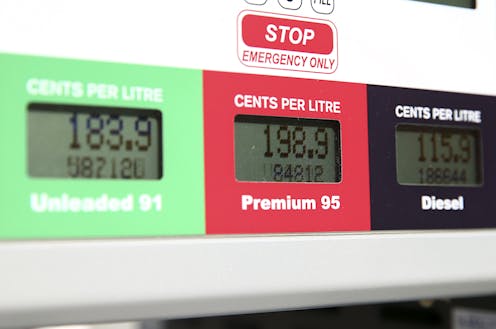
The government announcement that the Commerce Commission will soon have the power to regulate[1] wholesale petrol and diesel prices might be good news for cash-strapped motorists, but it’s arguably a retrograde step in the fight against climate change.
While there is some scepticism about whether the commission will ever act to enforce fuel price caps, any move to make carbon-emitting vehicles more affordable must come at the expense of efforts to encourage people out of cars and into more sustainable modes of transport.
Making matters more complicated, the policy announcement happened against the backdrop of the critical COP27 climate meeting[2] in Egypt, and the draft UN report[3] warning of soon-unreachable global warming targets. The move suggests conflicting government priorities at best.
Aside from being counter to other plans to mitigate climate change, there is plenty of evidence that price caps can often cause outcomes opposite to those intended. Sometimes, leaving it to the market can be the better option.
Fuel should be less affordable
Since last year, there has been a major focus globally on the transition to electric vehicles. While this is not without its own issues[4], New Zealand has fully embraced the approach, setting a goal of zero net emissions for 2050.
This would require 100% of imported cars to be electric by 2030 – an ambitious leap from the estimated 4.8%[5] of total vehicle imports they comprised in 2021. Suppressing fuel prices simply doesn’t fit the narrative of massive electric vehicle adoption (including subsidies of up to NZ$8,625 per vehicle intended to boost sales).
Read more: Electric cars alone won’t save the planet. We'll need to design cities so people can walk and cycle safely[6]
Relatively low petrol and diesel prices and the still high cost of new electric vehicles (and the home electricity to charge them) remain significant disincentives for decarbonising individual transportation.
But there are alternatives to price caps that won’t interfere with our climate goals. One alternative is a windfall tax[7] on the petroleum industry. Such a scheme would entail an additional levy on oil company profits, perhaps around 25%, as has been introduced in the UK.
For example, BP recently announced a profit of $230 million[8] in New Zealand. A windfall tax on this one firm would net the government an extra $57.5 million in revenue.
That could then be used to boost schemes and other transport modes that help people avoid having to go to the pump in the first place. The money could also be used to finance the “loss and damage” pledges made at COP27 to aid developing countries[9] already suffering from climate change.
The problem with price caps
There are other, wider questions about the efficacy of price caps and their potential to achieve the opposite of what is intended.
Capping prices is meant to make goods more affordable for the consumer, which increases demand. But it also makes selling the goods less attractive to the producer, potentially reducing supply[10]. Over time, this can affect supply chains and make removing caps difficult in the future.
Price caps are novel in New Zealand but have been used elsewhere to regulate various markets. Several countries have had price controls in the past, or are considering enacting them now, to control prices for food, petroleum, housing and other consumables in the face of rapid inflation.
Read more: Air of compromise: NZ's Emissions Reduction Plan reveals a climate budget that’s long on planning, short on strategy[11]
Famously, New York City has long applied rent controls to make living in the expensive city more affordable. However, research over decades[12] from New York and other US cities where rent-control policies have been used highlights the risk of setting non-market prices.
The evidence shows some short-term gains in affordable housing. But over the long run in rent-controlled areas, housing affordability decreased and gentrification increased – both unintended outcomes of a price cap.
But even if regulating the price of fuel could save consumers money, in reality this affects only a small portion of household expenses. At around $50 a week, the average household fuel bill is less than 4%[13] of total weekly spending. That will likely drop further if fuel prices stabilise while inflation continues to pressure mortgage rates and food costs.
Read more: It’s the big issue of COP27 climate summit: poor nations face a $1 trillion ‘loss and damage’ bill, but rich nations won’t pay up[14]
Short-term relief over long-term goals
Finally, we should ask why the Commerce Commission’s new powers to set “fair prices” in the face of perceived anti-competitive behaviour don’t apply elsewhere. Fuel is just one of many potentially anti-competitive sectors in New Zealand, with the grocery industry perhaps the most visible.
While the commission has taken steps to encourage competition in the sector, price controls are not part of the plan. Yet food accounts for about 17% of household spending[15] each week, much more than fuel.
At the same time, banks[16] and utility providers[17] have recently reported massive profits. Together they account for about 25% of average weekly household spending.
Given these and other factors, there should at least be some robust debate about whether the new Commerce Commission powers are necessary. That will involve asking whether making fossil fuels more affordable runs counter to our climate change goals, and whether we are trading planetary health for short-term economic relief.
References
- ^ power to regulate (www.rnz.co.nz)
- ^ COP27 climate meeting (www.rnz.co.nz)
- ^ UN report (www.newsroom.co.nz)
- ^ not without its own issues (theconversation.com)
- ^ 4.8% (www.stats.govt.nz)
- ^ Electric cars alone won’t save the planet. We'll need to design cities so people can walk and cycle safely (theconversation.com)
- ^ windfall tax (www.bbc.com)
- ^ profit of $230 million (www.stuff.co.nz)
- ^ aid developing countries (www.rnz.co.nz)
- ^ potentially reducing supply (www.brookings.edu)
- ^ Air of compromise: NZ's Emissions Reduction Plan reveals a climate budget that’s long on planning, short on strategy (theconversation.com)
- ^ research over decades (www.brookings.edu)
- ^ less than 4% (www.stats.govt.nz)
- ^ It’s the big issue of COP27 climate summit: poor nations face a $1 trillion ‘loss and damage’ bill, but rich nations won’t pay up (theconversation.com)
- ^ about 17% of household spending (www.stats.govt.nz)
- ^ banks (www.nzherald.co.nz)
- ^ utility providers (www.stuff.co.nz)
Authors: Timothy Welch, Senior Lecturer in Urban Planning, University of Auckland