When you change jobs, you get more pay – but the increase is less than it used to be
- Written by: Guay Lim, Professorial Research Fellow, Melbourne Institute, The University of Melbourne

This article is part of The Conversation’s series looking at Labor’s jobs summit. Read the other articles in the series here[1].
We are changing jobs less, an observation that has been offered as an explanation for why pay increases remain low.
The proportion of Australians switching jobs per year has fallen from 12.8% in the mid-1990s to 9.5%[2], after hitting a low of 7.5% in the year to February 2021.
We are unable to say why, but we are able to present new information from the Melbourne Institute’s monthly survey of consumer attitudes, sentiments and expectations[3] on what happens to their pay and their expectations when they change.
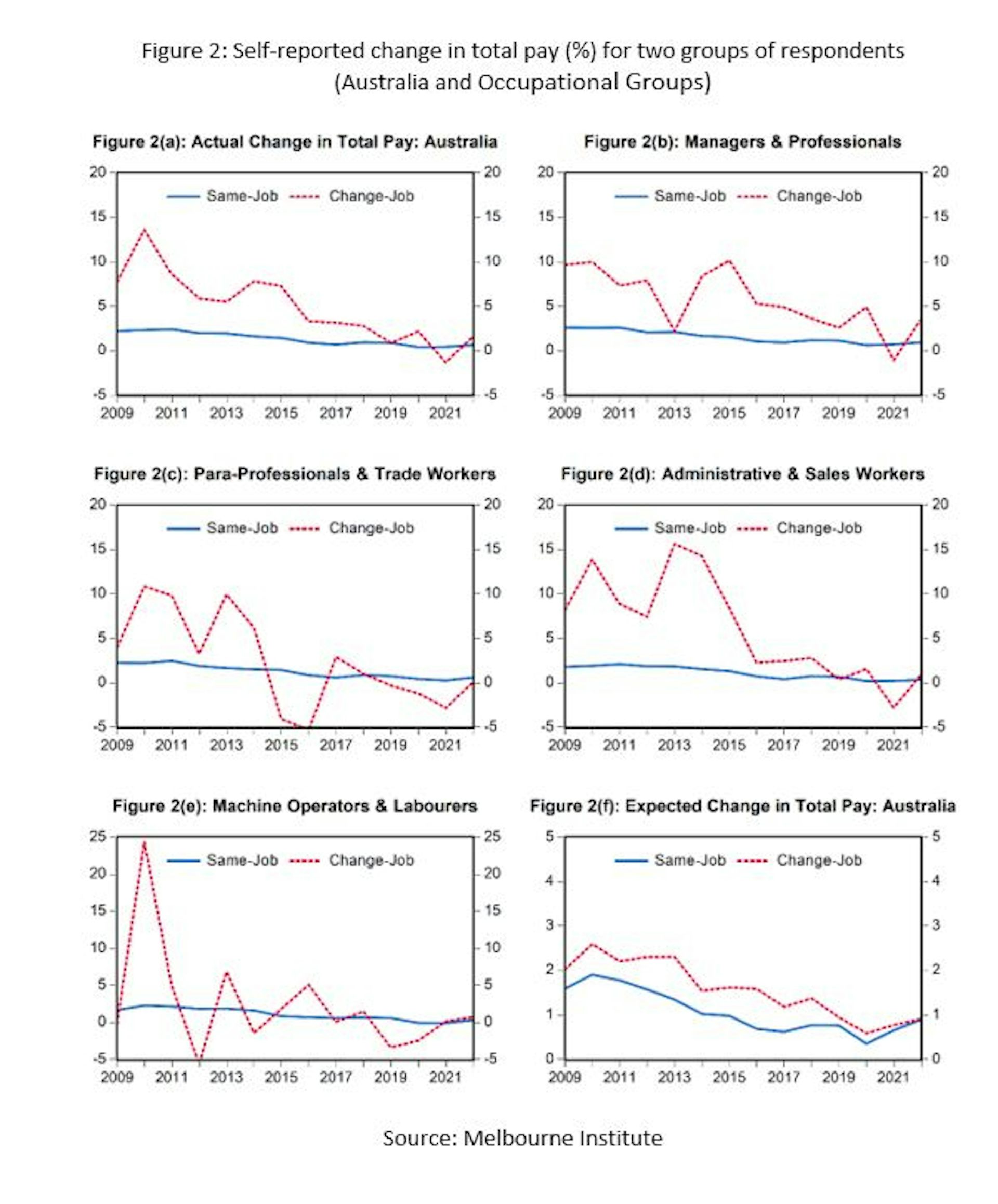
Using the full range of survey results from 2009 to 2022 (2022 is for the first eight months) we compared the self-reported changes in total pay over the previous year for those that have stayed in their job with the self-reported changes for those that have changed jobs.
The averaging method we used was the 30% trimmed mean[4].
Read more: The summit needs to get us switching jobs. It'd make most of us better off[5]
One of our findings was expected: the increase in total pay for those who changed jobs was generally significantly bigger.
The other was not: the gap narrowed over time. By 2021 those who changed jobs got a lower increase than those that remained – a pay cut of 1.3% compared to a pay increase of 0.44% for those that stayed.
Even if the 2021 result can be dismissed as a one-off, it is clear that over time the financial reward for switching jobs has shrunk.
Although the financial reward for switching declined across all occupations, we find it declined fastest[6] for trades workers and “para-professionals” such as community and personal service workers who as a group have taken cuts for changing jobs since 2018.
When we asked about expected pay changes over the following 12 months we found the expectations of those who changed their jobs and those who did not to be much more aligned, converging to the same expectation by 2022.
Our findings suggest that pay has become an increasingly unimportant motivator for changing jobs. It might be that since COVID, considerations such as working from home have become more important.
Read more: As the jobs summit talks skills – we predict which occupations will have shortages and surpluses in the next 2 years[7]
References
- ^ here (theconversation.com)
- ^ 9.5% (theconversation.com)
- ^ consumer attitudes, sentiments and expectations (researchdata.edu.au)
- ^ trimmed mean (www.wallstreetmojo.com)
- ^ The summit needs to get us switching jobs. It'd make most of us better off (theconversation.com)
- ^ fastest (images.theconversation.com)
- ^ As the jobs summit talks skills – we predict which occupations will have shortages and surpluses in the next 2 years (theconversation.com)
Authors: Guay Lim, Professorial Research Fellow, Melbourne Institute, The University of Melbourne