Australia's Reserve Bank has got a lot right, but there's still a case for an inquiry
- Written by: Selwyn Cornish, Adjunct Associate Professor, Research School of Economics, Australian National University
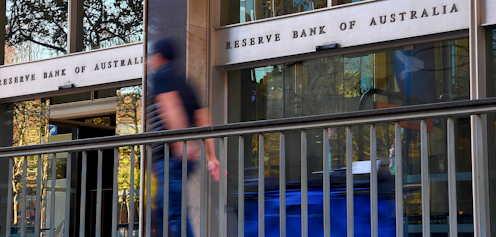
Treasurer Jim Chalmers is about to commission an independent review of the Reserve Bank of Australia. Refreshingly, his election promise was bipartisan – both sides of politics want it.
What we don’t know yet is who will conduct the inquiry and what it will look at.
In something of a cultural cringe, 12 leading Australian economists have called for an international expert[1] to conduct it – someone like a former governor of the Bank of England.
There is a lot to examine. But in our view, this does not include its record in hitting its inflation target, which has been near perfect and better than its peers.
In 1981 the Campbell[2] inquiry into the financial system examined some aspects of the Reserve Bank’s structure and operations. But there has been no systematic review of its goals or the means of achieving them since the bank was established in 1960 – and arguably earlier, when the same goals were set out in the Commonwealth Bank Act of 1945[3].
The Reserve Bank and interest rates: Explained - Selwyn Cornish, ANU, April 2010.Experiments, then inflation
Half a century ago Australia abandoned its fixed exchange rate with the British pound[4].
What followed was a long meandering journey, in which, in the words of the current Reserve Bank governor Philip Lowe, Australia experimented with almost every type of exchange rate regime[5] until floating the dollar in 1983.
For a while, the bank bought and sold financial instruments to stabilise the supply of money[6] in the economy, but money turned out to change shape when cornered, requiring ever-changing definitions and making it an imperfect instrument to control inflation.
Needing something else to target, in the mid-1980s the bank developed a much-lampooned “checklist[7]” which included everything but the kitchen sink:
all the monetary aggregates; interest rates; the exchange rate; the external accounts; the current performance and outlook for the economy, including movements in asset prices, inflation, the outlook for inflation, and market expectations about inflation.
It turned out to be so comprehensive as to provide neither discipline or guidance.
When in 1990 New Zealand became the first country in the world to formally target the rate of inflation and the rate of inflation alone (at first targeting a rate of 0-2%) Australia and other nations including Canada took notice.
Australia’s Reserve Bank Governor Bernie Fraser and then head of research Ian Macfarlane tried, and failed, to get the Hawke government to announce an inflation target in 1990[8].
From 1992[9] Fraser began referring in speeches to his goal of keeping inflation near 2-3%, and by 1994 Keating government ministers began quoting the goal of 2-3% in speeches.
Read more: Memo RBA: we ought to live with inflation, more of it[10]
In 1996[11] Treasurer Peter Costello and Governor Ian Macfarlane signed a formal agreement acknowledging an objective of keeping underlying inflation between 2% and 3% on average over the economic cycle.
By adjusting how much it borrows, or lends, in the overnight interbank market the bank can influence the “cash rate[12]” that banks charge each other and through it the general price of money, and hopefully, the rate of inflation.
Success, by numbers
On the numbers, this has been a success with the inflation target achieved.
Between March 1994 and the onset of COVID in the March quarter of 2000, inflation has averaged 2.48% – bang in the middle of the 2-3% target band.
As well, until the COVID shutdowns, Australia avoided recession, escaping both the 2001 “tech-wreck[13]” recession that ravaged the United States and the 2008 “Great Recession[14]” during the global financial crisis.
Under the Reserve Bank’s inflation-targeting regime unemployment[15] has fallen to its lowest in almost fifty years.
This is a record at least as good as other central banks and better than most. A review is unlikely to much improve Australia’s economic performance.
But there’s a case for a review
The first governor of the Reserve Bank, HC Coombs, wanted a review of the financial system every five years, an idea blocked by the treasury.
Yet there are things about the workings of the bank that need to be examined. One is the composition of the bank board[16].
Under former Treasurer Josh Frydenberg the board became majority female, and gained more independent members with economic expertise.
Until Peter Costello’s term as treasurer in the 1990s the board included a trade union leader.
There might be a case for bringing back union representation and adding social service representation to balance business interests.
There might be a case for releasing more information about the board’s deliberations, or for separating governance of its administration from the governance of monetary policy.
The Bank’s recruitment and promotion policies could be reviewed. Its preference for internal appointments preserves corporate memory but risks “groupthink[17]”.
And there would be a case for examining the mechanics of its bond-buying program (“quantitative easing[18]”) and its communications (“forward guidance[19]”) during the COVID crisis. There’s already a review into whether it should issue a digital currency[20], a prospect about which it seems unkeen[21].
Read more: Open letter: the RBA review should be independent of government[22]
Almost no one wants to revert to a fixed exchange rate, but the inflation target and the method the bank has used to achieve it ought to be open for scrutiny.
Some argue the bank has kept interest rates too low forcing up house prices[23] and widening inequality[24]. Others argue it has kept rates too high, allowing needless unemployment[25].
It’s hard to argue it’s done too much wrong. In recent years there have been independent reviews of the US Federal Reserve[26], the Bank of Japan, the Bank of England and the European Central Bank[27].
It is notable they have often recommended moving toward the monetary policy framework used by the Reserve Bank of Australia.
References
- ^ international expert (theconversation.com)
- ^ Campbell (treasury.gov.au)
- ^ Commonwealth Bank Act of 1945 (www.rba.gov.au)
- ^ British pound (www.rba.gov.au)
- ^ every type of exchange rate regime (www.rba.gov.au)
- ^ supply of money (www.rba.gov.au)
- ^ checklist (www.rba.gov.au)
- ^ in 1990 (www.tandfonline.com)
- ^ 1992 (www.tandfonline.com)
- ^ Memo RBA: we ought to live with inflation, more of it (theconversation.com)
- ^ 1996 (www.rba.gov.au)
- ^ cash rate (www.rba.gov.au)
- ^ tech-wreck (www.businessinsider.com)
- ^ Great Recession (www.investopedia.com)
- ^ unemployment (theconversation.com)
- ^ bank board (www.rba.gov.au)
- ^ groupthink (www.verywellmind.com)
- ^ quantitative easing (www.rba.gov.au)
- ^ forward guidance (www.rba.gov.au)
- ^ digital currency (www.rba.gov.au)
- ^ unkeen (theconversation.com)
- ^ Open letter: the RBA review should be independent of government (theconversation.com)
- ^ house prices (www.theguardian.com)
- ^ widening inequality (theconversation.com)
- ^ unemployment (isaacgrossnet.files.wordpress.com)
- ^ US Federal Reserve (www.federalreserve.gov)
- ^ European Central Bank (www.ecb.europa.eu)
Authors: Selwyn Cornish, Adjunct Associate Professor, Research School of Economics, Australian National University