Weekend Times


Google Workspace

Business News

Super co-contribution has cost $10 billion to help the wrong Australians – so let's scrap it

  • Written by Cain Polidano, Senior Research Fellow, The University of Melbourne

Super co-contribution has cost $10 billion to help the wrong Australians – so let's scrap it

Concerned that many people won’t have enough retirement savings even with compulsory superannuation, since 2003 the Australian government has had a scheme to encourage low and middle-income earners to voluntarily put more into superannuation.

The Superannuation Co-Contribution Scheme[1] currently provides 50 cents for every dollar voluntarily contributed, up to A$1,000, by anyone earning less than $42,000. (There are tapered co-contributions for those with incomes up to $57,000.)

To date the scheme has cost more than $10 billion – or $12.7 billion in today’s dollars. Last financial year it paid out about $127 million[2]. Over the next three years it is expected to cost $365 million[3].

So what is it achieving? Not much, it turns out.

Our analysis[4] of taxation data since 2000 suggests the scheme has made little difference to lifting voluntary super contributions by low and middle-income earners.

Most significantly, our findings indicate the scheme does little more than provide a bonus to those who would have put money into super anyway.

Given the need to rein in public debt, the new Albanese government should consider discontinuing the co-contribution scheme as “low-hanging fruit” – an easy budget cutback that will harm few people.

Read more: How to camouflage $150 billion in spending: call it 'tax expenditure'[5]

How we analysed the scheme

The co-contribution scheme was introduced 2003-04 by the Howard government as part of its “Better Superannuation System[6]” reforms meant to encourage higher contributions.

Initially the co-contribution was dollar-for-dollar. In 2004-05 it was increased to $1.50 for every dollar. In 2009-10 the Rudd government reduced it to $1 and in 2012-13 the Gillard government cut it to 50 cents.

Then prime minister John Howard spruiks superannuation policy reform in November 2001. Vera Devai/AAP

To evaluate the scheme[7], we used a data set from the Australian Taxation Office known as the Australian Longitudinal Information Files[8] (ALife). This contains a 10% anonymised sample of Australian superannuation and tax records that currently goes back to 1991.

We analysed records from 2000 onwards, looking at the super contributions of anyone who earned less than $80,000 for at least one year between 1999-2000 and 2016-17. This totalled 1.3 million individuals. Of these, 730,000 were eligible for a co-contribution in at least one year.

Before the scheme began, about 14.5% of those subsequently eligible for the co-contribution made voluntary contributions to superannuation.

Our analysis shows only marginal effects on the rate of voluntary contributions – even when the co-contribution rate was double or three times higher than it is now.

At a co-contribution rate of 50 cents on the dollar, the scheme has increased contributions by 1 percentage point.

At the previous rate of $1, the increase in super contributions was 1.5 percentage points. Even at the past rate of $1.50, it was just 3.5 percentage points.

In reading these estimates it’s important to note they aren’t simply percentage changes to the 14.5% contribution rate prior to the scheme. They are generated by an econometric model that has allowed us to measure changes in super contributions when people gain or lose eligibility for the co-contribution scheme, then compare those to changes in contributions of people whose eligibility did not change.

Who has benefited most?

The biggest increases in contributions were by high-income earners who happened to qualify in a particular year due to a temporary drop in income, as well by partnered women.

Those normally in the top 25% of income earners were four times more likely to take advantage of the scheme than those normally in the bottom 25%.

Women with partners were more than twice as likely to contribute as single women or men with partners, and four times more likely than single men. The likely explanation for this is that the scheme has been used by women with higher-earning partners.

The following chart shows these average effects across the life of the scheme.

Impacts on sub-group voluntary after-tax contribution rates
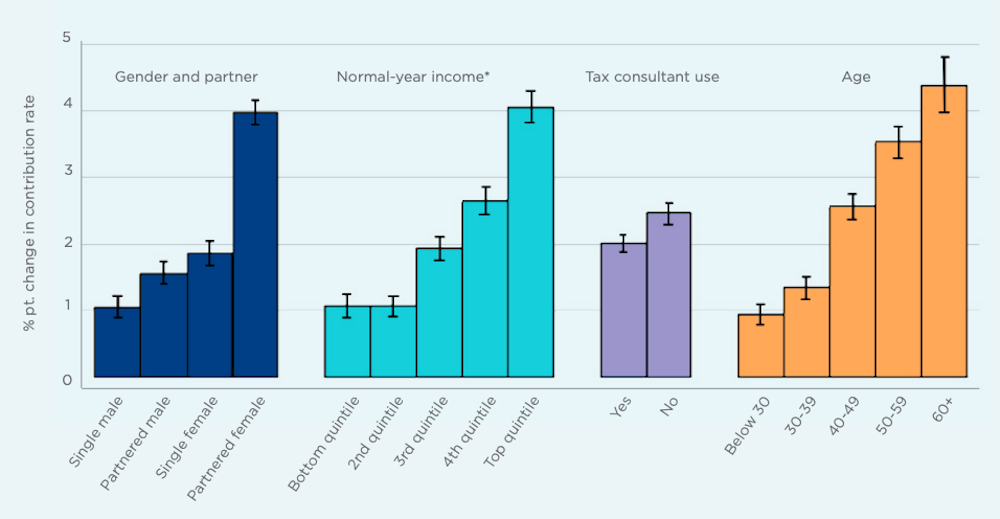
Impacts of the Superannuation Co-contribution Scheme on sub-group voluntary after-tax contribution rates, average across match rates.
Melbourne Institute, CC BY[9][10] Strikingly, our analysis indicates those taking advantage of the scheme would have made slightly higher voluntary super contributions without any co-contribution. The difference is slight – on average of $20 to $50 a year, depending on the co-contribution rate – but the whole point of the scheme is to encourage higher contributions, not provide a subsidy for people to contribute at the same (or a marginally lower) rate. Read more: Yes, women retire with less than men, but boosting compulsory super won't help[11] Failing to make a difference here and overseas These disappointing results from the scheme are in line with findings of similar schemes in the United States and Germany. There are two possible reasons. The first is that people may be unaware of the scheme. But we find no evidence for this. For example, our analysis indicates those who use tax agents – who are likely to be aware of the scheme and pass on such knowledge to their clients – are no more likely to use the scheme than those who do their own tax return. The second reason is the more obvious one. Most people on lower incomes don’t have spare cash to put into super. This is why increases have been minor even with a matching payments rate three times higher than now. If you don’t have the spare cash, it doesn’t make much difference a what rate the co-contribution is set. Our findings cast serious doubt on the point of the superannuation co-contribution scheme. Despite its relative simplicity and generosity, it has done little to lift the retirement savings of low and middle-income Australians as intended. The real beneficiaries of the scheme have been the small minority of eligible people who were already contributing. For them, this has been a windfall that has allowed them to reduce their personal contributions while still achieving their desired contribution levels. Read more: Retirement incomes review finds problems more super won't solve[12] References^ Superannuation Co-Contribution Scheme (www.ato.gov.au)^ $127 million (treasury.gov.au)^ $365 million (treasury.gov.au)^ analysis (melbourneinstitute.unimelb.edu.au)^ How to camouflage $150 billion in spending: call it 'tax expenditure' (theconversation.com)^ Better Superannuation System (parlinfo.aph.gov.au)^ evaluate the scheme (melbourneinstitute.unimelb.edu.au)^ Australian Longitudinal Information Files (taxpolicy.crawford.anu.edu.au)^ Melbourne Institute (melbourneinstitute.unimelb.edu.au)^ CC BY (creativecommons.org)^ Yes, women retire with less than men, but boosting compulsory super won't help (theconversation.com)^ Retirement incomes review finds problems more super won't solve (theconversation.com)Authors: Cain Polidano, Senior Research Fellow, The University of Melbourne

Read more https://theconversation.com/super-co-contribution-has-cost-10-billion-to-help-the-wrong-australians-so-lets-scrap-it-180680

The Weekend Times Magazine

How To Install PVC Shutters At Home

Homes are the best place for relaxing and refreshing after the hectic and tiring daily life routine. The home should be decorated so that it gives people a warm welcome...

4 Simple Tips To Help You Relax This Weekend

After a long week of hard work, a relaxing weekend is much needed. Often, some people just don't know how to lay back and enjoy their weekend without getting stressed...

Brisbane Compensation Lawyers for Work Injury Damages

Suffering a work-related injury can turn your life upside down. The physical pain, emotional stress, and financial uncertainty can feel overwhelming. If you’re in Brisbane and facing this situation, finding...

Stylish and Sustainable Comfort with Ceiling Fans Adelaide

For Adelaide homeowners, finding the right balance between comfort, style, and energy efficiency is always a priority. With hot, dry summers and mild winters, it’s important to have cooling solutions...

Aussies get budget savvy with surge in deferred payment of bills

Deferit co-founders Mat Blas and Jonty Hirsowitz Deferit, a payment platform exclusively focused on helping people pay their bills on time, has released new data on the huge uptake of its...

Catch a Flight to Broome for a Tropical Adventure

If you’re dreaming of a getaway that combines tropical beauty, rich culture, and a sense of adventure, look no further than Broome. Tucked away in Western Australia’s Kimberley region, Broome...

The Importance of Quality Paint Protection for Brisbane Drivers

Shielding Your Vehicle with the Right Protection Every car owner appreciates that fresh showroom finish—the gleam of the paintwork, the smoothness of brand new panels. But once you drive out of...

Making these five clever moving mistakes will cost you both money and time

Moving to a new location can be a thrilling adventure, but it can also be costly and stressful. Because so much packing, planning, and logistics are involved, it is easy...

Effective Pest Control Solutions in Ballarat: What You Need to Know

Living in Ballarat means enjoying a beautiful regional lifestyle, but it also comes with its share of challenges—one of which is managing pests. From termites threatening your home’s structure to...