Can Australian employers make you get a COVID-19 vaccine? Mostly not — but here's when they can
- Written by: Joo-Cheong Tham, Professor, Melbourne Law School, The University of Melbourne
Australia’s official policy on vaccines is that they be voluntary and free. But the federal government hasn’t shut the door completely on employers pursuing mandatory policies of their own.
Last week the federal government reiterated it won’t use its powers[1] to give employers a free hand to mandate vaccines. Yet Prime Minister Scott Morrison also said[2]:
Decisions to require COVID-19 vaccinations for employees will be a matter for individual business, taking into account their particular circumstances and their obligations under safety, anti-discrimination and privacy laws.
So far just two Australian companies — regional air carrier Alliance Airlines and canning company SPC[3] — have declared they will make a COVID-19 vaccination mandatory for their workers.
The reason so few have declared such intentions is because the law isn’t on the employer’s side. There are only limited circumstances where workplace vaccine mandates are likely to be found lawful.
Mandatory vaccines are an exception, not the rule
Safe Work Australia, the federal work health and safety regulator, and the Fair Work Ombudsman, the agency responsible for compliance with federal workplace laws, have both made it clear that most employers can’t make you get a vaccine.
Safe Work Australia’s guidance[4] says “most employers will not need to make vaccination mandatory” to meet their workplace, health and safety obligations.
The exceptions are when public health directions require them to do so. Examples are the New South Wales health order[5] requiring specified classes of quarantine facility, transport and airport workers to have had at least one vaccine shot, and the Queensland order[6] that health service employees in residential aged care be fully vaccinated by October 31.
The Fair Work Ombudsman says an employer needs to have a compelling reason before requiring vaccination of workers. Two conditions stand out:
Employees must interact with people with an elevated risk of being infected with coronavirus. For example, if they work in hotel quarantine or border control.
Employees must have close contact with people who are most vulnerable to the health impacts catching COVID. For example, if they work in aged care.
This second condition aligns with rulings in unfair dismissal cases involving employees refusing influenza vaccinations. In three such cases this year, the Fair Work Commission (Australia’s federal industrial tribunal) said it was reasonable for employers in the aged care and child care sectors to insist on vaccination as a condition of employment.
But overall, the Fair Work Ombudsman said[7]:
In the current circumstances, the overwhelming majority of employers should assume that they can’t require their employees to be vaccinated against coronavirus.
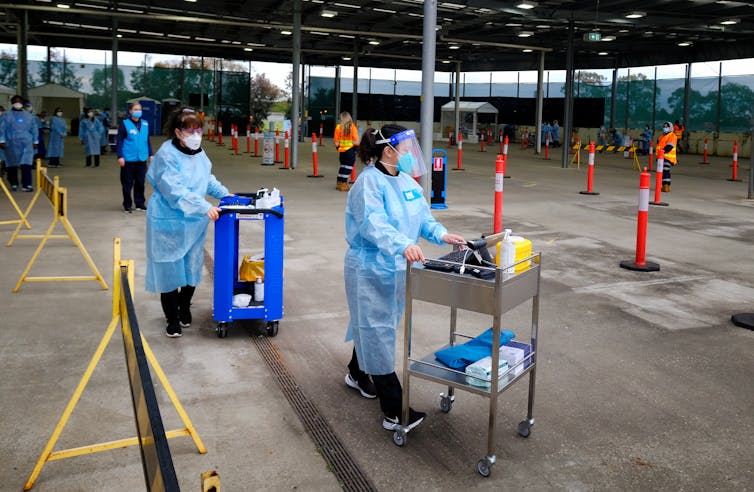 A drive-through COVID-19 vaccine hub in the west Melbourne surburb of Melton, August 9 2021.
Luis Ascui/AAP
A drive-through COVID-19 vaccine hub in the west Melbourne surburb of Melton, August 9 2021.
Luis Ascui/AAP
Trampling on worker rights
This legal context could, of course, be changed by the federal parliament amending the Fair Work Act[8] to expressly authorise employer mandates.
Given the composition of the senate, this might prove impossible to achieve. But even if it were possible, there are good reasons to oppose it — even while acknowledging the clear public health benefit[9] of COVID-19 vaccinations.
At stake are fundamental principles of worker rights. In the words of the International Labour Organisation’s 1944 Declaration of Phildelphia[10], workers have the right to “pursue both their material well-being and their spiritual development in conditions of freedom and dignity”.
Read more: Can governments mandate a COVID vaccination? Balancing public health with human rights – and what the law says[11]
Any decision to limit fundamental rights is best done through accountable public institutions, rather than private entities motivated by commercial considerations.
Public health orders give the community confidence that such decisions have been informed by expert advice, and that different stakeholders have had a chance to be heard (as employer groups and unions have had with the federal vaccine roll-out).
Opening a can of worms
Unions and employer groups largely agree that, in the limited situations where there are workplace vaccine mandates, they should be backed by public health orders.
Business Council of Australia chief executive Jennifer Westacott[12] says vaccination should be “driven as much as possible through public health orders, not left to individual employers”.
Australian Council of Trade Unions secretary Sally McManus[13] says any mandate “has to be based on the advice of health professionals, not just made up by employers, and workers must be consulted, along with their union”.
Consultation does not appear to have been a feature of the announcements by Alliance Airlines or SPC, whose workers reportedly learnt of the company’s decision[14] through the media.
Read more: Airline policies mandating vaccines will be a turbulent test of workplace rights[15]
Other companies may be waiting to see the upshot — whether those policies lead to challenges either through the Fair Work Commission, which arbitrates unfair dismissal claims, or through federal courts for breach of workplace laws.
But most — from big employers such as Wesfarmers and Commonwealth Bank to boutique outfits such as Atlassian — will not be waiting. Their emphasis is on carrots, not sticks,[16] for driving up vaccination rates.
If you find yourself out of step with both the Australian Council of Trade Unions and the Business Council of Australia, it’s a sign you are out on a legal limb, and need to consult an industrial lawyer.
References
- ^ won’t use its powers (www.pm.gov.au)
- ^ also said (www.pm.gov.au)
- ^ canning company SPC (www.abc.net.au)
- ^ guidance (www.safeworkaustralia.gov.au)
- ^ New South Wales health order (www.health.nsw.gov.au)
- ^ Queensland order (www.health.qld.gov.au)
- ^ said (coronavirus.fairwork.gov.au)
- ^ Fair Work Act (www.legislation.gov.au)
- ^ clear public health benefit (theconversation.com)
- ^ Declaration of Phildelphia (www.ilo.org)
- ^ Can governments mandate a COVID vaccination? Balancing public health with human rights – and what the law says (theconversation.com)
- ^ Jennifer Westacott (www.theage.com.au)
- ^ Sally McManus (www.abc.net.au)
- ^ learnt of the company’s decision (www.theage.com.au)
- ^ Airline policies mandating vaccines will be a turbulent test of workplace rights (theconversation.com)
- ^ carrots, not sticks, (www.afr.com)
Authors: Joo-Cheong Tham, Professor, Melbourne Law School, The University of Melbourne