Is that a good egg? How chocolate makers rate on social and environmental measures
- Written by: John Dumay, Professor - Department of Accounting and Corporate Governance, Macquarie University
Easter is the biggest chocolate-buying time of the year. But who’s really paying for the cost of that chocolate?
The second annual report[1] on the social and environmental performance of the world’s major chocolate makers show human exploitation and environmental degradation continue to be key ingredients in many chocolate products.
It is a collaboration between five advocacy groups – Be Slavery Free[2], German-based social justice organisation INKOTA[3] and US environmental outfits Green America[4],Mighty Earth[5] and the National Wildlife Federation[6]. (Macquarie Business School has been working with Be Slavery Free[7] on research into issues of modern slavery).
The report sorts 31 major chocolate makers into four bands – industry leaders,those showing improvement, those needing to do more and the industry laggards – based on their written responses to questions about their polices in six key areas covering social, environmental and governance practices.
Just four of the 31 received the highest “good egg” rating: US-based Alter Eco[8], Switzerland’s Chocolats Halba/Sunray[9], Netherlands-based Tony’s Chocolonely[10], and New Zealand’s Whittakers [11]. These are all relatively small chocolate makers.
Thirteen makers ranked in the second category, includes most of the world’s ten biggest confectionary companies – Mars Wrigley (US), Ferraro Group (Luxembourg/Italy), Mondelēz International (US, owner of the Cadbury, Toblerone and Milka brands), Hershey (US), Nestlé (Switzerland) and Lindt & Sprüngli (Switzerland).
Seven companies were in the third rank. Three were in the fourth – Meiji, Itochu and Morinaga (all Japan-based).
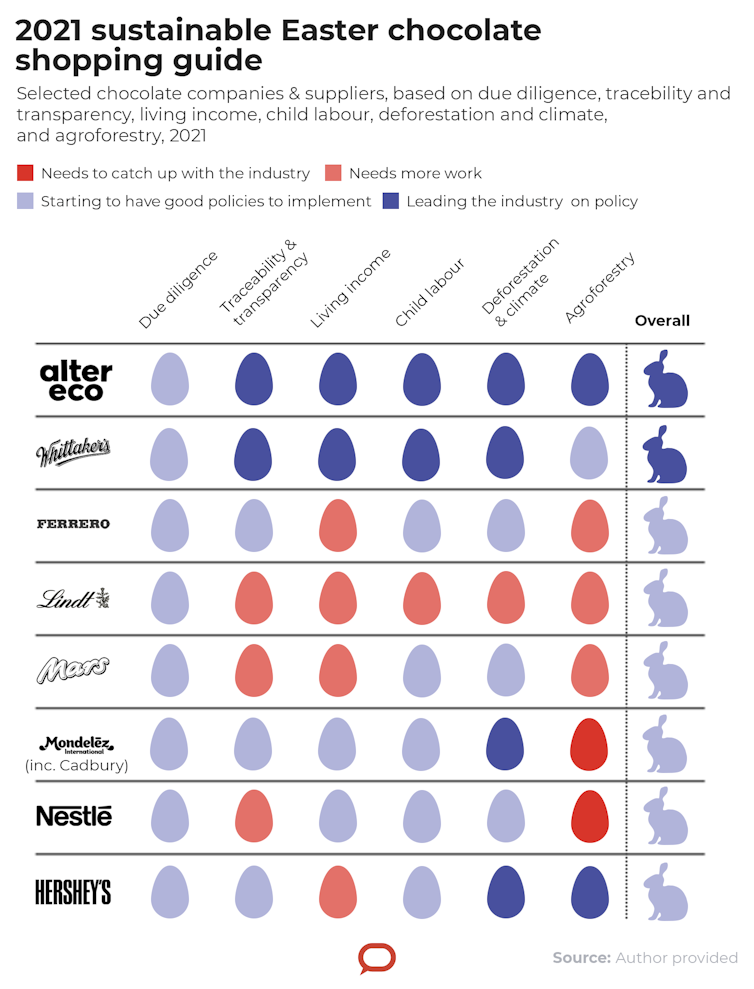 Selected chocolate brands available in Australia, from a full list of 31 makers.
Easter Chocolate Shopping Guide, CC BY-ND[12][13]
Selected chocolate brands available in Australia, from a full list of 31 makers.
Easter Chocolate Shopping Guide, CC BY-ND[12][13]
Four companies failed to respond to the survey: Valrhona (France); Starbucks (US, a major seller of hot chocolate products); Unilever (UK); and August Storck (Germany, maker of Werther’s, Toffifay and Merci chocolate brands).
The full list of rankings can be found here[14].
Read more: Sustainable shopping: save the world, one chocolate at a time[15]
Where chocolate comes from
The principle ingredient for making chocolate is cocoa, the powder made from grinding the seeds of the cacao plant. About 70% of cacao is farmed in West Africa, with Côte d'Ivoire and Ghana being the big two producers.
Most cacao farmers make less than US$1 a day (and women even less), well below the global poverty line of $US1.90. An estimated 1.6 million children[16] work in cocoa production in Côte d'Ivoire and Ghana alone.
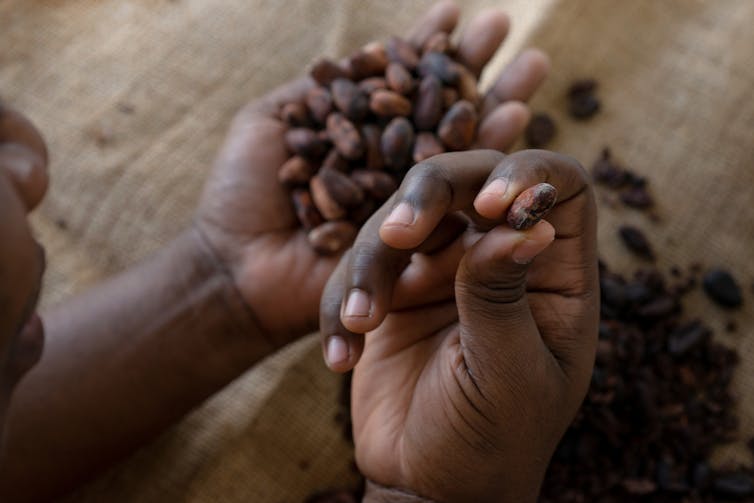 Most cacao farmers earn less than US$1 a day.
chomplearn/Shutterstock
Most cacao farmers earn less than US$1 a day.
chomplearn/Shutterstock
Clearing land to farm cacao is estimated to be responsible for about one-third of of the land cleared in Côte d'Ivoire and Ghana over the past 60 years. These countries have now lost more than 80%[17] of rainforest cover. Such deforestation contributes to climate change.
The good news is that most companies and four producer governments (Côte d'Ivoire, Ghana, Colombia and Cameroon) have committed to ending cocoa-driven deforestation through the Cocoa and Forest Initiative[18].
Some action is taking place through agroforestry[19], which involves farming a variety of crops while retaining natural vegetation. This has been shown to reduce the need for pesticides, increase carbon sequestration and improve biodiversity. It is also better for farmers’ food and income security, as they can grow diverse crops rather than relying on just one.
Supply chain transparency
Essential to addressing these social and environmental problems is achieving transparency in supply chains. If a company does not trace and track where products have come from, it cannot know if they have been produced through human exploitation or environmental destruction.
The report rates chocolate makers on two measures related to this – due diligence traceability and transparency. These are crucial as the foundation for all other reforms.
Read more: At last, Australia has a Modern Slavery Act. Here's what you'll need to know[20]
They are also key to Australia’s modern slavery act, which requires businesses with an annual turnover of A$100 million to publish a “modern slavery statement” reporting on the risks of modern slavery in their operations and supply chains, and on the actions they have taken to address these.
But such transparency alone will not be enough if consumers don’t act on that information, and put pressure on chocolate companies through their purchasing decisions.
So go with the good eggs, and avoid the bad.
References
- ^ second annual report (static1.squarespace.com)
- ^ Be Slavery Free (beslaveryfree.com)
- ^ INKOTA (www.inkota.de)
- ^ Green America (www.greenamerica.org)
- ^ Mighty Earth (www.mightyearth.org)
- ^ National Wildlife Federation (www.nwf.org)
- ^ Be Slavery Free (beslaveryfree.com)
- ^ Alter Eco (www.alterecofoods.com)
- ^ Chocolats Halba/Sunray (www.halba.ch)
- ^ Tony’s Chocolonely (tonyschocolonely.com)
- ^ Whittakers (www.whittakers.co.nz)
- ^ Easter Chocolate Shopping Guide (static1.squarespace.com)
- ^ CC BY-ND (creativecommons.org)
- ^ found here (static1.squarespace.com)
- ^ Sustainable shopping: save the world, one chocolate at a time (theconversation.com)
- ^ 1.6 million children (foodtank.com)
- ^ than 80% (www.theguardian.com)
- ^ Cocoa and Forest Initiative (www.worldcocoafoundation.org)
- ^ agroforestry (readcacao.com)
- ^ At last, Australia has a Modern Slavery Act. Here's what you'll need to know (theconversation.com)
Authors: John Dumay, Professor - Department of Accounting and Corporate Governance, Macquarie University