

The US is turning 250 – and Trump is making it all about him
- Written by: Weekend Times
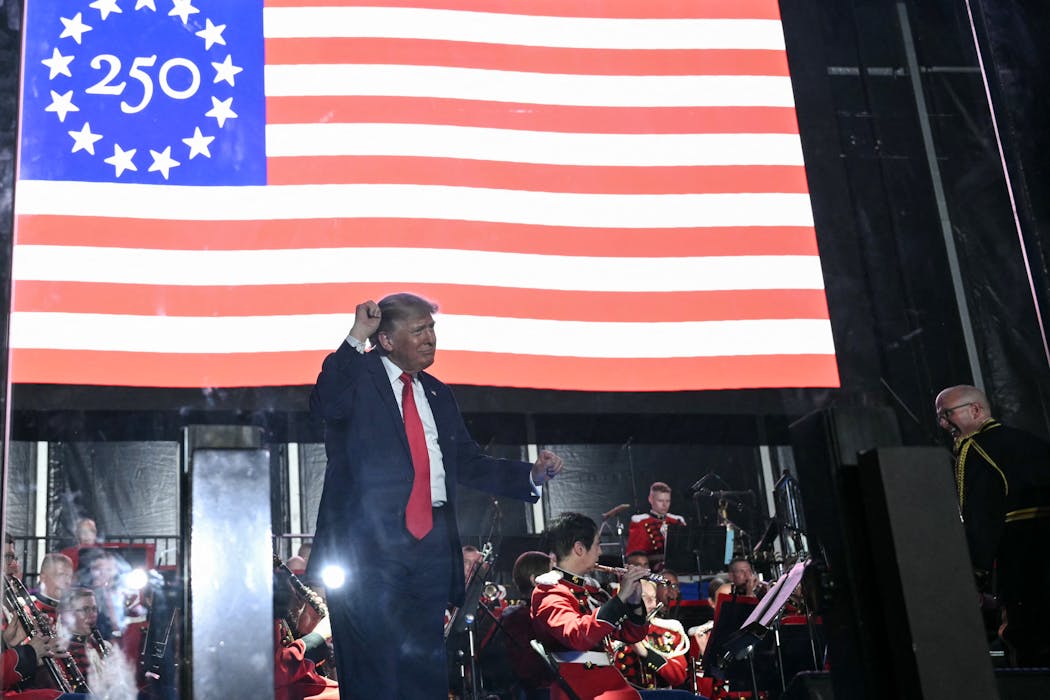
It’s almost the Fourth of July and Donald Trump is making the most of the 250th anniversary of American independence. He has all
but declared himself Patriot-in-Chief.
He’s putting his face on commemorative $250 bills and passports. A giant structure on the White House’s South Lawn, built for a pay-per-view UFC bout on Trump’s 80th birthday, was nicknamed the Arc de Trump. Perhaps Trump would have put his name on that, too, but as it was being built a court ordered his name be removed from another federal building.
Trump is not the first president to lean into an exaggerated patriotism at a time of crisis, attempting to direct or reorient Americans’ sense of national purpose.
But the vanity of Trump’s actions signals something perhaps unique or at least singularly intense, as he attempts to fuse patriotism with personal loyalty so that love of country is the same as loving him.
Other presidents have used patriotism to narrate the character of the nation, or to emphasise some change they felt necessary.
Patriotism as service and the presidency as stewardship
For George Washington, patriotism took the form of stepping down from the role as the nation’s first president.
In doing so, he showed the new republic was serious about its claim that it would be governed by popular sovereignty rather than by an inherited monarchy.
Washington’s actions showed that keeping the balance of the three branches of government – executive, legislative and judicial – required good-faith actors and restraint.
Roughly 200 years later, President Gerald Ford faced a dilemma. Richard Nixon had recently resigned in disgrace, and the oil shocks of the early 1970s meant wages were stagnant and inflation rampant for the first time since the Great Depression.
In those circumstances, Ford opted to mark the nation’s 200th birthday with a low-key expression of US patriotism. On July 4, Ford did not appear at an edifice built to honour him. Rather, he presided over a ceremony at Thomas Jefferson’s hallowed home and plantation, Monticello, to naturalise immigrant citizens.
Patriotism as a global mission and a loyalty test
Many American presidents have framed national pride and devotion in terms of the United States’ place in the world. They adopt a tradition captured in revolutionary pamphleteer Thomas Paine’s 1776 work, Common Sense, that
the cause of America is in a great measure the cause of mankind.
With the rise of fascism and Nazism in the 1930s, this sense of the US as having a global mission became acute.
As Franklin Roosevelt exhorted those he called “my fellow Americans” to step up to join the Allies, he argued their good fortune was also an obligation. His January 1941 Four Freedoms speech said the US must defend the freedom of expression and religion Americans already enjoyed but also “freedom from want” and “freedom from fear” for everyone, worldwide.
This strain of internationally-focused patriotism remained the hallmark of presidential rhetoric all the way through the Cold War and its immediate aftermath.
Then, in 2000, George W. Bush entered office with a promise to curb the US’s international entanglements. The 9/11 attacks ended that ambition, and from there Bush trumpeted a patriotism that foreshadowed what is happening today in its emphasis on loyalty. “Either you are with us, or you are with the terrorists,” Bush told other nations.
American citizens were also subject to new laws (one literally known as The Patriot Act), institutions and norms to intensify domestic surveillance and stifle dissent.
Freedom for some Americans, unfreedom for others
Even presidents with the grandest ideas of patriotism have not escaped the contradiction at the core of America’s self-image as a nation uniquely devoted to freedom. Because while in theory all people may be born equal, the US has never treated all of them that way.
American freedom has always come by excluding some from its bounty. George Washington himself enslaved hundreds of people and ferociously pursued those who escaped to freedom. President Woodrow Wilson, who wanted the US to make the world safe for democracy, segregated a previously integrated federal public service and promoted racist myths about America’s history. Franklin Roosevelt’s much-lauded New Deal and GI Bill, which did so much to redistribute wealth and build America’s middle class, excluded African Americans, Native Americans and many other people of colour.
In this regard, Trump’s inward-looking patriotism is familiar, although it is much more explicit about who it excludes than most presidents have been for some time.
What is new, however, is Trump’s fusion of patriotism, personal loyalty and an idea that he – as president but also because of his self-proclaimed sense of superiority in all aspects of life – somehow embodies the nation itself.
This is the patriotism of the corporate raider: acquire the institution, put your name on the façade, reward loyalists and above all, extract all the value you can.
The 250th anniversary of independence doesn’t require us to ask if Trump is politicising patriotism. Patriotism is always political. The question is whether and how patriotism can be made to serve the greater good, or whether it is just yet another asset for Trump to own.
Clare Corbould has received funding from the Australian Research Council. She is a member of the Australian Historical Association.