

What Australia must learn from Ukraine about drone technology and the future of warfare
- Written by: Clive Williams, Visiting professor, School of Humanities and Social Sciences, UNSW Sydney
In the lead-up to the release of the National Defence Strategy (NDS) this week, the Albanese government has announced[1] it will spend an additional A$2–5 billion on drones and counter-drone systems.
This will bring total spending on uncrewed and autonomous systems to A$12–15 billion over the decade to 2035–36.
With this announcement, the government is apparently learning from the conflicts in Ukraine and the Middle East how best to prepare for the future of warfare.
What is emerging is not simply a technological shift in military capabilities, but a structural one: recognising the growing importance of cost, scale and domestic industrial capacity in determining military effectiveness.
The rapid evolution of drone warfare
The origins of this dynamic lie in Iran’s development of mass-produced offensive drones, which cost US$20,000–$50,000[2] (A$28,000–70,000) each, depending on the model.
Since Russia’s full-scale invasion of Ukraine in 2022, Iran has supplied it[3] with both Shahed drones (known locally as Geran) and production expertise, enabling Moscow to swarm the skies over Ukraine.
This has forced both sides into a rapid process of adaptation, focused less on maximising performance and more on reducing cost and increasing production volume.
Ukraine has quickly become a world leader in drone technology. Last year, it announced it would produce around four million drones[4], about double its production of the previous year. It has also developed a layered defence system capable of defending against swarms of Russian drones.
While both Russia and Ukraine initially focused on developing small quadcopters, they are now investing heavily in fixed-wing drones optimised for range, endurance and adaptability.
Russia’s Molniya (and newer Molniya-2 version) is a cheap, expendable, fixed-wing loitering munition, built from lightweight plywood and foam. These drones[5] have extended Russia’s strike range into Ukraine’s rear areas and can operate as “motherships[6]” for smaller drones. They can also relay messages from one drone to another.
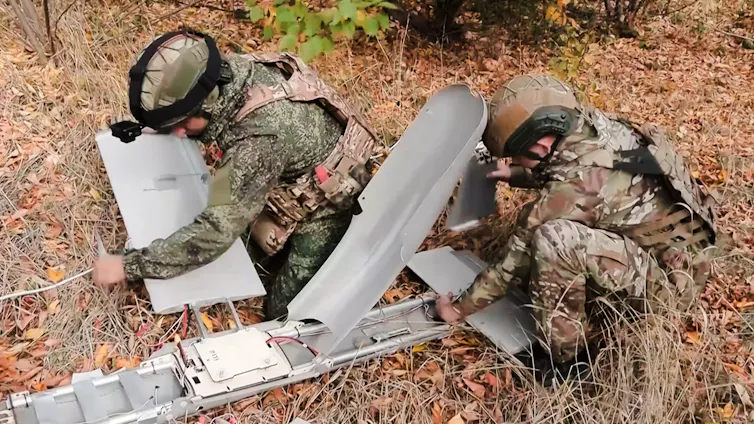
These Russian platforms are increasingly being deployed in conjunction with first-person-view (FPV) quadcopters. They often incorporate satellite communications (such as Starlink terminals) and specialised payloads. These can include smaller attack drones or reconnaissance sensors.
Ukraine, in turn, is developing its own fixed-wing interceptors and strike systems, including the Blyskavka[7], which is also constructed[8] from plywood and foam or plastic. These systems emphasise speed (up to 140 kilometres per hour), autonomy and resistance to electronic warfare.
The goal on both sides is the same: keep it super cheap. The Blyskavka reportedly costs[9] around US$800 (A$1,120) per unit. It is simple to build in garages or small workshops, but can carry a payload of up to eight kilograms[10].
Ukraine is also partnering with a Japanese firm to develop a low-cost, stealthy, high-speed interceptor drone called the Terra A1[11].
The Terra A1, with a top speed of 300 kph, is designed specifically to counter piston-engined Shahed-type drones with a top speed of 185 kph. The Terra A1 system combines relatively simple features — electric propulsion, autonomous targeting and short endurance — with the ability to be deployed in large numbers.
Its exact materials have not been publicly disclosed. However, it likely uses lightweight composites, 3D-printed parts or other cheap materials to achieve its low unit price[12] of US$2,500–3,000 (A$3,500–4,200).
Why this matters for Australia
As Australia unveils its next defence strategy, it must focus on how to defend large areas with finite resources.
Australia’s current drone capability emphasises high-end, ISTAR systems (meaning intelligence, surveillance, target acquisition and reconnaissance), including the Shadow[13] and Triton[14] drones. Australia is also increasingly adopting low-cost tactical drones.
Compared to Ukraine, though, Australia lacks large-scale domestic drone production and does not have a standalone unmanned systems branch.
Australia is different from Ukraine in many ways, but both countries share similar underlying constraints. Because Australia needs to defend extensive maritime approaches, northern military bases and critical infrastructure, this raises many critical questions Ukraine has had to face, such as how to deal with:
saturation threats, where large numbers of relatively simple systems overwhelm defences
cost-imposition strategies, in which adversaries exploit cheaper technologies to generate financial strain
the capacity to produce and replenish defence systems over time.
While more traditional, high-end air defence systems remain essential, particularly against cruise and ballistic missile threats, the Ukraine and Middle East wars have shown that Australia can’t rely on these alone.
This means the key issue is not the replacement of advanced systems, but the integration of very low-cost alternatives.
For Australia, this implies a need for a more layered approach combining:
high-capability systems for complex and high-speed threats
low-cost, disposable systems capable of countering large volumes of simple drone platforms.
A shift in the economics of warfare
Land wars of the recent past were shaped primarily by the industrial-scale production of tanks and artillery. Increasingly, wars are now being determined by the capacity to produce and deploy large numbers of unmanned systems at relatively low cost.
Iran demonstrated how affordability could be used to great effect. Ukraine, working with international partners, has applied similar principles in defence.
The war in Ukraine is, therefore, not only a contest over territory. It is also a contest over the cost of warfare itself.
Australia’s latest defence strategy must fully reflect this shift. Because cost is becoming a defining feature of modern conflict, the ability to generate capability at scale — and cheaply — may prove as important as technological sophistication.
References
- ^ announced (theconversation.com)
- ^ cost US$20,000–$50,000 (www.nytimes.com)
- ^ supplied it (theconversation.com)
- ^ four million drones (www.atlanticcouncil.org)
- ^ drones (www.popularmechanics.com)
- ^ motherships (www.19fortyfive.com)
- ^ Blyskavka (www.vyriy.com)
- ^ constructed (www.smgconferences.com)
- ^ reportedly costs (www.pravda.com.ua)
- ^ payload of up to eight kilograms (militarnyi.com)
- ^ Terra A1 (www.unmannedairspace.info)
- ^ low unit price (www.reuters.com)
- ^ Shadow (www.army.gov.au)
- ^ Triton (www.aspistrategist.org.au)
Authors: Clive Williams, Visiting professor, School of Humanities and Social Sciences, UNSW Sydney