Australia has ruled out repatriation for ISIS families. This isn’t a safe or coherent plan
- Written by: Se Youn Park, Sessional academic, School of Political Science and International Studies, The University of Queensland
Australian Prime Minister Anthony Albanese said his government will not help repatriate the 34 Australian women and children with links to Islamic State fighters who were released from a detention camp in Syria and are reportedly trying[1] to return to Australia.
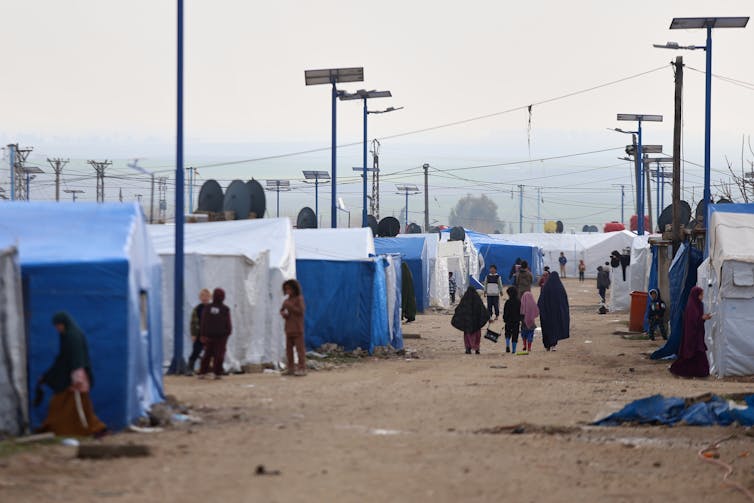
The women and children were among more than 2,000 people from 50 different countries detained at al-Roj camp in Kurdish-controlled northern Syria. The Australians were turned back by Syrian officials when trying to reach Damascus this week, with the goal of returning to Australia.
The Albanese government’s stance on the Australian women and children in Syria has never really been clarified, which is fuelling all of this uncertainty at the moment.
There’s a precedent for repatriation
Australia has demonstrated it can repatriate[2] its citizens safely when it feels compelled to. In 2022, for example, it helped repatriate four women – the wives and widows of IS militants – and their 13 children from al-Roj camp in Syria.
It has also acknowledged that if citizens return independently from conflict zones, security agencies[3] are capable of investigating and managing any risks.
Yet, it has not established a permanent framework for when and how such returns should occur.
Instead, Australia continues to rely on ad hoc decision-making shaped by individual circumstances, rather than a solid plan. This case-by-case approach[4] has produced uneven and opaque outcomes.
Take for example the four women repatriated in 2022. What happened next remains only partially known. One of the women, Mariam Raad[5], was prosecuted in Australia for entering Islamic State-controlled territory. She pleaded guilty, but was discharged without conviction and placed on a good behaviour bond.
Others, including Mariam Dabboussy[6], returned and resettled in the community. Yet, there is little publicly available information about their legal situations, monitoring arrangements or long-term reintegration plans.
This opacity makes it difficult to assess whether Australia is applying consistent legal standards or managing risk systematically.
Mitigating risks through managed returns
The ambiguity here reflects a broader pattern of political caution and strategic delay.
For years, Australian governments framed the repatriation of citizens who had travelled to Syria or Iraq as an unacceptable security risk. They relied on citizenship revocation and political refusal to prevent it.
In 2022, however, the High Court limited[7] the government’s power to revoke citizenship, removing one of these key tools.
At the same time, the conditions in the Syrian detention camps deteriorated, heightening international pressure on countries to repatriate their citizens trapped there.
These factors eventually forced a shift in Australia’s stance, resulting in the 2022 repatriation. However, this shift was never institutionalised.
In 2024, then-Home Affairs Minister Clare O'Neil seemed set to do this by preparing a plan[8] to repatriate the remaining women and children. However, this plan was shelved and never revisited.
As a result, the problem has been deferred rather than resolved. This weakens Australia’s ability to manage the possible security risk posed by these women effectively. Leaving citizens in overseas detention does not eliminate risk. It just makes it somebody else’s problem.
When individuals remain in foreign camps, Australian authorities cannot monitor them effectively, prosecute them or support their disengagement from radical ideologies. This limits our intelligence capabilities and our ability to track former members and the potential threat they pose.
Avoiding repatriation does not prevent their return, either. It just makes returns harder to manage.
Some allies have a different approach
Last October, two Australian women and their four children escaped a camp in Syria and made their own way to Lebanon. Once at the Australian embassy, they were given passports[9] to return to Australia.
When individuals return through informal pathways such as this, authorities have less time to prepare and fewer opportunities to implement structured legal, monitoring and reintegration measures. It’s also far more dangerous for the people involved.
Many of Australia’s allies have recognised this reality.
The United States[10] has actively encouraged Western countries[11] to repatriate their citizens in the name of global security. It’s even offered military assistance[12] to do so.
Several European governments[13] have also begun repatriating women and children with more urgency.
Countries such as the Netherlands[14] and Germany[15] have implemented planned repatriation programmes linked to judicial processes and long-term supervision. These governments recognise that repatriation is not a concession. It is a security management strategy.
France, too, which had long been hesitant to repatriate its nationals from Syria, shifted from a “case-by-case” approach[16] in 2022 after facing criticism from the European Court of Human Rights and the UN Committee Against Torture.
Responsibility to protect
There is also a deeper legal issue at stake. Many Australian women detained in Syria have been held for years without charge or trial. By leaving citizens in indefinite offshore detention, Australia risks undermining its commitment to due process and the rule of law.
The choice is not between security and accountability. It is between managing citizens within Australia’s legal system or leaving them in unstable environments where Australia has no oversight.
The question is no longer whether Australian women and children will return. It is whether Australia will manage their return deliberately, or continue responding only after events force its hand.
References
- ^ reportedly trying (www.abc.net.au)
- ^ repatriate (www.smh.com.au)
- ^ security agencies (www.abc.net.au)
- ^ case-by-case approach (drive.google.com)
- ^ Mariam Raad (www.abc.net.au)
- ^ Mariam Dabboussy (www.theguardian.com)
- ^ limited (www.news.com.au)
- ^ preparing a plan (www.theguardian.com)
- ^ they were given passports (www.theage.com.au)
- ^ United States (www.theguardian.com)
- ^ encouraged Western countries (www.state.gov)
- ^ military assistance (www.theage.com.au)
- ^ European governments (icct.nl)
- ^ Netherlands (icct.nl)
- ^ Germany (www.aljazeera.com)
- ^ shifted from a “case-by-case” approach (www.lemonde.fr)
Authors: Se Youn Park, Sessional academic, School of Political Science and International Studies, The University of Queensland