New data show where the parties got their money from in the lead-up to the 2025 election
- Written by: Kate Griffiths, Democracy Deputy Program Director, Grattan Institute
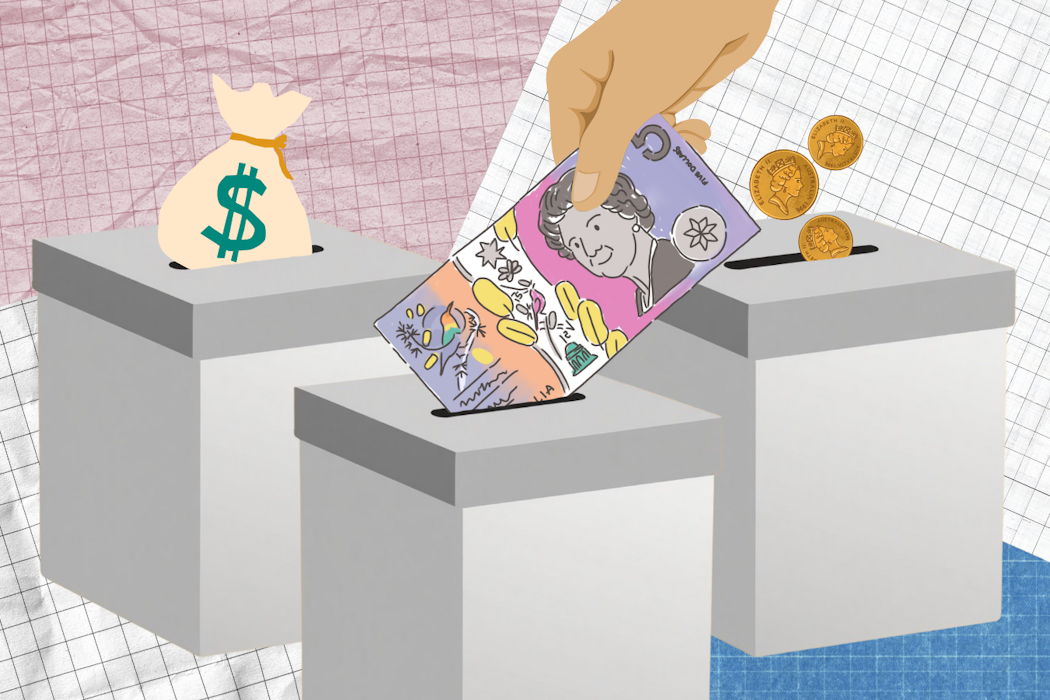
Australia’s political parties set new records in funds raised and spent in the lead-up to the 2025 federal election. Now, nine months later, Australians finally get a look at who funded the parties’ election campaigns.
Data released today[1] reveal that big money matters in Australian elections, and political donations remain highly concentrated among a small number of powerful individuals and interest groups.
The big spenders
Money matters in Australian elections because it helps spread political messages far and wide. The Coalition substantially outspent Labor in the year leading up to the 2025 election, declaring $212 million in expenditure compared with Labor’s $160 million. In fact, the two major parties together spent three quarters of a total $489 million in 2024–25. These figures include electoral communication, as well as party operating expenses and salaries, but there is no breakdown.
Clive Palmer’s Trumpet of Patriots party came in third, declaring $53 million in expenditure, well below the $123 million[2] and $89 million[3] his United Australia Party spent in the 2022 and 2019 election campaigns, respectively. The Greens declared $40 million and One Nation just $3 million in expenditure in 2024–25.
Australia’s political parties collectively exceeded their 2022 election budgets in 2025, raising $490 million, compared with $402 million in the lead-up to the 2022 election, and coming very close to the half-a-billion mark for the first time.
The Coalition has long led the fundraising “arms race” between the major parties, with Labor taking a substantive lead only once on record – in the lead-up to the 2007 election that saw Kevin Rudd’s Labor Party defeat John Howard’s Coalition government.
The big donors
So who’s stumping up these whopping sums? A few big donors dominate the picture.
Clive Palmer’s Mineralogy – which donated almost exclusively to the Trumpet of Patriots – was by far the largest donor in the 2024–25 financial year. While Palmer’s $54.3 million in donations this electoral cycle is lower than his record-breaking intervention in 2022[4], it still shows the substantial sway a single donor can have in an election year.
Climate 200 was the second-largest donor over the period, with the organisation making $6.6 million in donations to a range of independent candidates and campaign groups. Donors to Climate 200 – including Scott Farquhar, William Taylor Nominees, and Mike Cannon-Brookes – were among those stumping up the largest individual donations.
One new player this cycle was Coal Australia, a lobby group founded in 2024[5] to represent coal mining interests. The group made more than $4 million in donations to electoral campaign groups such as Australians for Prosperity, and Jobs for Mining Communities.
The single biggest donation to the Coalition came from philanthropist Pam Wall, who gave $5.2 million to the Liberal Party of South Australia in 2024–25, in memory of her late husband, Ian Wall. Other major donors to the Coalition included the Cormack Foundation (an investment arm for the Liberal Party), Oryxium Investments (linked to the Lowy family), and DoorDash Australia.
Labor’s single biggest donor was Labor Holdings (an investment arm of the party), which donated $4 million, followed by the Mining and Energy Union ($3.3 million). SA Progressive Business, a fundraising arm of the Labor Party, donated $1.4 million.
Anthony Pratt’s paper and packaging company Pratt Holdings made big donations to both Labor and the Coalition, as it has done in previous years[6], with Labor benefiting to the tune of $2 million, and the Coalition $1 million.
What about the rest of the money?
There’s a lot of hidden money in Australian politics. Declared donations made up only a quarter of political parties’ total income in 2024–25. Public funding made up another quarter, and “other receipts” a further 20%. That leaves about 30% ($144 million) in undisclosed private funds.
The Coalition’s funding is a little more murky: 36% of Coalition income in 2024–25 was undisclosed, compared with 23% for Labor. Only donations bigger than $16,900 need to be declared under the current rules, so substantial donations remain hidden.
Reform is coming, but there’s still more to do
Fortunately, the rules are changing soon[7] to provide much more transparency. From July 1 this year, the donations disclosure threshold will be lowered to $5,000, and donations data will be released much more quickly. Donations will be required to be disclosed within seven days during an election period, and at other times, within 21 days following the month the gift was received.
That means Australians will finally know who’s donating while policy issues – and elections – are still “live”.
The new rules[8] also introduce caps on donations and electoral expenditure, helping to reduce the influence of money in politics. But the new rules unfairly advantage major parties over independents and new entrants.
The new total cap of $90 million for electoral expenditure by a political party is too high, keeping too much money in politics. And the per-seat spending cap of $800,000 is too low, advantaging incumbents over new entrants. There is also a loophole[9] in the design of the donations cap that advantages major parties by allowing the cap to apply separately to each branch of a party.
The new legislation should be reviewed and amended to close the loopholes before the next federal election.
References
- ^ released today (transparency.aec.gov.au)
- ^ $123 million (theconversation.com)
- ^ $89 million (theconversation.com)
- ^ record-breaking intervention in 2022 (theconversation.com)
- ^ founded in 2024 (www.afr.com)
- ^ previous years (theconversation.com)
- ^ changing soon (www.aph.gov.au)
- ^ new rules (www.aph.gov.au)
- ^ loophole (theconversation.com)
Authors: Kate Griffiths, Democracy Deputy Program Director, Grattan Institute