With Iran weakened, Trump’s end goal may now be regime change. It’s an incredibly risky gamble
- Written by: Amin Saikal, Emeritus Professor of Middle Eastern Studies, Australian National University; The University of Western Australia; Victoria University
The United States and the Islamic Republic of Iran are once again on the brink of a major confrontation. This would have terrible ramifications for both countries, the region and the world.
All signs point in this direction[1], but the two sides also have an off-ramp: the possibility of reaching an agreement on Iran’s nuclear program and other disputed issues.
The Iranian regime has never been so besieged both internally and externally. It has just faced yet another widespread protest movement[2] demanding the government’s ouster, while dealing with the threat of military action by the US, supported by its ally, Israel.
Even so, the regime remains resilient and defiant. It brutally crushed the recent protests at the cost of thousands of lives[3] and mass arrests and has warned the US of an all-out war if it attacks.
At the same time, it has signalled a willingness to reach a deal[4] with the US over its nuclear program to avoid such an outcome.
So, what happens next, and can war be avoided?
A regime in survival mode
The regime’s tenacity is embedded in its unique theocratic nature, in which societal subordination and confrontation with outside enemies are the modus operandi.
Since its inception 47 years ago, the regime has learned how to ensure its longevity. This requires having a strong and defendable state, armed with all the necessary repressive instruments of state power, along with an ideology that mixes the concept of Shia Islamic martyrdom with fierce Iranian nationalism.
Given this, the regime has operated[5] within a jihadi (combative) and ijtihadi (pragmatist) framework for its survival.
It has prepared for both war and making deals. This is not the first time Iran’s clerical leaders have been put in a tight corner by their own people and outside adversaries. They have always found a way to work through challenges and threats to their existence.
Still, the current challenge is bigger than any they’ve faced before. Over the past month, US President Donald Trump has vowed to punish the regime for its repression of the Iranian people[6], and now for its refusal to reach a deal[7] on its nuclear program.
Some believe his ultimate goal, though, is to create the conditions for regime change[8].
Regime change not a given
Trump must know that regime change in Iran will not happen easily. Supreme Leader Ayatollah Ali Khamenei and his fellow clerics are ready to fight to the very end. They know that if the Islamic system they created goes down, everyone in the regime is most likely to perish with it.
The regime has built sufficient fanatical forces (namely, the Islamic Revolutionary Guard Corps and Basij paramilitary force) and advanced missiles and drones to defend itself. It also has the ability to block the Strait of Hormuz, though which 20% of the world’s oil[9] and 25% of its liquefied natural gas flows every day.
The regime also has the backing of China, Russia and North Korea, which means any US assault could quickly escalate into a broader regional war.
Although Trump has not favoured regime change[10] in the past, he now seems as if he’s not ruling it out. (His ally, Israeli Prime Minister Benjamin Netanyahu has long had this aim[11].)
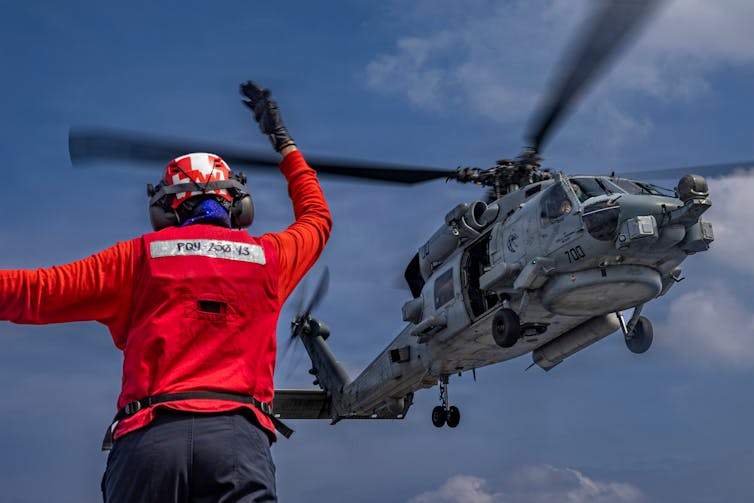
But even though Trump now has a “massive armada[12]” of ships and fighter jets in the region, the Iranian regime cannot be toppled by air and sea alone. And a ground invasion is not on Trump’s agenda, given the United States’ bitter experiences with ground offensives in Vietnam, Iraq and Afghanistan.
The regime could only crumble if a sizeable part of its security forces defected to the opposition. So far, they have remained quite loyal and solidly behind the leadership – as the brutal crackdown to the recent protests shows.
A possible destabilising future
Even if the regime were to crumble from within by some chance, what would come next?
Iran is a large and complex country, with an ethnically mixed population. While Persians form a slim majority[13] of the population, the country has significant minority groups, such as the Kurds, Azeris, Arabs and Balochis. They all have a history of movements for secession and autonomy.
With the exception of two short periods of experimenting with democracy in the early and mid-20th century, Iran has been governed by authoritarian rulers. In the event of a power vacuum, it remains prone to chaos and disintegration.
It is doubtful that Reza Pahlavi[14], the son of the last shah of Iran, Mohammad Reza Pahlavi, who ruled from 1941–79, will command sufficient public support and organisational strength to ensure a smooth transition to democracy. He has lived most of his life in exile in the US and has been closely identified with Israeli and American interests.
Netanyahu would be pleased to see a disintegrated Iran, as he has always wanted to prevent the formation of a united Muslim front against Israel. But the fall-out from a destabilised Iran would be problematic for the region.
These considerations are probably weighing on Trump’s mind, delaying his promise to the Iranian protesters that “help is on its way[15]”.
Diplomacy is the better way forward. The time has come for the Iranian and American leadership to compromise and resurrect their July 2015 nuclear deal[16], from which Trump withdrew in 2018.
This should be urgently followed by Iran’s clerical rulers opening their iron fist and allowing the Iranian people to determine their future and that of their country within a democratic framework.
Otherwise, the volatility that has long dominated this oil-rich country, where between 30–40% of the population lives in poverty[17], will eventually devour the regime.
References
- ^ point in this direction (www.abc.net.au)
- ^ protest movement (theconversation.com)
- ^ cost of thousands of lives (www.bbc.com)
- ^ willingness to reach a deal (irangov.ir)
- ^ operated (www.amazon.com.au)
- ^ repression of the Iranian people (www.youtube.com)
- ^ refusal to reach a deal (www.bbc.com)
- ^ create the conditions for regime change (www.timesofisrael.com)
- ^ 20% of the world’s oil (www.abc.net.au)
- ^ has not favoured regime change (www.youtube.com)
- ^ had this aim (www.haaretz.com)
- ^ massive armada (www.theage.com.au)
- ^ form a slim majority (en.wikipedia.org)
- ^ Reza Pahlavi (theconversation.com)
- ^ help is on its way (www.theguardian.com)
- ^ July 2015 nuclear deal (www.cfr.org)
- ^ 30–40% of the population lives in poverty (www.amazon.com.au)
Authors: Amin Saikal, Emeritus Professor of Middle Eastern Studies, Australian National University; The University of Western Australia; Victoria University