5 years on from the junta’s coup, Myanmar’s flawed elections can’t unite a country at risk of breaking apart
- Written by: Adam Simpson, Senior Lecturer in International Studies in the School of Society and Culture, Adelaide University
Five years ago, on February 1 2021, Myanmar’s top generals decapitated[1] the elected government. Democratic leaders were arrested, pushed underground or forced into exile.
Since then, the economy has spluttered and foreign investors have headed for the exit. The only growth industries – mostly scam centres[2], drugs[3] and other criminal[4] activities – enrich those already well-fed.
The military junta has kept its stranglehold via draconian curbs on civil and political liberties. It has bolstered its fighting forces through ruthless conscription, including of child soldiers[5]. They now face rebellions in almost every corner of the ethnically diverse country.
It helps that the military brass can still depend on international[6] support from Russia. China, meanwhile, is playing a careful game to ensure its interests – including prized access to the Indian Ocean for oil and gas[7] – are secured.
And US President Donald Trump’s second term in office has introduced newly unpredictable and detrimental elements to great power politics.
The US government last year cited[8] “notable progress in governance and stability [and] plans for free and fair elections” as justification for removing the Temporary Protected Status designation for immigrants from Myanmar. Although a federal judge blocked[9] this decision a few days ago, this may eventually force previously protected Myanmar citizens to return home.
However, far from being free and fair, the month-long elections that just concluded in Myanmar have been devoid of meaningful democratic practice.
They will entrench the junta and provide little more than a patina of legitimacy that anti-democratic major powers will use to further normalise relations with Myanmar’s military leaders.
Myanmar’s deeply flawed election
The multi-stage elections were being held in only a fraction[10] of the country currently under the military’s authority. Elections were not held in opposition-held territory, so many otherwise eligible voters were disenfranchised.
As such, there is no serious opposition to the military’s proxy, the Union Solidarity and Development Party (USDP). Civil and political space is also heavily restricted[11], with criticism[12] of the election itself being a criminal offence.
The main opposition would be the National League for Democracy (NLD) party, which has won by a landslide in every national election it has participated in since 1990. But it has been banned[13], along with dozens of other opposition political parties. Its senior leaders, including Aung San Suu Kyi, have been imprisoned.
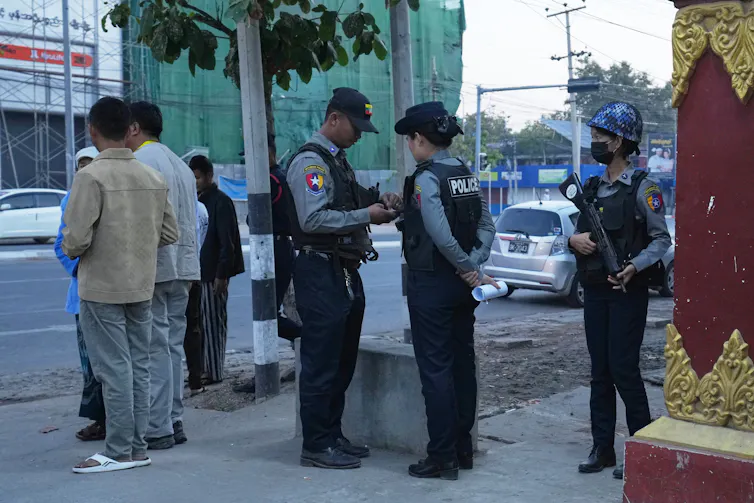
Citizens have been coerced[14] into taking part[15] in an election with only electronic-voting machines[16]. This is against a background of expanded surveillance and pervasive fear.
Break up of Myanmar?
Despite recent military gains[17] by the junta, supported by Russian military technology and Chinese government pressure, the lines of control may be starting to solidify into an eventual Balkanisation[18], or break up, of Myanmar into hostile statelets.
The prospects for a future federalised democratic Myanmar seem increasingly remote.
Since, the coup there are many areas now under full opposition control. Take, for instance, a recent declaration[19] of independence by a breakaway ethnic Karen armed group. While they represent only one part of the Karen community in eastern Myanmar, this could well precipitate a flood of similar announcements by other ethnic minorities.
Other groups might declare themselves autonomous and seek backing from governments and commercial and security interests in neighbouring countries such as China, Thailand, India and Bangladesh.
Most neighbouring countries will be uneasy about any further fracturing of Myanmar’s territorial integrity. Some, however, see potential benefits. China, for example, supports some ethnic armed groups to protect its strategic economic assets and maintain stability and influence along its borders.
Will international rulings have any impact?
While the conflict continues at home, Myanmar’s military leadership is defending itself at the International Court of Justice (ICJ) in The Hague. It faces claims it committed genocide[20] against the Muslim Rohingya[21] ethnic minority, particularly during the massacres of 2017.
During the three-week hearings[22], the junta has argued its “clearance operations” were merely counterterrorism activities[23], despite the 700,000 refugees[24] it created.
Given the disdain for international law shown by Russia, China and the Trump administration in the US, any finding against the junta will have limited practical impact anyway.
What next?
Meanwhile, some countries in the the ASEAN bloc appear to be softening[25] their opposition to the junta.
Recently, the Philippines foreign secretary met[26] with Myanmar’s senior military leadership in the country’s first month chairing the bloc. This highlights the conundrum faced by regional leaders.
In the years immediately after the coup, ASEAN sought to keep Myanmar’s junta at arm’s length. But a number of key ASEAN players, particularly the more authoritarian regimes in Southeast Asia, would prefer to find a way to normalise engagement with the generals.
From that perspective, the flawed elections are a chance to embrace superficial democratisation and renewal.
This leaves the Myanmar people – millions of whom have fought hard against the coup and its negative consequences – with invidious choices about how to best pursue their independence and freedom.
There is little positive economic news on the horizon. The IMF[27] projects inflation in Myanmar will stay above 30% in 2026 with a real GDP fall of 2.7%. This would compound an almost 20%[28] contraction since the coup. The currency[29] is worth around one quarter of what it was five years ago at the time of the coup.
In practice, this means many Myanmar families have gone backwards dramatically. An untold number are now entangled in illicit and often highly exploitative businesses.
The military’s proxy, the Union Solidarity and Development Party (USDP), will undoubtedly form government after the elections. But unlike the USDP-led government that formed after the similarly flawed 2010 election, this new administration is unlikely to pursue political and economic liberalisation sufficient to entice opposition forces to play along.
The people of Myanmar have now been betrayed and brutalised by the military far too often to believe their easy promises.
References
- ^ decapitated (theconversation.com)
- ^ scam centres (www.abc.net.au)
- ^ drugs (www.unodc.org)
- ^ criminal (www.cfr.org)
- ^ child soldiers (www.hrw.org)
- ^ international (eastasiaforum.org)
- ^ oil and gas (www.irrawaddy.com)
- ^ cited (www.abc.net.au)
- ^ blocked (www.nytimes.com)
- ^ fraction (www.crisisgroup.org)
- ^ restricted (www.ohchr.org)
- ^ criticism (www.amnesty.org.au)
- ^ banned (www.theguardian.com)
- ^ coerced (www.irrawaddy.com)
- ^ taking part (myanmar-now.org)
- ^ electronic-voting machines (news.un.org)
- ^ gains (asiatimes.com)
- ^ Balkanisation (eastasiaforum.org)
- ^ declaration (www.nationthailand.com)
- ^ genocide (www.icj-cij.org)
- ^ Rohingya (www.tandfonline.com)
- ^ hearings (www.hrw.org)
- ^ counterterrorism activities (news.un.org)
- ^ 700,000 refugees (www.oxfam.org)
- ^ softening (www.irrawaddy.com)
- ^ met (www.straitstimes.com)
- ^ IMF (www.imf.org)
- ^ 20% (www.iseas.edu.sg)
- ^ currency (news.un.org)
Authors: Adam Simpson, Senior Lecturer in International Studies in the School of Society and Culture, Adelaide University