Trump is threatening more tariffs over access to critical minerals – will NZ be targeted?
- Written by: Jane Kelsey, Emeritus Professor of Law, University of Auckland, Waipapa Taumata Rau
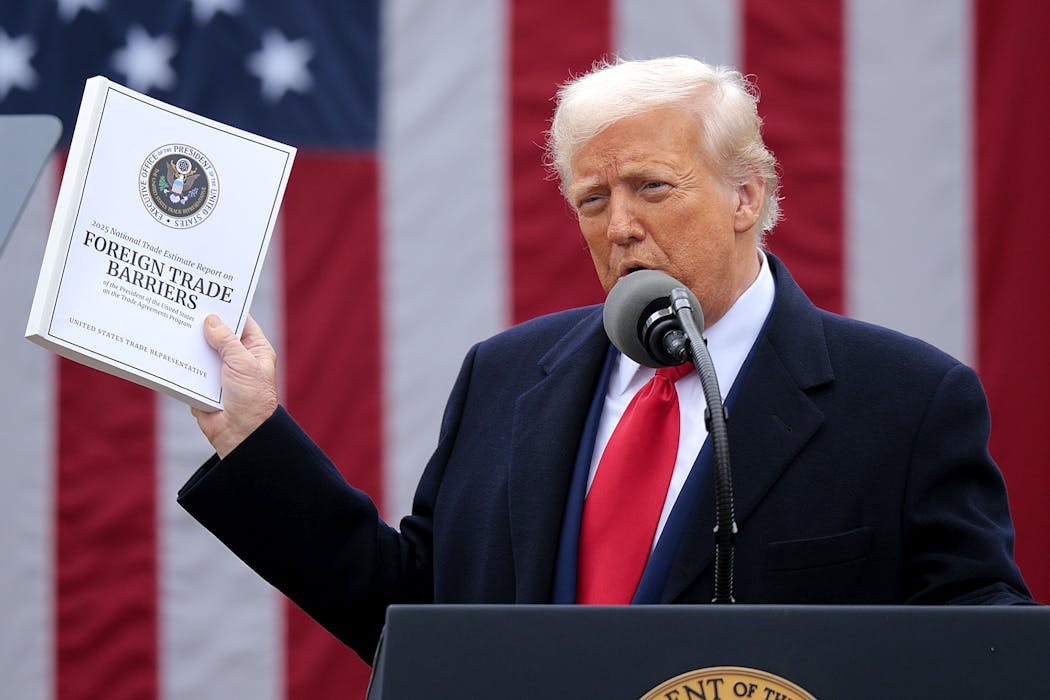
On January 14, Donald Trump issued a proclamation[1] threatening yet more tariffs if “trading partners” fail to sign agreements on critical minerals and their derivative products within 180 days of his announcement.
There is no list of target countries, but it would be surprising if Aotearoa New Zealand is not one of them.
Trump’s pronouncement follows an investigation under section 232[2] of the Trade Expansion Act 1962 that found the United States is too reliant on foreign sources of critical minerals and derivative products, threatening its national (and economic) security.
According to the investigation, this dependence and unpredictable supply chains create vulnerability that could be exploited by “foreign actors”.
Ultimately, this is the latest salvo in Trump’s economic war with China. Critical minerals are essential to advanced weapons systems, high-tech industries (including artificial intelligence and data centres), nuclear energy and electric vehicles.
China dominates[3] the mining, processing and manufacturing supply chain[4] for rare earth elements and rare-earth magnets used in wind turbines, medical devices, electric vehicles and military technology. It sources much of the raw product from investments[5] offshore.
The United States is totally or largely dependent on imports of over 40 critical minerals. Those it mines it lacks the capacity to process, exporting raw materials for refining and importing the final product.
Trump blames lack of investment in US processing capacity on China buying up mining assets in other countries, processing raw materials cheaply in China, then manipulating prices by flooding the market with cheap products, making US domestic production uneconomic.
Tensions grew last year when China imposed export controls[6] on critical mineral technologies in the tit-for-tat tariff war with the US.
What Australia’s deal tells us
Trump has directed Commerce Secretary Howard Lutnick and Trade Representative Jamieson Greer to pursue or continue negotiations with other countries to ensure an adequate supply of critical minerals, and to mitigate supply-chain vulnerabilities.
We should assume the template for these negotiations is the critical minerals framework agreement[7] Australia secretly negotiated with the US over five months, and signed in October last year.
The agreement contains numerous commitments[8] that were once anathema to free trade advocates, including:
“price support mechanisms”, with a minimum price on “priority minerals” to come into effect in late 2026
developing a global framework to support those price controls
curbing Chinese acquisitions of new mining assets through domestic screening of investments and pressure on third countries.
On the investment side, a US$8.5 billion pipeline for targeted financing and joint ownership of projects[9] between Australia and the US would see US$1 billion invested by each country within six months, and Australia fast-tracking approvals.
Australia’s mineral industry hailed the deal[10] as “AUKUS in action”, with Australia also committing to major new military purchases.
Read more: Australia is betting on a new 'strategic reserve' to loosen China's grip on critical minerals[11]
There’s a logic behind the deal. Australia is the world’s fourth-largest producer of rare earth elements, and home to BHP, Rio Tinto and Lynas Rare Earths, among other mining giants. It was the top investment destination for rare earth exploration in 2024.
But Australia now faces tricky questions about who it can and can’t sell these products to.
An Australian representative from a critical minerals mining operation has been reported[12] as saying their company was “mindful of the context in which we’ve been funded” and there’s an assumption they “won’t be making many sales to Chinese customers”.
But Australia has free trade[13] and investment agreements[14] with China, its largest trading partner[15]. Most of China’s investments in Australia[16] are in mining and energy.
The text of the US–Australia critical minerals agreement says it is non-binding and unenforceable. But the US has many forms of retaliation for non-compliance.
Trump’s proclamation makes it clear that anything below what the US demands, either in these new agreements or their implementation, can face retaliation through trade sanctions.
The US–Australia agreement also said they would convene a ministerial mining, minerals and metals investment meeting within 180 days, but it is unclear with which countries.
Would NZ sign up to Trump’s agenda?
What does this mean for Aotearoa New Zealand? At this stage we don’t know if the government has been approached, and any deal would be secret until it is signed. But given the coalition government’s pro-mining agenda, the background context is important.
As part of a Critical Minerals Dialogue[17] under the US-led Indo-Pacific Economic Framework, New Zealand conducted a mapping of mineral reserves, resources and processing capacity in 2024.
The framework seemingly lapsed with the end of the Biden administration, but the critical minerals project lives on in another form.
In January 2025, the Ministry of Business, Innovation and Employment published a Minerals Strategy[18], featuring a list of 37 critical minerals[19], 21 of which could be exploited here.
The strategy aims to double the value of minerals exports to NZ$3 billion by 2035, strengthen global minerals supply chains, and leverage relationships and international partnerships.
In November 2025, the government announced it had joined the international Minerals Security Partnership[20] as a means to advance those goals.
At the same time, there is a current claim before the Waitangi Tribunal’s climate change inquiry[21] challenging the government’s mining agenda as a breach of the Crown’s Treaty obligations.
To date we have heard nothing from the government about any demands from the Trump administration, and it is following a softly-softly foreign policy approach[22] to the US.
But if New Zealand is a target of the latest Trump directive, there needs to be a full discussion about the implications – before, not after the fact.
References
- ^ proclamation (www.whitehouse.gov)
- ^ investigation under section 232 (www.congress.gov)
- ^ dominates (iea.blob.core.windows.net)
- ^ supply chain (www.iea.org)
- ^ investments (iea.blob.core.windows.net)
- ^ imposed export controls (www.reuters.com)
- ^ critical minerals framework agreement (www.industry.gov.au)
- ^ numerous commitments (www.csis.org)
- ^ financing and joint ownership of projects (www.abc.net.au)
- ^ hailed the deal (minerals.org.au)
- ^ Australia is betting on a new 'strategic reserve' to loosen China's grip on critical minerals (theconversation.com)
- ^ has been reported (www.theguardian.com)
- ^ free trade (www.dfat.gov.au)
- ^ investment agreements (www.austlii.edu.au)
- ^ largest trading partner (camaltd.com)
- ^ investments in Australia (camaltd.com)
- ^ Critical Minerals Dialogue (www.pm.gov.au)
- ^ Minerals Strategy (www.beehive.govt.nz)
- ^ list of 37 critical minerals (www.beehive.govt.nz)
- ^ Minerals Security Partnership (www.beehive.govt.nz)
- ^ climate change inquiry (ngatoki.nz)
- ^ softly-softly foreign policy approach (theconversation.com)
Authors: Jane Kelsey, Emeritus Professor of Law, University of Auckland, Waipapa Taumata Rau