What charges does Benjamin Netanyahu face, and what’s at stake if he is granted a pardon?
- Written by: Michelle Burgis-Kasthala, Professor of International Law, La Trobe University
Israeli Prime Minister Benjamin Netanyahu has requested[1] a pardon in his long-running corruption trial – a move that has set off alarm bells among his critics that he’s trying to circumvent the rule of law.
In a video message[2], Netanyahu says Israel’s current “security and political” situation makes it impossible for him to appear in court several times a week.
His request for a pardon from Israel’s president is just the latest twist[3] in a case that has dragged on for years. It could have significant implications for Israel’s legal system – and Netanyahu’s political future, with elections due next year.
What charges does he face?
Netanyahu is indisputably the most important political figure of modern Israeli politics. He was first elected prime minister in 1996 and is now in his sixth term.
He has been indicted on charges of bribery, fraud and breach of trust, related to investigations[4] that date back to 2016. There are three cases now known by numbers[5] – Case 1,000, Case 2,000 and Case 4,000. The trial began in 2020.
In Case 1,000[6], Netanyahu is alleged to have received some US$200,000 (A$305,000) worth of gifts, including cigars and champagne, from Hollywood producer Arnon Milchan and Australian billionaire James Packer.
Case 2,000[7] is related to alleged meetings Netanyahu had with Arnon Mozes, the publisher of the prominent Yediot Ahronot newspaper. Prosecutors say Mozes offered Netanyahu favourable coverage in exchange for restrictions being imposed on one of his rival newspapers.
And the final case, Case 4,000[8] is related to a communications conglomerate, Bezeq. The attorney-general alleges another reciprocal agreement: Netanyahu would be portrayed positively on the online platform, it’s alleged, in exchange for him supporting regulatory changes that would benefit Bezeq’s controlling shareholder.
Netanyahu has consistently denied any wrongdoing in the cases, saying he’s a victim of a “witch hunt”. In 2021, he characterised the charges as “fabricated and ludicorous[9]”. When he took the stand in 2024, he said[10]:
These investigations were born of sin. There was no offence, so they found an offence.
Experts have pointed out[11] that a pardon can only be given once someone’s been convicted of a crime. But Netanyahu is not offering to admit any responsibility or guilt in the case, and he likely never will. He’s simply asking for a pardon, so that he can get on with his job.
Independence of Israel’s judicial system
Since the trial began in 2020, many witnesses have testified in the case[12], including some former Netanyahu aides who entered into plea bargains and became state witnesses. So, there’s been some pretty damning material brought against Netanyahu.
But he’s been extremely savvy and politically intelligent to use other issues – particularly the Gaza war – at every opportunity to try to postpone or interrupt the proceedings.
And after the Hamas attacks of October 2023, the number of trial days was limited because of security. According to media reports[13], Netanyahu has frequently requested his hearings be cancelled due to his handling of the war.
Netanyahu’s supporters don’t seem to have a problem with his request for a pardon, but it is shining a light on broader questions around the independence of the Israeli legal system.
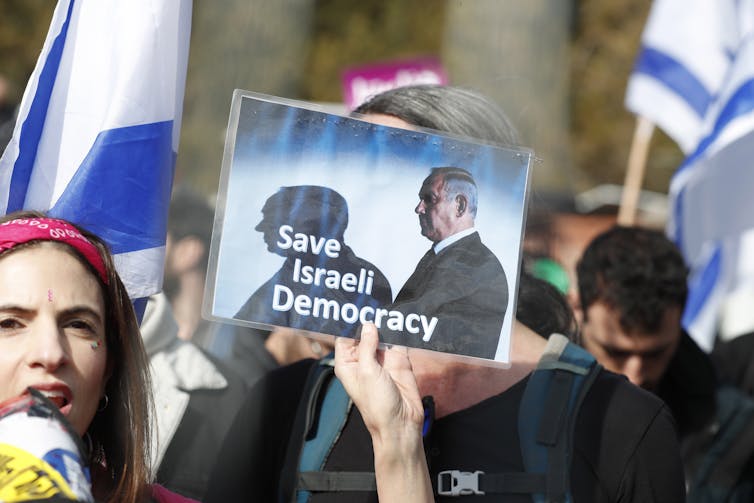
In early 2023, the Netanyahu government put forth plans to overhaul the judicial system[14], which critics said would weaken the Supreme Court and Israel’s system of checks and balances. Netanyahu wasn’t involved in the effort because the attorney-general said[15] it would be a conflict of interest due to his corruption trial, but other ministers in his cabinet were pushing it.
Massive protests happened on a regular basis throughout Israel in response to this move. Critics saw this as a frontal attack[16] on the basic foundations of the Israeli legal system.
The request for a pardon is now part of this wider story, even though the two issues are not formally linked. Netanyahu’s opponents say it’s yet another indication of him and his coalition having a fundamentally different conception[17] of the rule of law.
Netanyahu’s political survival
This is all about Netanyahu’s personal and political survival. He was re-elected[18] leader of the Likud Party this month and he has declared[19] his intention to run again for prime minister in next year’s elections – and that he expects to win.
The Israeli Basic Law suggests[20] Netanyahu couldn’t run if he’s been convicted of a serious offence, though it’s not clear if he would actually be blocked at this point.
Media reports have suggested Netanyahu wants to move up the elections[21] from November to June in the hopes he’ll be able to secure deals to normalise relations with both Saudi Arabia and Indonesia by then. This fits a pattern of him trying to use foreign policy gains to offset his domestic problems.
With elections coming, he’s now trying every possible manoeuvre to improve his position – and the pardon is just one of them. It’s likely the only option he has now to make the case go away because the trial has gone on for so long and at some point the court will have to make a decision.
References
- ^ requested (www.nytimes.com)
- ^ video message (x.com)
- ^ latest twist (edition.cnn.com)
- ^ investigations (edition.cnn.com)
- ^ known by numbers (www.bbc.com)
- ^ Case 1,000 (apnews.com)
- ^ Case 2,000 (www.bbc.com)
- ^ Case 4,000 (www.bbc.com)
- ^ fabricated and ludicorous (www.i24news.tv)
- ^ said (www.france24.com)
- ^ pointed out (www.nytimes.com)
- ^ testified in the case (www.theguardian.com)
- ^ media reports (www.timesofisrael.com)
- ^ overhaul the judicial system (www.bbc.com)
- ^ said (www.theguardian.com)
- ^ frontal attack (www.pbs.org)
- ^ fundamentally different conception (www.nytimes.com)
- ^ re-elected (www.aa.com.tr)
- ^ declared (www.timesofisrael.com)
- ^ suggests (www.gov.il)
- ^ move up the elections (www.aa.com.tr)
Authors: Michelle Burgis-Kasthala, Professor of International Law, La Trobe University