Pro-cycling crashes can be bad, but evidence suggests slower bikes aren’t the answer
- Written by: Dylan A Mordaunt, Research Fellow, Faculty of Education, Health, and Psychological Sciences, Te Herenga Waka — Victoria University of Wellington
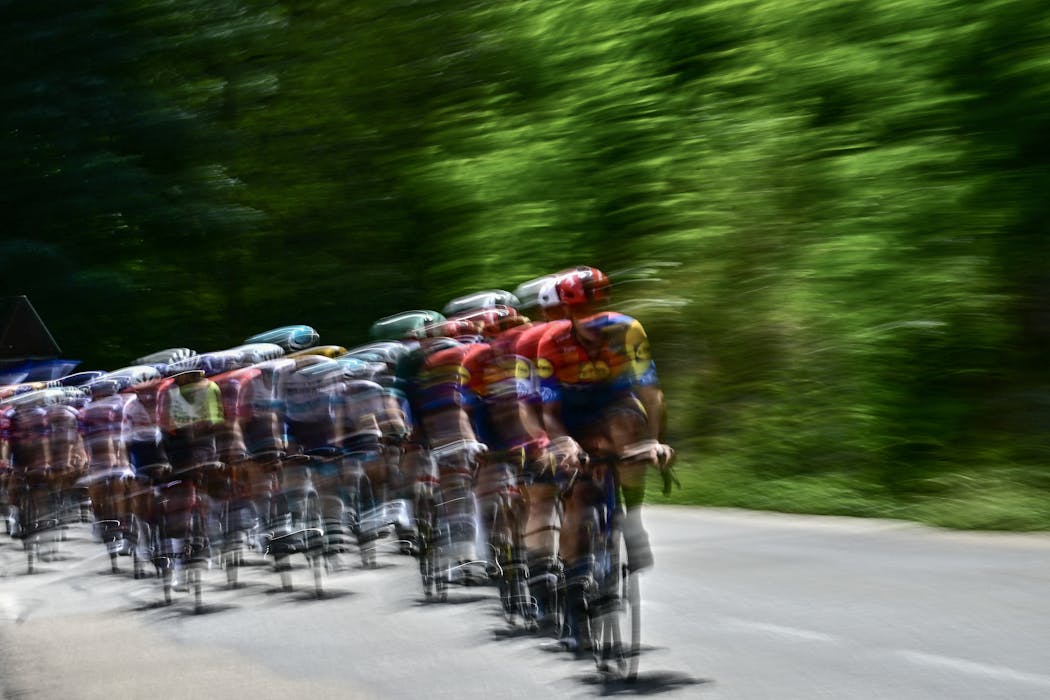
It might seem counter-intuitive in a sport built around speed, but the world governing body for competitive cycling wants to slow elite riders down.
Worried about high-speed crashes during pro-racing events, the Union Cycliste Internationale (UCI) has proposed a cap on the gear size[1] riders can use. The idea is to lower the possible top speed bikes can achieve.
The risks are real, too. At the recent Tour Down Under Men’s Classic in Australia, a high-speed multi-rider crash on the final corner sent bikes into the barriers and into the crowd, badly injuring a spectator[2].
In August this year, champion British rider Chris Froome crashed while training[3] in France, suffering a collapsed lung, broken ribs and a spinal fracture.
But would restricting gear size prevent these kinds of high-speed crashes? Certainly, not everyone thinks so[4].
Earlier this month, a Belgian court paused the rule change[5] after teams and a major cycle component maker argued the safety case was not proven. While slower bikes might sound safer, they argue, the evidence tells a different story.
What the evidence tells us
The proposed rule would limit the largest gear size to 54 teeth on the front chainring and 11 on the rear sprocket. The idea is simple: lower the top gear to reduce top speed and, in theory, cut risk.
But while speed clearly matters when it comes to crashes, it is only one part of how they happen in a tightly packed peloton[6] (the main pack of riders in a road race).
Our recent review[7] of 18 studies of race speed and crash risk found two clear patterns:
- higher speed makes injuries worse once a crash occurs
- but the link between speed and the chance of crashing is weaker and depends on context.
Injury rates in the UCI WorldTour[8] have climbed even though average race speeds have been steady. So, something else is at work.
We also examined the proposed gear cap[9] itself. Based on our analysis, we argue any rule change should be evidence-based rather than simply a reaction to pressure after high-profile incidents.
Understanding why crashes occur is central to this. Essentially, they are about people and space, and happen for a number of reasons:
- when riders fight for position[10] as they enter a narrowing corner
- when sprint “trains” (riders in the same team lining up for aerodynamic efficiency) cross wheels[11]
- or when road “furniture” appears too late to be avoided.
In this year’s Paris–Nice race, for example, Mattias Skjelmose struck a traffic island[12] at speed and abandoned the race. Reports described it as a poorly marked obstacle.
Course design, peloton density and inconsistent rule enforcement often play a bigger role than a few extra kilometres per hour.
Olympic champion Tom Pidcock demonstrates a high-speed descent on the Rossfeld Panoramastrasse in Germany.Why a gear limit won’t help much
On hill descents, where many serious injuries occur, riders freewheel in a tucked body position. Gravity and aerodynamics set the speed – gearing does not.
When riders are actually pedalling in a sprint, a 54×11 gear at high “cadence” (around 110–120 revolutions per minute) gives a speed of roughly 65 kilometres per hour (km/h). The very fastest finishes in elite men’s races reach about 75 km/h – the absolute peak speed.
A cap on gearing would trim roughly 5–10 km/h from the top-end, bringing the fastest sprints down to around 65–70 km/h. But most sprint pileups start below those speeds and are triggered by contact or line changes.
Lowering everyone’s top speed could even bunch the field more tightly and raise the risk of contact. The pro-cycling world already knows what helps:
These steps match what other high-speed sports have done to reduce injuries. Motor sports redesign the environment rather than just limit speed, with NASCAR and IndyCar having adopted energy-absorbing barriers[13] to cut wall-impact forces.
And alpine skiing manages risk[14] with course design, as well as nets and airbag protection to control speed and crash severity.
Similar approaches to safety are used in aviation[15], mining[16] and healthcare[17]. The aim is to focus on the environment and behaviour[18], measure exposure[19], fix the hotspots[20] and share what works[21] to keep improving safety.
References
- ^ cap on the gear size (www.uci.org)
- ^ injuring a spectator (www.abc.net.au)
- ^ Chris Froome crashed while training (www.theguardian.com)
- ^ not everyone thinks so (theconversation.com)
- ^ paused the rule change (www.belgiancompetition.be)
- ^ tightly packed peloton (cyclinguptodate.com)
- ^ recent review (papers.ssrn.com)
- ^ UCI WorldTour (www.uci.org)
- ^ examined the proposed gear cap (papers.ssrn.com)
- ^ fight for position (www.cyclingnews.com)
- ^ cross wheels (www.cyclingweekly.com)
- ^ Mattias Skjelmose struck a traffic island (www.cyclingnews.com)
- ^ energy-absorbing barriers (mwrsf.unl.edu)
- ^ manages risk (www.fis-ski.com)
- ^ aviation (www.faa.gov)
- ^ mining (www.icmm.com)
- ^ healthcare (www.who.int)
- ^ focus on the environment and behaviour (www.cdc.gov)
- ^ measure exposure (bjsm.bmj.com)
- ^ fix the hotspots (investment.infrastructure.gov.au)
- ^ share what works (asrs.arc.nasa.gov)
Authors: Dylan A Mordaunt, Research Fellow, Faculty of Education, Health, and Psychological Sciences, Te Herenga Waka — Victoria University of Wellington