Another local election, another low turnout? Syncing local and general elections could be the answer
- Written by: Julia Talbot-Jones, Senior Lecturer | School of Government, Te Herenga Waka — Victoria University of Wellington
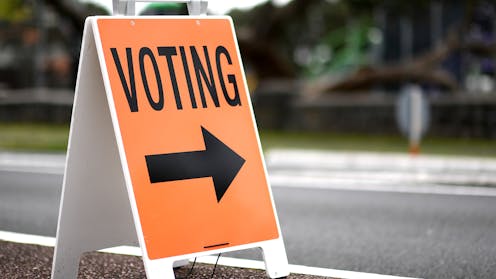
By now you should have received those familiar orange envelopes containing your local body election papers. Have you opened them? Will you vote? And will you remember to post them back?
These are important questions now that voting has opened[1]. The results of these elections, which happen every three years, will shape how New Zealanders live, work and travel around the country’s small towns and big cities.
But when voting closes on October 11, concerns about low voter turnout will inevitably resurface. Voting rates have been falling for at least 30 years[2] and voter participation now rests around 40% – roughly half that of general elections.
The implications are significant[3]. City and district councils manage local services, infrastructure and planning, including roads, water, waste, parks, libraries and local regulations. Regional councils oversee water quality, land use, flood control and often public transport and regional parks.
A weak local democracy[4] compromises that system, and affects how elected representatives respond to local needs and plan for the future. The question is, how can we close the voter gap?
Previous suggestions have included paying people to vote[5], making voting compulsory[6], using incentives to change voter behaviour[7] (such as giving away “I voted” stickers), and introducing online voting[8].
However, a potentially more effective strategy could be syncing local elections with general elections. This would come with certain risks, but evidence suggests it is the most effective strategy for boosting voter turnout.
The crisis of civic engagement
The challenge facing local democracy[9] in Aotearoa New Zealand is not unique. Internationally, voter turnout in local elections is falling and is consistently below the levels observed at general elections.
In the US, local election turnout is often less than 20%[10], despite presidential elections seeing an average turnout of around 60%. In the UK, voter turnout for local elections is around half[11] the general election rate.
Even in Australia, where voting in local elections is compulsory in most states and territories, only around 60% of enrolled voters voted in the recent Northern Territory local government elections[12]. In some parts of the territory, voter turnout was as low as 10%.
This all has significant implications for representative decision making. Voters who do turn out for local elections are often demographically unrepresentative[13] of the electorate as a whole.
They tend to be more affluent and have higher education levels than non-voters, and are more likely to be working full-time. Voters are also consistently older than non-voters, with over 65s being the most overrepresented group.
Although it’s difficult to measure, these sociodemographic factors likely correlate with differences in issue preferences. In some cases, this can lead to the election of local councillors[14] who prioritise issues that may not be representative of the preferences and needs of the electorate overall.
In smaller elections, there is also a risk of “policy capture[15]” – the undue influence of vested interests on public decision making – leading to outcomes not in the best interests of most constituents.
Closing the voter gap
There is growing evidence[16] that syncing local elections with state or general elections through structural reform is one way to increase voter turnout and improve local democracy.
In California, for example, synced local elections have produced turnout rates dramatically higher than un-synced elections[17], and local elections held concurrently with national elections have more than double the rate of voter turnout.
Syncing elections could also reduce the risk of “voter fatigue[18]”, which was an undeniable factor affecting voter engagement in recent state elections in Tasmania.
Given this, Aotearoa New Zealand could consider structural reform as a strategy to boost local democracy and voter engagement. Local and general election cycles could be synced by a one-off, one year extension of the local body electoral term to align it with the general election cycle.
Alternatively, the debate about whether to extend the parliamentary term to four years[19] might be expanded to also consider the syncing of local and general elections.
Risk and reform
Structural reform to increase democratic engagement would not be without risks. A four-year parliamentary term is already controversial, due to fears it could consolidate power in the executive[20] without adequate adequate checks and balances.
Likewise, there is a risk[21] that holding local and general elections concurrently could overwhelm and turn off some voters, or make them focus on one set of issues at the expense of others.
Information overload might mean some voters are less informed about candidates or issues. “Ballot fatigue” could see voters skipping options on their voting papers.
But the emerging evidence is pretty persuasive: shifting to concurrent elections has the greatest impact on local government voter turnout relative to any other reform measure (outside of making voting compulsory).
When the subject of plummeting voter turnout[22] inevitably reemerges next month, debating the merits and limitations of deeper structural reform across electoral cycles might be timely.
References
- ^ voting has opened (www.votelocal.co.nz)
- ^ falling for at least 30 years (www.dia.govt.nz)
- ^ implications are significant (www.treasury.govt.nz)
- ^ weak local democracy (newsroom.co.nz)
- ^ paying people to vote (www.rnz.co.nz)
- ^ making voting compulsory (www.nzherald.co.nz)
- ^ change voter behaviour (www.dpmc.govt.nz)
- ^ online voting (www.rnz.co.nz)
- ^ challenge facing local democracy (www.oecd.org)
- ^ often less than 20% (knightfoundation.org)
- ^ around half (lginform.local.gov.uk)
- ^ Northern Territory local government elections (www.abc.net.au)
- ^ often demographically unrepresentative (www.oecd.org)
- ^ election of local councillors (newsroom.co.nz)
- ^ policy capture (www.oecd.org)
- ^ growing evidence (papers.ssrn.com)
- ^ dramatically higher than un-synced elections (phys.org)
- ^ voter fatigue (www.abc.net.au)
- ^ extend the parliamentary term to four years (www.rnz.co.nz)
- ^ consolidate power in the executive (theconversation.com)
- ^ there is a risk (academic.oup.com)
- ^ plummeting voter turnout (newsroom.co.nz)
Authors: Julia Talbot-Jones, Senior Lecturer | School of Government, Te Herenga Waka — Victoria University of Wellington