Pacific leaders reach agreement on big issues – but unity remains elusive
- Written by: Sione Tekiteki, Senior Lecturer, Faculty of Law, Auckland University of Technology
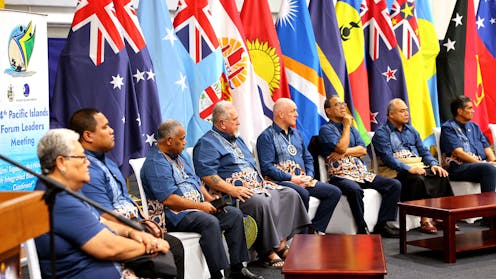
The Pacific Islands Forum wrapped up its annual leaders meeting last week with some significant agreements, including the launch of the region’s own climate financing facility, the endorsement of the Ocean of Peace declaration[1] and policies on partnerships and broader aspirations for “deeper integration”.
But integration remains a contested term. It implies unity but is shaped by the often uneven and unequal ways in which the region is tied together.
An EU-style integration has never taken root in the Pacific, primarily because forum members are not equals. Some are newly independent, while others, such as New Caledonia and French Polynesia, remain colonised.
Australia and New Zealand sit apart as larger, wealthier powers whose influence inevitably shapes the terms of integration. A closer look into the recent forum’s resolutions illustrates this fragile balance.
Integrating peace, bilaterally
Like many negotiated texts, the Ocean of Peace declaration is filled with ambiguities that allow for diverging interpretations and opportunities for it to be co-opted.
For larger forum powers, peace cannot be separated from deterrence. Since the China-Solomon Islands pact in 2022[2] bilateral security deals have proliferated[3], now including reports of a landmark PNG-Australia defence treaty[4] promising “total integration”.
Security is therefore integrating bilaterally, with only thin reinforcement at the regional level.
For many Pacific nations, peace looks different. It means little without confronting climate change, nuclear harms and human security. For them, integration takes shape through initiatives such as the Pacific Resilience Facility[5], a regional fund designed to unlock access to climate finance, or through joint efforts on labour mobility and human development.
The Ocean of Peace declaration is light on ambition. It avoids any reference to demilitarisation, even as the Pacific sees unprecedented military build-up[6].
On nuclear issues, the declaration focuses narrowly on testing and legacy, while sidestepping contemporary controversies[7], including Japan’s treated-nuclear water discharges[8] or nuclear propulsion and stationing under AUKUS[9]. That omission is deliberate – consensus was preserved, but only by avoiding the hardest questions.
Colonial legacies
This dynamic is also evident in the Review of the Regional Architecture (RRA[10]), designed to respond to increasing interest in the region. The RRA is policy-speak for how the region should better “work together” under diverging pressures.
It goes to the heart of Pacific regionalism, raising difficult questions[11] about who sits at the table, how power is shared, and how much sovereignty members are willing to cede in the pursuit of deeper integration.
But these questions expose a harder truth about the region’s dependence on Australia and New Zealand in particular, and the colonial roots of its institutions.
Colonial powers sit as members of all major regional bodies and dominate the security architecture. Foreign policy jargon such as the “centrality of the Forum[12]” and “family-first approach[13]” are less about unity than limiting entry of non-traditional partners.
A high-level political panel consulted and presented its findings[14] to forum leaders. But Nauru’s rejection of the RRA in its entirety underscores the sensitivities, and comes despite former Nauruan President Baron Waqa now serving as secretary general.
Taiwan and China
In response to the surge in external interest, leaders endorsed a tiered partnerships policy. The real test will be in how it is applied and who falls to the lower tier. One partner, Taiwan, is used to this dynamic.
The leaders’ reaffirmation of their 1992 decision on “development partners” (code for Taiwan) keeps it in a separate track altogether: invited to the forum but not part of the main partners’ dialogue.
But Taiwan’s role is hard to ignore. In seeking to better integrate climate finance flows, its US$3 million pledge to the Pacific Resilience Facility sits alongside China’s US$500,000. Taiwan is excluded politically, yet contributes more than China.
Another irony is that while much of the debate focused on how to deepen integration, West Papua and New Caledonia face the opposite. To the Indigenous population, regionalism is not integration, but the right to dis-integrate.
It was also stressed last week[15] that there cannot be genuine regionalism without addressing unfinished decolonisation. Pacific nations generally support self-determination but manage relations with France and Indonesia.
The forum’s communique[16] reflects this balancing act. On West Papua, it once again reaffirmed Indonesia’s sovereignty, while the long-promised UN Human Rights Commissioner’s mission is no closer to happening[17].
On New Caledonia, leaders simply “noted” the High-Level Troika Plus mission report[18] from October 2023, signalling reluctance to be drawn too deeply into France’s unfinished process.
A region of people-centred integration
The freer movement of Pacific people is one of the clearest examples of deepening integration. Like security, it is driven through bilateral agreements, then elevated to principle at the regional level, such as the endorsement of the Labour Mobility Principles[19]. Australia and New Zealand schemes provide vital jobs and remittances.
Pacific communities are interwoven with Australia, New Zealand and the United States through geography, legacy and large diasporas, and with France through its territories. But this form of integration carries economic and social impacts[20] and actively shapes political futures.
If sovereignty is to be preserved, integration must advance Pacific agency rather than entrench dependency. If it does the latter, it edges towards neo-colonialism in disguise.
Integration can empower Pacific nations and people through shared opportunities and connections. But it can also constrain when shaped by unequal power. The joint Pacific-Australian bid[21] to host next year’s UN climate summit in Adelaide is a clear example of the imbalance: the Pacific lends its moral voice, but Australia holds the gavel.
References
- ^ Ocean of Peace declaration (www.foreignaffairs.gov.fj)
- ^ China-Solomon Islands pact in 2022 (gjia.georgetown.edu)
- ^ bilateral security deals have proliferated (newsroom.co.nz)
- ^ PNG-Australia defence treaty (www.abc.net.au)
- ^ Pacific Resilience Facility (forumsec.org)
- ^ unprecedented military build-up (www.youtube.com)
- ^ contemporary controversies (fijisun.com.fj)
- ^ treated-nuclear water discharges (www.rnz.co.nz)
- ^ nuclear propulsion and stationing under AUKUS (www.asa.gov.au)
- ^ RRA (forumsec.org)
- ^ difficult questions (devpolicy.org)
- ^ centrality of the Forum (www.pm.gov.au)
- ^ family-first approach (www.foreignminister.gov.au)
- ^ consulted and presented its findings (islandsbusiness.com)
- ^ stressed last week (pina.com.fj)
- ^ forum’s communique (forumsec.org)
- ^ no closer to happening (www.rnz.co.nz)
- ^ High-Level Troika Plus mission report (www.rnz.co.nz)
- ^ endorsement of the Labour Mobility Principles (www.rnz.co.nz)
- ^ economic and social impacts (forumsec.org)
- ^ joint Pacific-Australian bid (theconversation.com)
Authors: Sione Tekiteki, Senior Lecturer, Faculty of Law, Auckland University of Technology