The ancient Greeks invented democracy – and warned us how it could go horribly wrong
- Written by: Konstantine Panegyres, Lecturer in Classics and Ancient History, The University of Western Australia
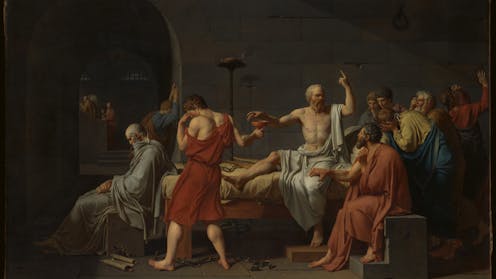
The ancient Greek orator Dio Chrysostom[1] (1st-2nd century CE) said in his speech To the People of Alexandria[2] that there were two kinds of democracy: one good and one bad.
According to Dio, one form of democracy “is reasonable and gentle and truly mild”. It allows for free speech. It is fair, magnanimous and respectful of good people and good advice.
But Dio continues[3] with darker words about democracy:
The more prevalent kind of democracy is bold and arrogant, difficult to please in anything, fastidious, resembling tyrants or much worse, seeing that its vice is not that of one individual or of one kind but a jumble of the vices of thousands; and so it is a multifarious and dreadful beast.
In the modern world, there are many arguments about the nature of democracy, and many words both of praise and of criticism. To a lot of readers, Dio’s words might ring true.
For people in ancient times, democracy was also a complicated and hotly debated concept.
So, what exactly were the ancient Greeks’ ideas about democracy, and how much do they differ from modern thinking?

Power of the people – but which people?
The term comes from the ancient Greek word demokratia. This is a combination of the words dēmos (meaning “people”) and kratos (meaning “power” or “rule”).
Basically, democratia meant “power of the people”. But who were the people who had the power?
The word dēmos is potentially ambiguous[5]. But in a basic sense, dēmos referred to people who live in a specific area.
However, in the political context of ancient Greece, dēmos usually meant all the citizens who were eligible to vote.
But some ancient thinkers equated the dēmos with the mob – the poor and uneducated people who, by sheer numbers, could outvote the wealthy and educated.
Athenian democracy
When we reflect today on ancient democracy, we are usually thinking of demokratia in Athens in Attica, Greece, that lasted from around 507 BCE to around 321 BCE.
The Athenians represented democracy as the goddess Demokratia. In artwork she is sometimes depicted crowning an old man[6] who symbolises the people.
In the ancient world, the politician Cleisthenes[7] was regarded as the founder of democracy. After the tyrant Hippias[8] was expelled from Athens in 510 BCE, Cleisthenes won a power struggle and introduced a new system of representation.
He divided the region of Attica into ten tribes and 139 demes[9]. Each citizen was member of a tribe and deme. Each tribe and deme had a fixed number of representatives elected by vote.
Fundamental to early Athenian democracy were the ideas of liberty and equality.
Liberty meant freedom to take part in politics, freedom of speech, and freedom to live the kind of private life you wanted.
Equality meant everyone had the same opportunity to be involved in politics and speak at political events, and everyone was subjected to the same laws.
Political rights in democracy were only available to adult male Athenians. A man was enrolled on the roster of citizens at age 20 and could be a political candidate or juror only at the age of 30.
There were no political rights for women, slaves, or people who were not Athenian by birth.
Of some 300,000 people living in Attica, only about 30,000 men had full political rights at any time.
The Athenian democracy ended in around 321 BCE when the Macedonians defeated the Athenians in the Lamian War[10]. The Macedonians replaced the democracy of Athens with an oligarchy.
In a democracy, people can vote for horrible things
In the ancient world, democracy was never without critics.
One of the sternest ancient detractors of democracy was the philosopher Plato[11] (429-347 BCE). Plato believed democracy was at fault for allowing people to participate in politics regardless of whether or not they were qualified to do so.
Plato was probably personally biased against democracy because the Athenians had voted for his beloved teacher, Socrates[12], to be put to death.
Others in antiquity complained that in a democracy people can vote for horrible things. As the Roman writer Claudius Aelian[13] (2nd-3rd century CE) protested[14]:
What decrees the Athenians passed, even though they were a democracy!
They ordered that each Aeginetan should have his right thumb amputated so that he could not hold a spear but would be able to manage an oar. They ordered the execution of all adult Mytileneans.
They passed this proposal, made by Cleon, son of Cleaenetus. Captured prisoners from Samos were to be branded on the forehead, the mark being an owl; this too was an Athenian decree […]
I wish these measures had not been passed by the Athenians and that such things were not reported of them.
From ancient to modern democracy
In modern times, democracy is the word we use to refer to a system of government where the people elect representatives to push for their interests in the national assembly.
Unlike in ancient times, in most modern countries with democratic forms of government most adults[15] are eligible to take part in politics and vote for representatives.
But just like in ancient times, democracy continues to have its supporters and critics.
Still, regardless of democracy’s inevitable faults, many would probably still agree with ancient thinker Periander[16] of Corinth, who said[17]:
Democracy is better than tyranny.
References
- ^ Dio Chrysostom (oxfordre.com)
- ^ To the People of Alexandria (www.loebclassics.com)
- ^ continues (penelope.uchicago.edu)
- ^ Vangelis Aragiannis/Shutterstock (www.shutterstock.com)
- ^ potentially ambiguous (www.perseus.tufts.edu)
- ^ depicted crowning an old man (www.ascsa.edu.gr)
- ^ Cleisthenes (www.oxfordreference.com)
- ^ Hippias (www.oxfordreference.com)
- ^ demes (www.britannica.com)
- ^ Lamian War (www.oxfordreference.com)
- ^ Plato (oxfordre.com)
- ^ Socrates (www.oxfordreference.com)
- ^ Aelian (www.oxfordreference.com)
- ^ protested (www.loebclassics.com)
- ^ most adults (www.sl.nsw.gov.au)
- ^ Periander (www.oxfordreference.com)
- ^ said (www.loebclassics.com)
Authors: Konstantine Panegyres, Lecturer in Classics and Ancient History, The University of Western Australia