Granting visas to enter Australia is a delicate balancing act
- Written by: Danielle Ireland-Piper, Associate Professor of Law, National Security College, Australian National University
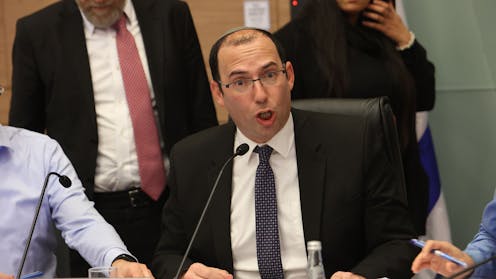
The Australian government has cancelled the visa[1] of Israeli politician Simcha Rothman, setting off a diplomatic falling out that’s escalated over the course of the week.
Rothman is a member of a far-right political party, Mafdal-Religious Zionism, which is part of Israeli Prime Minister Benjamin Netanyahu’s ruling coalition.
Home Affairs Minister Tony Burke says the visa was cancelled because of comments Rothman had made about Palestinian children[2]. Israel then retaliated by revoking the visas[3] of some Australian diplomats.
While the government stands by the decision in the face of intense criticism[4] from Netanyahu, the Liberal Party has had a different take. Shadow Home Affairs Minister Andrew Hastie has said[5] the government shouldn’t be stopping foreign elected representatives from entering the country.
These sorts of cancellations raise a number of issues, including freedom of expression, public safety, national security and international law.
So what does the law say about whether foreign politicians should be subject to different rules, particularly ones from nations with which Australia has diplomatic ties?
The basic visa laws
Australia’s federal government has discretion over which non-citizens can enter the country. Other than the specific rights of those seeking protection under international law, such as refugees, the capacity of a non-citizen to enter Australia is a privilege, not a right.
This is a big part of how all nations protect their sovereignty.
There are several grounds on which a minister can decline a visa. These include someone’s criminal record and concerns about domestic violence or terrorist activity.
The minister can also consider the risk of vilification of a segment of the community, including conduct likely to be incompatible with the smooth operation of a multicultural society.
It is not unusual for visas to be cancelled or knocked back for this reason. Notably, a Palestinian cookbook author, Mona Zahed, also had her visa cancelled[6] this month for reportedly expressing support for the terrorist organisation Hamas.
These cases can have broader implications for freedom of expression, generally. Constitutionally, for example, the implied freedom[7] of political communication can lawfully be burdened where there is a legitimate public interest (like protection from vilification). The means used must be proportionate to that legitimate public interest.
Overall, the minister is to consider the best interests[8] of the Australian community.
Importantly, ministerial decisions about visas cannot be reviewed. The minister’s decision is final.
What about foreign politicians?
For private individuals, the way visa laws are applied is relatively straightforward.
Rothman’s case is more complicated. He is not merely an individual travelling to Australia to air personal views, but a member of a democratically elected government with which Australia has diplomatic relations. Rothman is the chair of the Knesset’s Constitution, Law and Justice Committee[9].
Under international law, heads of state, ministers and diplomats have a special status and can be generally seen to be acting on behalf of the nation-state.
This means the decision to revoke the visa of a senior politician may make a political statement not just about a person, but a government and, by extension, a state.
This is why it has implications for Australia’s international relations, despite the fact Rothman is not a foreign or senior minister.
Not cancelling the visa may also have signalled a political and legal position on the actions of Israel in relation to the conflict in Gaza. Rothman is part of a government whose prime minister is the subject of a warrant[10] from the International Criminal Court for alleged war crimes, including:
starvation as a method of warfare, and
intentionally directing an attack against the [Gazan] civilian population.
Further, even if we accept the argument that Rothman is visiting as an official representative of the state of Israel, then it is relevant to consider the current international position of Israel.
In July 2024, the International Court of Justice delivered an advisory opinion[11] confirming its view that the occupation of Palestine was illegal. It said Israel had an obligation to leave the occupied territory.
Australia seeks to promote the international rule of law to the world, so these matters may be relevant factors.
Social cohesion means safety
This is also a national security issue.
In February 2025, the Australian Security Intelligence Organisation (ASIO) Director-General Mike Burgess gave his annual threat assessment[12]. He noted a “polarised, grievance-rich environment” in which “social cohesion will remain strained and we can expect spikes in communal violence”.
Read more: The ASIO threat assessment is a dark outlook for Australia's security. Are our laws up to the task?[13]
This observation was made against a backdrop of a widely reported and marked increase in antisemitic[14] and Islamaphobic[15] incidents in Australia since October 2023.
In the year after the October 7 Hamas attacks on Israel, the Executive Council of Australian Jewry reported a 316% increase[16] in the number of reported antisemitic incidents in Australia compared with the same period in the previous year.
The Islamophobia Register Australia has recorded a surge of more than 530%[17] in Islamophobic incidents being reported between October 2023 and July 2025.
A 2024 report[18] on social cohesion showed negative attitudes towards Muslims remain by far the highest of any single faith group for more than ten years.
This unrest threatens both the safety of individuals and the stability of our entire society. It increases our vulnerability to external threats, including foreign interference. This may have also been taken into consideration when deciding whether to cancel the visa.
A fine balancing act
In short, freedom of expression is a basic human right and our relationships with other countries matter, even countries with whom we disagree.
After all, Australia receives many foreign officials from countries that may not share our values. Decisions like these have consequences for our international relations.
At this point in history, however, we should take care when considering to whom we grant a platform.
The issue of visa cancellations of foreign officials is complex and nuanced. There is not always an easy answer.
References
- ^ cancelled the visa (www.abc.net.au)
- ^ Palestinian children (www.theage.com.au)
- ^ revoking the visas (theconversation.com)
- ^ intense criticism (theconversation.com)
- ^ has said (www.abc.net.au)
- ^ visa cancelled (www.smh.com.au)
- ^ implied freedom (theconversation.com)
- ^ best interests (immi.homeaffairs.gov.au)
- ^ Constitution, Law and Justice Committee (knesset.gov.il)
- ^ subject of a warrant (www.theguardian.com)
- ^ advisory opinion (www.icj-cij.org)
- ^ threat assessment (theconversation.com)
- ^ The ASIO threat assessment is a dark outlook for Australia's security. Are our laws up to the task? (theconversation.com)
- ^ antisemitic (theconversation.com)
- ^ Islamaphobic (www.theguardian.com)
- ^ 316% increase (www.ecaj.org.au)
- ^ more than 530% (www.theguardian.com)
- ^ 2024 report (scanloninstitute.org.au)
Authors: Danielle Ireland-Piper, Associate Professor of Law, National Security College, Australian National University