can you pick a Victorian from a Queenslander? How our accents change from state to state
- Written by: Howard Manns, Senior Lecturer in Linguistics, Monash University
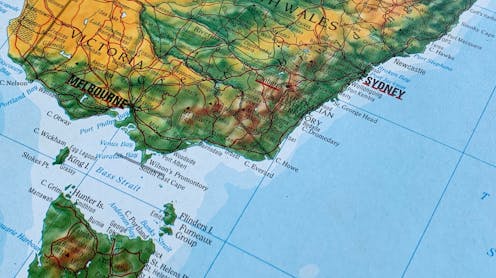
In Australia, we can often tell[1] what state someone is from based on the words they use: whether they go to the beach in “togs”, “bathers” or “swimmers” or if they prefer to eat a “potato cake”, “potato scallop” or “potato fritter”.
But compared to places such as the United States and United Kingdom, it can be harder to hear regional accent differences.
The relative uniformity of the Australian accent can be traced to our early European history, our youth as a nation and the slow pace of language change.
But Australian regional accents are there if you listen closely enough – and they are getting stronger.
Birth of the ‘uniform’ Aussie accent
In the UK, George Bernard Shaw once wrote[2]:
It’s impossible for an Englishman to open his mouth without making another Englishman hate or despise him.
Some 1500 years of history will do that.
In the US, “American English” dates to 16th/early 17th centuries, so settlement, history and depth of time have led to American regional variation.
For example, in the US South, a word like “time” might be said[3] like “tom” or “tam”, a word like “bait” might sound like “bite” and a word like “sit” might be heard as “see it”.
In Australia, English only permanently arrived with the First Fleet[4] in 1788, and observers began to comment on the uniformity of English from its early days. A visiting ship’s captain, James Dixon, wrote[5] in 1822:
The children born in those colonies, now grown up, speak a better language, purer, more harmonious than is generally the case in most parts of England.
This didn’t mean[6] Australian English was good. It just wasn’t “tainted” with regional accents.
The formation of new accents and languages often comes down to kids accommodating to one another (trying to sound like one another). But in the early days, these colonial kids had no Australian accent to accommodate to.
A linguistic melting pot
Early English-speaking Australians used a melting pot of features[7] from London, Ireland, Scotland, the West Country[8] and East Anglia[9] (among other places).
We see this in Sydney court records such as this one[10], featuring an Irish woman, Margaret O’Brien:
On Monday night quoth, Mrs O’Brien, my blessed husband went to Saint Pathrick’ a’cos ‘tis a taytotaler he is […] I axked her in purlistest terms the raison of her wiolence… Hevings forgive you, Mary Han, for telling sich a whopper; yer an hinnercent girl Mary Han.
O’Brien uses some Irish features like “raison” for “reason” and “sich” for “such”. But she also uses “Cockney” features like “wiolence” for “violence” and “hinnercent” for “innocent”.
Linguists describe this as a “feature pool”. Over time, some features rise to the top of the pool whereas others sink into obscurity.
The survivors became “Australian English”.
Survival in the tumultuous feature pool is often a mix[11] of “majority rules” and “prestige”.
Cockneys were neither a majority nor prestigious in Australia, so it is little wonder pronunciations like “wiolence” and “hinnercent” faded away.
Australia had many Irish settlers but their English wasn’t prestigious either. That said, there is some evidence[12] of Irish influence – as in the way some Aussies say words like “haitch[13]” and “filum” (for “film”).
Majority didn’t always rule[14] when it came to deciding which features survived.
Once formed, the Australian accent stayed uniform[15] for longer than you might expect.
This is because early European Australia had a highly mobile population: they often stuck close to the coast and travelled from port to port. When they travelled inland, they often did it together and in mixed company.
Australian English also stayed uniform longer because more than a few Aussies continued to look to Britain for their accent cues – some until the 1980s.
Early differences in Australian English were largely associated with social groups or whether one favoured British-like pronunciations or Australian-like pronunciations.
Before regional variation can flourish, English speakers must settle into stable and self-confident use of the local variety. To these ends, Australians have finally arrived[16].
Australian regional accents
The seeds for regional variation in Australia were planted early on. Yet, as in any garden, it can take a while for them to bloom: a language needs time, patience and the right social conditions.
South Australia was settled later[17] than other colonies and by free settlers, who used[18] newer pronunciations from the British homeland.
South Australians are apt[19] to pronounce words like “castle”, “dance” and “chance” with a longer “ah” sound (as most English speakers pronounce “palm”).
In contrast, in Tasmania, these words are more apt[20] to be pronounced with a shorter, flatter “a” sound (as most English speakers pronounce “trap”) – the older pronunciation.
In other parts of Australia, it is more complicated.
People in Brisbane and Sydney tend to follow[21] the Tasmanian pattern. In Melbourne, a majority seem to follow the shorter, flatter “trap” pronunciation. However, Melburnians may also use, or shift into the “palm” pronunciation in more formal situations.
Beyond these early seeds, Australians are starting to cultivate homegrown innovations. Linguists working with sophisticated technologies have started to note subtle regional differences[22].
For instance, you may notice Victorians have begun[23] to say the words “salary” and “celery” the same way. This vowel “merger” means many an “Ali” has received a coffee cup with “Eli” written on it in “Malbourne”.
Regional accents start as a wispy whisper. Put your ear to the wind and you just may hear them. But for a regional accent to truly flourish, you need a firm national identity, regional rivalries and a heavy dollop of time.
Keep your ears peeled.
References
- ^ can often tell (lingroadshow.com)
- ^ wrote (en.wikipedia.org)
- ^ might be said (www.wiley.com)
- ^ the First Fleet (digital-classroom.nma.gov.au)
- ^ wrote (eprints.utas.edu.au)
- ^ didn’t mean (www.taylorfrancis.com)
- ^ used a melting pot of features (www.taylorfrancis.com)
- ^ West Country (www.fodors.com)
- ^ East Anglia (www.britannica.com)
- ^ such as this one (catalogue.nla.gov.au)
- ^ is often a mix (www.taylorfrancis.com)
- ^ there is some evidence (theconversation.com)
- ^ haitch (theconversation.com)
- ^ didn’t always rule (www.taylorfrancis.com)
- ^ stayed uniform (www.taylorfrancis.com)
- ^ have finally arrived (www.taylorfrancis.com)
- ^ was settled later (www.taylorfrancis.com)
- ^ used (www.degruyter.com)
- ^ are apt (www.taylorfrancis.com)
- ^ are more apt (www.degruyter.com)
- ^ tend to follow (www.degruyter.com)
- ^ subtle regional differences (assta.org)
- ^ have begun (www.taylorfrancis.com)
Authors: Howard Manns, Senior Lecturer in Linguistics, Monash University