The US has high hopes for a new Gaza ceasefire, but Israel’s long-term aims seem far less peaceful
- Written by: Ali Mamouri, Research Fellow, Middle East Studies, Deakin University
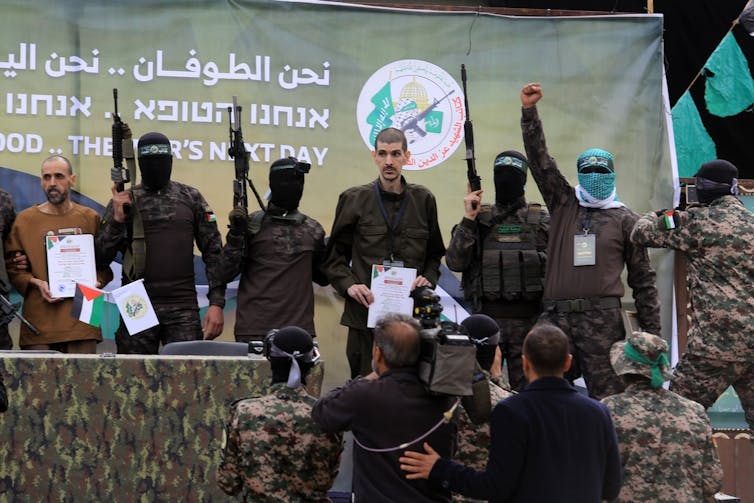
US President Donald Trump has hosted Israeli Prime Minister Benjamin Netanyahu for dinner at the White House, where he has declared talks[1] to end the war in Gaza are “going along very well”.
In turn, Netanyahu revealed he has nominated Trump for the Nobel Peace Prize[2], saying:
he is forging peace as we speak, in one country, in one region, after the other.
Despite all the talk of peace, negotiations in Qatar[3] between Israeli and Palestinian delegations have broken up without a breakthrough. The talks are expected to resume later this week.
If an agreement is reached, it will likely be hailed as a crucial opportunity to end nearly two years of humanitarian crisis in Gaza, following the October 7 attacks[4] in which 1,200 Israelis were killed by Hamas-led militants.
However, there is growing scepticism about the durability of any truce. A previous ceasefire agreement[5] reached in January led to the release of dozens of Israeli hostages and hundreds of Palestinian prisoners.
But it collapsed by March, when Israel resumed military operations[6] in Gaza.
This breakdown in trust on both sides, combined with ongoing Israeli military operations and political instability, suggests the new deal may prove to be another temporary pause rather than a lasting resolution.
Details of the deal
The proposed agreement outlines a 60-day ceasefire aimed at de-escalating hostilities in Gaza and creating space for negotiations toward a more lasting resolution.
Hamas would release ten surviving Israeli hostages and return the remains of 18 others. In exchange, Israel is expected to withdraw its military forces to a designated buffer zone along Gaza’s borders with both Israel and Egypt.

While the specific terms of a prisoner exchange remain under negotiation, the release of Palestinian detainees[8] held in Israeli prisons is a central component of the proposal.
Humanitarian aid is also a key focus of the agreement. Relief would be delivered through international organisations, primarily UN agencies and the Palestinian Red Crescent[9].
However, the agreement does not specify the future role of the US-backed Gaza Humanitarian Fund[10], which has been distributing food aid since May.
The urgency of humanitarian access is underscored by the scale of destruction in Gaza. According to Gaza’s Health Ministry, Israel’s military campaign has killed more than 57,000 Palestinians[11]. The offensive has triggered a hunger crisis, displaced much of the population internally, and left vast areas of the territory in ruins[12].
Crucially, the agreement does not represent an end to the war, one of Hamas’s core demands. Instead, it commits both sides to continue negotiations throughout the 60-day period, with the hope of reaching a more durable and comprehensive ceasefire.
Obstacles to a lasting peace
Despite the apparent opportunity to reach a final ceasefire, especially after Israel has inflicted severe damage on Hamas[13], Netanyahu’s government appears reluctant to fully end the military campaign.

A central reason is political: Netanyahu’s ruling coalition heavily relies on far-right parties[15] that insist on continuing the war. Any serious attempt at a ceasefire could lead to the collapse of his government.
Militarily, Israel has achieved several of its tactical objectives.
It has significantly weakened Hamas and other Palestinian factions and caused widespread devastation across Gaza. This is alongside the mass arrests, home demolitions, and killing of hundreds[16] of Palestinians in the West Bank.
And it has forced Hezbollah in Lebanon to scale back its operations[17] after sustaining major losses.
Perhaps most notably, Israel struck deep into Iran’s military infrastructure, killing dozens of high-ranking commanders and damaging its missile and nuclear capabilities[18].
Reshaping the map
Yet Netanyahu’s ambitions may go beyond tactical victories. There are signs he is aiming for two broader strategic outcomes.
First, by making Gaza increasingly uninhabitable, his government could push Palestinians to flee. This would effectively pave the way for Israel to annex the territory[19] in the long term – a scenario advocated by many of his far-right allies.
Speaking at the White House, Netanyahu says he is working with the US on finding countries that will take Palestinians from Gaza:
if people want to stay, they can stay, but if they want to leave, they should be able to leave.
Second, prolonging the war allows Netanyahu to delay his ongoing corruption trial[20] and extend his political survival.
True intentions
At the heart of the impasse is the far-right’s vision for total Palestinian defeat[21], with no concession and no recognition of a future Palestinian state. This ideology has consistently blocked peace efforts for three decades.
Israeli leaders have repeatedly described any potential Palestinian entity as “less than a state” or a “state-minus”[22], a formulation that falls short of Palestinian aspirations and international legal standards.
Today, even that limited vision appears to be off the table, as Israeli policy moves towards complete rejection of Palestinian statehood.
With Palestinian resistance movements significantly weakened and no immediate threat facing Israel, this moment presents a crucial test of Israel’s intentions.
Is Israel genuinely pursuing peace, or seeking to cement its dominance in the region while permanently denying Palestinians their right to statehood?
Following its military successes and the normalisation of relations with several Arab states under the Abraham Accords[23], Israeli political discourse has grown increasingly bold.
Some voices in the Israeli establishment are openly advocating for the permanent displacement[24] of Palestinians to neighbouring Arab countries such as Jordan, Egypt and Saudi Arabia. This would effectively erase the prospect of a future Palestinian state.
This suggests that for certain factions within Israel, the end goal is not a negotiated settlement, but a one-sided resolution that reshapes the map and the people of the region on Israel’s terms.
The coming weeks will reveal whether Israel chooses the path of compromise and coexistence, or continues down a road that forecloses the possibility of lasting peace.
References
- ^ declared talks (www.bbc.com)
- ^ Nobel Peace Prize (www.theguardian.com)
- ^ negotiations in Qatar (www.theguardian.com)
- ^ October 7 attacks (www.pm.gov.au)
- ^ previous ceasefire agreement (www.aljazeera.com)
- ^ military operations (www.bbc.com)
- ^ Anas-Mohammed/Shutterstock (www.shutterstock.com)
- ^ Palestinian detainees (www.hrw.org)
- ^ Palestinian Red Crescent (www.palestinercs.org)
- ^ Gaza Humanitarian Fund (www.abc.net.au)
- ^ 57,000 Palestinians (www.timesofisrael.com)
- ^ territory in ruins (www.aljazeera.com)
- ^ damage on Hamas (www.bbc.com)
- ^ Anas-Mohammed/Shutterstock (www.shutterstock.com)
- ^ far-right parties (www.theguardian.com)
- ^ killing of hundreds (www.aljazeera.com)
- ^ its operations (www.reuters.com)
- ^ nuclear capabilities (www.axios.com)
- ^ annex the territory (theconversation.com)
- ^ corruption trial (www.theguardian.com)
- ^ total Palestinian defeat (edition.cnn.com)
- ^ “less than a state” or a “state-minus” (www.timesofisrael.com)
- ^ Abraham Accords (www.state.gov)
- ^ permanent displacement (www.timesofisrael.com)
Authors: Ali Mamouri, Research Fellow, Middle East Studies, Deakin University