Overtourism is reshaping communities in Europe – could Australia be next?
- Written by: Freya Higgins-Desbiolles, Adjunct professor and adjunct senior lecturer in tourism management, University of South Australia
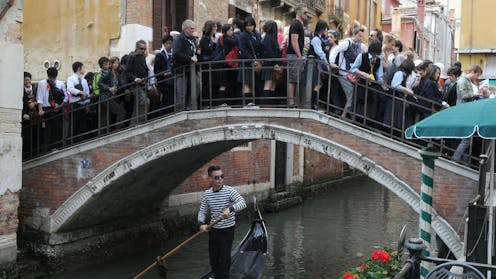
A media frenzy erupted over the recent Jeff Bezos “wedding of the century[1]” in Venice.
Also notable were the public protests that showed tensions around tourism, especially mass tourism, are increasing. Leading the action was the activist collective No space for Bezos[2], which declared:
[This wedding] is at the expense of those who live, work, and study in this city [and who are] already faced with countless difficulties after years of mass tourism.
They complained Venice had been turned into a “private amusement park” for the rich. Locals were fighting for what they describe as a “living Venice[3]”, not a tourism playground.
The backlash against overtourism is sparking protests[4] across several countries. It has even prompted the US State Department[5] to urge travellers to be cautious when heading to Europe this summer.
Growth at all costs
Local residents feel their communities are being reshaped to cater for visitors, and are pushing back against what they call the “touristification[6]” of place.
Touristification describes a situation where locals fear[7] their home towns and cities are being developed, designed and managed to attract and accommodate tourists.

This touristification process benefits commerce and industries that profit from catering to visitors. Everyone else misses out, or is literally pushed out by rising housing costs[9].
At the heart of this polarising issue are some key questions. Are such places “tourism destinations” or do they belong to the local people who live there? Whose interests should prevail when tourism growth exacerbates tensions?
These issues are being thoroughly investigated, including through a project I am involved in – Chronic Emergencies and Ecosocial Transformations in Touristified Coastal Spaces[10]. Such research is focused on understanding the problems of tourism and co-designing solutions with communities.
Continual growth in tourism[11] is one of the guiding principles the industry promotes. It is this “growth fetish[12]” that is catalysing overtourism and unsustainability. This is when tourism exceeds the local social and ecological carrying capacity of a place.
It means there are simply too many tourists, and the impact is poorly managed.
Aussie hotspots
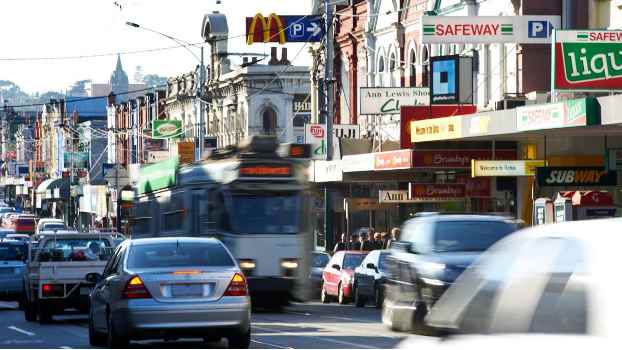
The dynamics of overtourism are emerging in some Australian locations. This includes popular coastal destinations such as Byron Bay[13] and small towns along the scenic Great Ocean Road[14].
Some places are overwhelmed by short-term overtourism. This may be the result of mega cruise ship visits[15] or viral postings on social media, such as images of Western Australia’s popular pink lakes[16].
Byron Bay offers a telling example. It has evolved from a place attractive for alternative lifestyles, to a magnet for social media influencers and the location for the Netflix series[17] Byron Baes.
As a result, Byron Bay is the epitome of overtourism in Australia[18]. Local housing, for instance, is being sacrificed for holiday rentals[19], facilitated by agencies such as Airbnb.
Not surprisingly, there is growing local resistance[20] to tourism overwhelming the sense of place.
Is Australia in danger of touristification?
If we aren’t careful, popular opposition to mass tourism will continue to grow here in Australia.
But whether we see the European phenomenon of touristification is harder to discern.
It may already be evident when environmental and social regulations are overturned to make development processes more friendly to the tourism industry[21].
Projects can be fast tracked if they are declared a high-priority “major development”, which allows governments to override restrictive regulations. Anti-red-tape rhetoric[22] is clear in Queensland’s tourism strategy harnessing the growth power of the 2032 Olympic and Paralympic Games.

Another example of touristification may be when taxpayer-funded events are run for branding presence on a national or international stage rather, than for the benefit of the surrounding community.
For example, the South Australian government found itself in hot water when its tourism commission held a marketing event featuring a Sam Smith concert at d'Arenberg winery. Social media influencers were invited to attend[24] – many from interstate with all expenses paid – but locals weren’t welcome.
It also occurs when public commons are appropriated for tourism purposes, including national parks and protected areas, public spaces and beaches.
Another example – again from South Australia – involves the decision to move the annual LIV Golf tournament to the Adelaide Parklands from 2028. The state government is being accused of a public land grab[25]. The Adelaide community loves these heritage listed parklands and has resisted attempts to co-opt their use for private interests for decades.
Reclaimining a sense of place
Ultimately, in places like Venice, Bali and even in Byron Bay, local communities do not feel heard or empowered by tourism models which are focused on growth.
Their protest actions are designed to ensure their quality of life is not undermined in the process of catering to tourists. It is a struggle for reclaiming places as local people’s homes, rather than as tourist destinations.
While locations can be shared, tourism must be better managed so locals don’t find their homes unrecognisable – or even worse, find themselves displaced.
References
- ^ wedding of the century (www.vogue.com)
- ^ No space for Bezos (atmos.earth)
- ^ living Venice (campaignforalivingvenice.org)
- ^ sparking protests (www.reuters.com)
- ^ US State Department (abcnews.go.com)
- ^ touristification (www.oxfordbibliographies.com)
- ^ locals fear (www.tandfonline.com)
- ^ Marta Perez/AAP (photos.aap.com.au)
- ^ rising housing costs (www.skaleurope.org)
- ^ Chronic Emergencies and Ecosocial Transformations in Touristified Coastal Spaces (emcrotur.uib.eu)
- ^ Continual growth in tourism (wttc.org)
- ^ growth fetish (static1.squarespace.com)
- ^ Byron Bay (viatormundi.com)
- ^ Great Ocean Road (www.abc.net.au)
- ^ mega cruise ship visits (www.abc.net.au)
- ^ pink lakes (www.abc.net.au)
- ^ Netflix series (www.theguardian.com)
- ^ overtourism in Australia (www.accomnews.com.au)
- ^ sacrificed for holiday rentals (www.abc.net.au)
- ^ local resistance (theconversation.com)
- ^ tourism industry (www.abc.net.au)
- ^ Anti-red-tape rhetoric (www.detsi.qld.gov.au)
- ^ Kiros Amin/Shutterstock (www.shutterstock.com)
- ^ invited to attend (www.abc.net.au)
- ^ public land grab (www.abc.net.au)
Authors: Freya Higgins-Desbiolles, Adjunct professor and adjunct senior lecturer in tourism management, University of South Australia