With Trump undoing years of progress, can the US salvage its Pacific Islands strategy?
- Written by: Alan Tidwell, Director, Center for Australian, New Zealand and Pacific Studies, Georgetown University
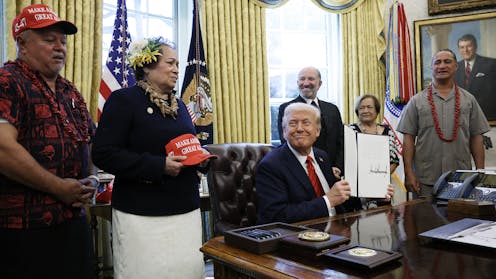
Since 2018, the United States has worked, albeit often haltingly, to regain its footing with Pacific Island countries. It’s done this largely by reflecting a sentiment familiar in Pacific capitals: the region is not a geopolitical backwater, but a crucial strategic zone in the 21st century.
Spurred by China’s strategic expansion – security deals, port access, political influence – the first Trump presidency and then the Biden administration renewed the US focus on the Pacific.
Washington was also prodded by regional allies, including New Zealand. In 2018, Foreign Minister Winston Peters[1] said: “We unashamedly ask for the United States to engage more and we think it is in your vital interests to do so. And time is of the essence.”
Building on the tentative steps of its predecessor, the Biden administration acted. It opened new embassies, invited Pacific leaders to the White House, unveiled a dedicated strategy for the Pacific Islands[2], and committed to recognising the Cook Islands and Niue.
It also negotiated more funding for the Compacts of Free Association[3] with the Federated States of Micronesia, the Republic of the Marshall Islands and Palau. Along with the 2022 Pacific Islands Summit[4], it all signalled Washington’s desire to be a better partner.
Crucially, the Biden administration recognised climate change and the economy, not great-power rivalry, as the region’s defining security concerns. Now, much of that progress is being eroded.
The second Trump administration has gutted key international development agencies[5], with the US Agency for International Development (USAID) and the Millennium Challenge Corporation shuttered.
More than mere symbols, these agencies were tools of statecraft, facilitating Washington’s capacity to compete with China’s “no questions asked” development model. Their removal leaves a vacuum, which Beijing will happily fill.
China pressing the advantage
Other signs of retreat are equally troubling. Congressional funding for the South Pacific Tuna Treaty[6] – which pays for access for US fishing fleets and is the primary multiparty agreement the US has with the Pacific Islands – was tripled by Biden, but remains incomplete.
Trump recently signed an executive order opening the Pacific Islands Heritage Marine National Monument[7], a 1,282,534 square kilometre protected marine zone, to commercial fishing. This might be welcomed by the US tuna fleet, but it raises questions about Washington’s commitment to the tuna treaty.
Hoped-for expansion of US consular access, especially vital for Pacific Islanders who must travel long distances for basic services such as visa applications, is in limbo. The US embassy in Vanuatu, damaged by the earthquake in 2024, remains closed, leaving diplomats to work out of their hotel rooms.
China, by contrast, has not slowed down. Its security pact with Solomon Islands[8], its police training efforts in Samoa and Kiribati, and its growing intelligence presence across the region show a clear pattern of assertiveness.
Beijing has proven adept at offering timely, visible assistance. Its diplomats show up. Its companies build. Its promises, however opaque, are matched with resources.
The result has not necessarily meant Pacific nations have “chosen” China. Rather, most revert to the longstanding posture of “friend to all, enemy to none”.
In a region where non-alignment is both a survival strategy and a principle of sovereignty, the perception of US unreliability makes China’s attentions all the more welcome, or at least tolerable.
Not a binary contest
The US now appears to be abandoning efforts to break this cycle, and the Trump administration risks a genuine strategic error rather than a mere diplomatic misstep.
More than distant dots on a map, the Pacific Islands control vast stretches of ocean, including key shipping lanes and undersea cables. Their diplomatic weight matters in the United Nations.
And the region matters to Taiwan, which is recognised by 12 countries[9] globally, three of which are in the Pacific.
Some argue the US should press Pacific nations to “choose” between Washington and Beijing. But that approach is shortsighted and counterproductive.
Most have no interest in being drawn into a binary contest. They seek concrete benefits – resilience funding, fair trade, visa access – not ideological alignment. Framing relationships as zero-sum contests misunderstands the region’s diplomatic logic.
Listening to Pacific leaders
To revive the relationship, the US will need to show up, follow through and demonstrate its partnership offers more than rhetoric.
This would involve restoring some elements of foreign assistance, fully funding the South Pacific Tuna Treaty obligations, opening and staffing embassies, and supporting Pacific regional organisations such as the Pacific Islands Forum[10] with meaningful recognition and resources.
But the US review of Pacific foreign assistance (a small portion of US development aid formerly administered by USAID) has been delayed once again, and likely won’t emerge until mid-July.
More importantly, the US will have to listen to Pacific leaders, who have articulated their priorities clearly[11]. They do not want to be sites of contest; they want to be agents of their own futures.
In short, the US will have to treat the Pacific Islands as sovereign equals. When Trump returned to the White House, he found a workable policy architecture for the Pacific. Its core elements could still be rescued.
But continued neglect, mixed signals and cost-cutting risk hastening the outcome China seeks – a region that finds Washington unreliable. Winston Peters, now foreign minister in a new government, might want to update his 2018 call for US engagement in the Pacific – with the emphasis on reliability.
References
- ^ Foreign Minister Winston Peters (www.beehive.govt.nz)
- ^ strategy for the Pacific Islands (www.politico.com)
- ^ Compacts of Free Association (www.rnz.co.nz)
- ^ 2022 Pacific Islands Summit (2021-2025.state.gov)
- ^ gutted key international development agencies (www.theguardian.com)
- ^ South Pacific Tuna Treaty (www.fisheries.noaa.gov)
- ^ Pacific Islands Heritage Marine National Monument (www.fws.gov)
- ^ security pact with Solomon Islands (www.theguardian.com)
- ^ recognised by 12 countries (en.mofa.gov.tw)
- ^ Pacific Islands Forum (forumsec.org)
- ^ articulated their priorities clearly (www.wgtn.ac.nz)
Authors: Alan Tidwell, Director, Center for Australian, New Zealand and Pacific Studies, Georgetown University