conservative influencers have brought angrier anti-abortion politics to Australia
- Written by: Prudence Flowers, Senior Lecturer in US History, College of Humanities, Arts and Social Sciences, Flinders University
After two decades of abortion decriminalisation across Australian states and territories, there has been a sudden surge of anti-abortion activity online, in the streets and in parliaments.
Since 2022, right-to-life bills were introduced[1] federally and in Queensland and were voted on in South Australia. During the 2024 Queensland state election, one politician vowed to introduce a conscience vote[2] on abortion to return it to criminal law.
This month, major anti-abortion protests occurred in New South Wales as politicians voted to pass a bill to improve access[3] to abortion care for pregnant people in rural areas.
During the New South Wales debates, state Liberal leader Mark Speakman delivered a scathing speech[4] in which he accused the anti-abortion activist and influencer Joanna Howe of “brazen bullying” and attempting the “Americanisation of NSW politics.”
Howe, a University of Adelaide law academic with expertise in migration law, has been at the centre of state and federal anti-abortion action since she emerged on the scene in mid-2022.
On social media, her daily posts are often adversarial, a tone amplified in comments[5] posted by her followers.
Politicians across party lines who support abortion rights have described a “wave of death threats and vile abuse[6]” from opponents of abortion after being mentioned by Howe on social media.
Australian anti-abortionists are increasingly assertive, angry and confrontational. It marks a new chapter in abortion politics in Australia.
The emotions of social movements
Historical accounts of social protest movements have often emphasised[7] the place of reason, logic or rationality rather than feelings.
Yet as anthropologist Monique Scheer[8] notes, the “practice of negative feelings” is central to much political activism and engagement. Emotions such as anger and disgust are much more effective at moving someone to action than mere “conceptual knowledge”.
My research on the anti-abortion movement in the United States reveals how central anger[9] was from the earliest moments of this cause.
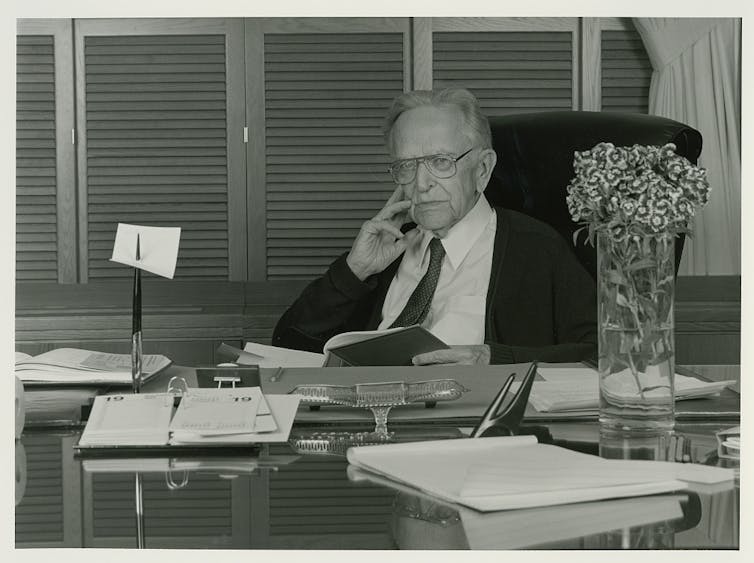
US Supreme Court Justice Harry Blackmun, author of the 1973 majority opinion[10] in Roe v Wade that legalised abortion, received about 70,000 letters on abortion over 21 years.

Most were deeply abusive[13]. His papers effectively represent an archive of hate.
Ordinary Americans wrote to suggest his mother should have had an abortion. Others imagined detailed scenarios about the suffering of his loved ones, including infant grandchildren. He received death threats of various levels of severity and more frequently, letters that fantasised about his death.
He was routinely called a murderer and a baby-killing thug. Blackmun was compared to King Herod, Adolf Hitler and Joseph Stalin, and was sent graphic images of aborted fetuses.
These types of messages were a private expression of hate and anger.
Publicly, however, opponents of abortion in the United States and Australia told a different story. They worked to repudiate the perception that they were motivated by anger and hostility and opposed women’s rights.
Public love, private hate
By the start of the 21st century, anti-abortionists had done immense work to position themselves as a positive rather than negative movement.
Activists insisted they were motivated by emotions such as love or the desire to help and protect[14]. Clinic protests were described as prayer vigils.
Self-described “pro-life feminists” like Melinda Tankard Reist[15] argued abortion was “violence against women”.
During decriminalisation debates, a popular slogan that encapsulated this rhetorical turn was the exhortation to “Love them Both[16]”.

However, these outward professions of love and concern occurred in parallel with deep hostility towards people who supported abortion rights or provided abortions. They were often seen as legitimate targets for hate.
During law reform debates, politicians including Jacinta Allan[18] in Victoria, Michelle O’Byrne[19] in Tasmania and Tammy Franks[20] in South Australia experienced campaigns of “abusive,” “graphic” and “offensive” anti-abortion letters and phone calls. These included rape and death threats.
A new chapter
The Australian public is highly pro-choice, with 76% of Australians supporting access to abortion in a 2021 study[21].
Why, then, are we witnessing this new wave of anti-abortion bills and activism?
The 2022 overturning of Roe v Wade in the US emboldened global opponents of abortion, including in Australia.
Read more: Abortion is back in the headlines in Australia. The debates in the United States tell us why[22]
The US movement “won” by developing long-term strategies that chipped away[23] at abortion rights and access. Since the mid-1990s[24], they also focused closely[25] on the statistically rare number of abortions performed after 20 weeks gestation.
These strategies are reflected wholesale in the emerging anti-abortion backlash in Australia.
After losing their campaign to stop decriminalisation, Australian opponents of abortion are working to amend laws and erode rights.
They also reject the claim that abortion is health care. They are fighting progressive attempts to end the postcode lottery[26] that currently shapes access to abortion.
However, the success or failure of individual legislative efforts seems to matter less than the opportunity to get their rhetoric, images and claims in front of an ever-growing (increasingly online) audience.
In the United States, social media has proved central for a new generation of conservative female activists: the “political tradwife[27].”
Best exemplified by conservative commentator Candace Owens, these women merge femininity and maternalism with career and a lucrative online identity.
Howe warns politicians, “I’m not your nice pro-life Christian girl[28]”. She frames her anti-abortion predecessors as well-meaning but naïve.
 A screenshot from Joanna Howe’s Instagram account taken on May 27 2025.
Joanna Howe/Instagram[29]
A screenshot from Joanna Howe’s Instagram account taken on May 27 2025.
Joanna Howe/Instagram[29]
Her posts are marked by what journalists characterise as a confrontational style and “contemptuous language[30]” towards opponents.
Howe’s legislative and activist approach is variously dubbed as “MAGA-style[31]” or “Trumpian[32]”.
In this, Howe reflects a broader trend observed by scholars. Social media incentivises “moral outrage[33]” and is changing the nature of political conversations online. Content creators talk openly about the engagement value of posting “rage bait[34]”.
It’s a combination of a domestic movement fighting against the “normalisation” of abortion with a broader online culture that encourages and amplifies what might once have been private expressions of anger.
It’s then compounded by the pervasive influence of US examples of conservative social activism.
This moment in Australian abortion politics, therefore, brings together the old and the new, ushering in an era of increasingly heightened and contentious public debate.
The Conversation contacted Joanna Howe for comment, but did not receive a response before the deadline.
References
- ^ introduced (theconversation.com)
- ^ conscience vote (www.theguardian.com)
- ^ improve access (www.abc.net.au)
- ^ scathing speech (www.smh.com.au)
- ^ amplified in comments (www.theguardian.com)
- ^ wave of death threats and vile abuse (www.theguardian.com)
- ^ often emphasised (www.taylorfrancis.com)
- ^ Monique Scheer (onlinelibrary.wiley.com)
- ^ anger (www.bloomsbury.com)
- ^ 1973 majority opinion (supreme.justia.com)
- ^ Nancy Lee Katz/Library of Congress (www.loc.gov)
- ^ CC BY-NC-ND (creativecommons.org)
- ^ deeply abusive (womensenews.org)
- ^ protect (www.tandfonline.com)
- ^ Melinda Tankard Reist (www.smh.com.au)
- ^ Love them Both (www.canberratimes.com.au)
- ^ James Gourley/AAP (photos.aap.com.au)
- ^ Jacinta Allan (www.abc.net.au)
- ^ Michelle O’Byrne (www.examiner.com.au)
- ^ Tammy Franks (www.abc.net.au)
- ^ 2021 study (www.ipsos.com)
- ^ Abortion is back in the headlines in Australia. The debates in the United States tell us why (theconversation.com)
- ^ chipped away (link.springer.com)
- ^ mid-1990s (global.oup.com)
- ^ focused closely (abcnews.go.com)
- ^ postcode lottery (www.health.gov.au)
- ^ political tradwife (journals.sagepub.com)
- ^ I’m not your nice pro-life Christian girl (www.theguardian.com)
- ^ Joanna Howe/Instagram (www.instagram.com)
- ^ contemptuous language (www.abc.net.au)
- ^ MAGA-style (www.smh.com.au)
- ^ Trumpian (www.theguardian.com)
- ^ moral outrage (www.science.org)
- ^ rage bait (www.bbc.com)
Authors: Prudence Flowers, Senior Lecturer in US History, College of Humanities, Arts and Social Sciences, Flinders University