the organisations that spent the most on social media during the election
- Written by: Mark Riboldi, Lecturer in Social Impact and Social Change, UTS Business School, University of Technology Sydney
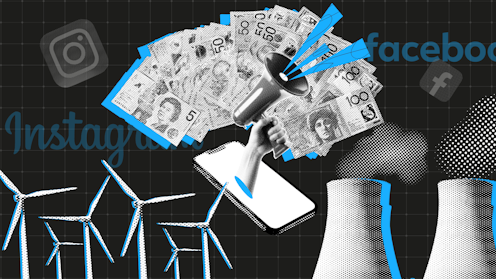
Social media advertising is an increasingly important frontier in election campaigns.
Political parties, candidates and third-party groups – such as trade unions, industry bodies and interest groups – all spend big to push their message high into the algorithms of potential voters.
Read more: What did the parties say on TikTok in the election, and how? Here's the campaign broken down in 5 charts[1]
In the 2025 Australian federal election, this spend has been estimated at around A$40 million[2] across the Meta- and Google-owned digital media platforms.
Based on our analysis of data from the Meta Ad Library[3] – part of a broader research project on third sector groups (not political parties or candidates) during the election – third party groups spent more than $7.5 million advertising on Meta platforms Facebook and Instagram from March 28 to May 3 – the date the election was called to polling day.
Understanding which of these groups spent what, and on what, offers insights into the election results and modern political campaigning generally.
Some surprises in the stats
During the election campaign, much media commentary[4] focused on right wing organisation Advance Australia’s digital campaigning.
However, our analysis shows pro-Liberal/National Party groups were outspent on Meta (which owns Facebook) almost 3:1 by anti-Liberal groups.
Much of this was focused on workers’ rights, or in opposition to the Coalition’s nuclear energy policy.
The top 25 spending groups on Meta spent just more than $6 million between them, at a rate of around $6,500 a day. The rate of spending increased steadily during the campaign, with the bulk of the spend (more than $4 million) occurring in the final two weeks.
On May 2, the day before the election, these 25 big spenders paid on average $16,622 to push their message on Meta social media platforms.
Conservative campaign group Advance Australia[5] spent just less than $50,000 on Meta on the final day of the campaign (social media advertising is exempt[6] from the two-day ad-blackout laws affecting traditional media operators).
Advance was the biggest third-party campaigning group on Meta during the election, spending more than $1 million during the campaign’s 37 days.
Advance’s left-wing competitor during the campaign was the Australian Council of Trade Unions (ACTU)[7], which spent around $475,000 on Meta advertising across the campaign, including more than $52,000 on May 2.
While the ACTU spent less than half of Advance’s spend across Meta during the campaign, it spent three times as much on YouTube/Google advertising. Data from the Google Ad Transparency Center[8] reveals the ACTU spent $928,000 on the platform between March 28 and May 3, whereas Advance spent $296,000 during the same period.
Key battlegrounds: climate and energy
The other two big Meta spenders the day before polling day highlight the key policy contest among third party organisations – the Coalition’s proposal to introduce nuclear powered energy[9] to Australia.
Nuclear for Australia[10] was the biggest spender on Meta on May 2, spending more than $65,000 in one day. Its direct counterpoint, Liberals Against Nuclear[11], spent a touch more than $32,000 on the same day.
However, during the whole campaign, Liberals Against Nuclear spent more ($246,000 compared to Nuclear for Australia’s $236,000).
An anti-nuclear message was particularly prominent across the top 25 spending groups on Meta. Of the 15 organisations we identified as being explicitly anti-Liberal, nine were climate organisations with an anti-nuclear message.
These nine organisations spent a total of $2.5 million across Meta during the course of the campaign.
The most significant of these was Climate 200[12], which spent almost $900,000 on Meta during the election campaign.
Another key anti-nuclear nuclear campaigner on Meta was Climate Action Network Australia (CANA)[13], which spent almost $400,000 between March 28 and May 3 across two different Facebook pages, and Hothouse Magazine[14], which spent almost $300,000 on pro-renewables advertising.
Together, the 15 explicitly anti-Liberal groups spent more than $3.6 million during the election, far eclipsing the two clear pro-Liberal groups, Advance Australia and Nuclear for Australia, which spent around $1.3 million between them.
So, what insights might these findings offer into the election results?
What may the future hold?
There certainly appears to be a correlation between the historic low Coalition vote[15] and the outspending of pro-Liberal entities on Meta.
Read more: Political parties can recover after a devastating election loss. But the Liberals will need to think differently[16]
Outside of Advance and Nuclear for Australia’s Meta campaigning, big-spending right-wing groups such as Australians for Prosperity, Better Australia and Australian Taxpayer’s Alliance seemed more singularly focused on tearing down the Greens and Climate 200-backed independents than on helping the Coalition win government.
In contrast, the anti-Dutton and anti-nuclear focus of the anti-Liberal third party spending has a degree of collective discipline about it, which is probably indicative of the strength of the workers’ rights and climate movements in Australia.
Additionally, the climate movement’s strong anti-nuclear campaign may have presented a message which glossed over Labor’s climate failures[17] during the previous term.
This may have sent some pro-climate voters to Labor rather than to the Greens or Climate 200 independents. For their part, these organisations appeared to campaign more around the opportunities of a possible minority government than on environmental issues.
Civil society actors such as trade unions and industry groups have a long history of involvement in Australian politics.
The increasing non-major party vote, now around a third of all voters[18], means there are now more voices in our democratic processes.
This in turn creates more opportunities for third party organisations to influence policy debate and election outcomes.
References
- ^ What did the parties say on TikTok in the election, and how? Here's the campaign broken down in 5 charts (theconversation.com)
- ^ estimated at around A$40 million (www.theguardian.com)
- ^ Meta Ad Library (www.facebook.com)
- ^ media commentary (www.theguardian.com)
- ^ Advance Australia (www.abc.net.au)
- ^ social media advertising is exempt (www.theguardian.com)
- ^ Australian Council of Trade Unions (ACTU) (www.actu.org.au)
- ^ Google Ad Transparency Center (adstransparency.google.com)
- ^ introduce nuclear powered energy (www.abc.net.au)
- ^ Nuclear for Australia (www.crikey.com.au)
- ^ Liberals Against Nuclear (www.theguardian.com)
- ^ Climate 200 (www.crikey.com.au)
- ^ Climate Action Network Australia (CANA) (www.cana.net.au)
- ^ Hothouse Magazine (www.abc.net.au)
- ^ the historic low Coalition vote (www.sbs.com.au)
- ^ Political parties can recover after a devastating election loss. But the Liberals will need to think differently (theconversation.com)
- ^ Labor’s climate failures (www.crikey.com.au)
- ^ a third of all voters (www.abc.net.au)
Authors: Mark Riboldi, Lecturer in Social Impact and Social Change, UTS Business School, University of Technology Sydney