A prisoner voting ban shows again how few checks there are on parliamentary power
- Written by: Stephen Winter, Associate Professor in Political Theory, University of Auckland, Waipapa Taumata Rau
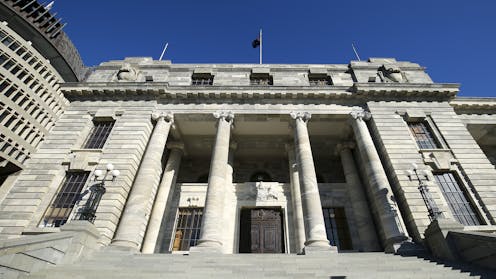
Justice Minister Paul Goldsmith’s recent announcement that the government would reinstate a total ban on prisoners voting[1] was in keeping with the coalition’s overall tough-on-crime approach.
The move was called “ridiculous” and “stupid” by opposition spokespeople, largely because it contradicted findings by the Supreme Court and the Waitangi Tribunal.
But behind those concerns about the ban[2] placing an “unreasonable limit on the electoral rights guaranteed under the New Zealand Bill of Rights Act” lies a broader constitutional question to do with parliament’s relationship with the courts.
In short, removing prisoner voting rights will damage a critical but fragile check on government power – what is known as the “judicial declaration of inconsistency”.
An ‘executive paradise’
New Zealand has been described as an “executive paradise[3]” by constitutional lawyer and former prime minister Geoffrey Palmer. There is no upper house, no federal structure, and the courts lack the power to strike down unconstitutional legislation.
The constitution itself is a collection of statutes and conventions that, for the most part, can be changed by a simple parliamentary majority. The 1990 Bill of Rights Act[4] is a cornerstone of that constitution, but is an ineffectual check on government power.
When parliament considers a bill that is potentially inconsistent with “the human rights and fundamental freedoms[5]” set out in the Bill of Rights, the attorney-general delivers a report explaining the inconsistencies.
This is supposed to be a deterrent, and one might think it would be the end of the matter. Unfortunately, that is not the case. Adverse attorney-general reports have appeared regularly[6] (there have been 15 since 2021) without blocking legislation.
Parliament’s habit of passing legislation that does not comply with the Bill of Rights is why the recently developed judicial declaration of inconsistency is constitutionally important.
The declaration is a “soft” legal power. It doesn’t strike down laws or rewrite them. Rather, it is a “weak form[7]” of review that enables affected citizens to petition the court to declare a law inconsistent with the Bill of Rights. This should then spur parliament to fix the problem.
The declaration aims to start a constitutional dialogue[8] between the two branches of government. Enabling citizens to hold parliament accountable, it is a vital instrument in a system otherwise heavily dominated by the executive branch.
Constitutional dialogue in action
The High Court issued the first such declaration in the case of Taylor vs Attorney-General[9] in 2015, declaring a total ban on prisoners voting was inconsistent with the Bill of Rights Act. The government appealed, but the Supreme Court affirmed[10] the declaration in a landmark 2018 decision.
What happened next, however, was just as important. If the declaration was to initiate a constitutional dialogue, it was up to parliament to respond – which it did. In 2020, it rescinded the ban[11] on voting for prisoners incarcerated for less than three years.
Then, in 2022, it amended the Bill of Rights to require the attorney-general to notify parliament[12] when a superior court issues a declaration of inconsistency. And it required a ministerial report to parliament on the government’s response within six months.
Those measures put in place a framework for constitutional dialogues. And this process played out in the next (and to date only) declaration of inconsistency. This was in 2022, when the Supreme Court declared prohibiting 16-year-olds from voting was inconsistent with the Bill of Rights.
In 2023, the government tabled its response and introduced a bill to enable 16-year-olds to vote in local elections. The government initially announced it would do the same for parliamentary elections. But that idea was dropped when it became clear this wouldn’t get the necessary super-majority support of 75% of MPs.
An over-powered parliament
Although modest, parliament’s responses were constitutionally important because they modelled a new framework for accountability. Chief Justice Helen Winkelmann suggested the process illustrated how courts and parliament could work together in the “gradual and collaborative elaboration[14]” of New Zealand’s constitution.
An evolving constitutional dialogue would enable the courts to pose a modest check on New Zealand’s over-powered parliament. So, those who hoped they were seeing the dawn of a new constitutional convention will be disheartened by the move to ban all prisoners from voting.
The current government has already terminated the bill enabling 16-year-olds to vote, without mentioning[15] this contradicted the Supreme Court’s declaration of inconsistency.
Should parliament now ban prisoner voting, it will have nullified all substantial responses to declarations of inconsistency. That would be a profound constitutional setback.
Parliament regularly flouts the Bill of Rights. We are now seeing it double down by rolling back its previous responses to judicial declarations.
New Zealanders already have comparatively little constitutional protection from parliament. Reinstating a total ban on prisoner voting will undermine the practice of constitutional dialogue between the two branches of government. And it will weaken a fragile check on government power.
References
- ^ total ban on prisoners voting (www.rnz.co.nz)
- ^ concerns about the ban (www.justice.govt.nz)
- ^ executive paradise (theconversation.com)
- ^ Bill of Rights Act (www.legislation.govt.nz)
- ^ the human rights and fundamental freedoms (www.legislation.govt.nz)
- ^ appeared regularly (www.justice.govt.nz)
- ^ weak form (academic.oup.com)
- ^ constitutional dialogue (www.wgtn.ac.nz)
- ^ Taylor vs Attorney-General (img.scoop.co.nz)
- ^ Supreme Court affirmed (www.courtsofnz.govt.nz)
- ^ rescinded the ban (www.rnz.co.nz)
- ^ notify parliament (www.legislation.govt.nz)
- ^ Getty Images (www.gettyimages.co.nz)
- ^ gradual and collaborative elaboration (www.courtsofnz.govt.nz)
- ^ without mentioning (www.beehive.govt.nz)
Authors: Stephen Winter, Associate Professor in Political Theory, University of Auckland, Waipapa Taumata Rau