How did sport become so popular? The ancient history of a modern obsession
- Written by: Konstantine Panegyres, Lecturer in Classics and Ancient History, The University of Western Australia
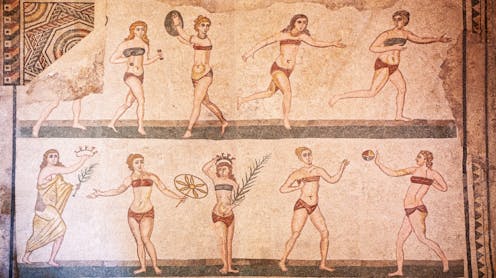
It’s almost impossible to go a day without seeing or hearing about sport.
Walk around any city or town and you will almost always catch a glimpse of people playing sports in teams or participating solo.
Turn on the TV or radio and you’ll be able to find some kind of sport being played at international or national level.
Why do people love sport so much?
To answer this question, it’s worth a dive back into ancient history.
An ancient person’s perspective
One of the most famous figures from the ancient world, Saint Augustine of Hippo[1] (354-430 AD), once wrote[2] that when he was a boy he was obsessed with playing sports:
I liked to play ball as a boy and my playing slowed my progress in learning to read and write.
In fact, Saint Augustine was so preoccupied with playing ball that his teacher was said to sometimes beat him for it. His teacher said it was bad to waste one’s youth on such things – it’s better to study hard.
Why was Saint Augustine obsessed with ball games? He loved to win[5]:
I loved to play games […] in these games I was overmastered by my vain desire to excel, so I used to strive to win, even by cheating.
Plenty of people today probably share Saint Augustine’s view that winning is one of the things that make sport enjoyable.
Of course, there are many other reasons why people might like to play sport.
What sports did they play?
If you walked down a city street in ancient Greek and Roman times, it’s likely you’d come across children or even adults playing a ball game.

The Roman playwright Plautus[8] (3rd/2nd century BC) even has one of his characters complain[9] about people “who play ball in the street”.
Ball games were probably the most popular sporting activity in the ancient world and could be played in many different ways.
In one ball game, called episkyros[10], two teams competed against each other. If one team got the ball over the line behind the other team, they scored. Feet and hands could be used and tackles were permitted.
Sounds familiar, doesn’t it?
Of course, many other sports were also popular: athletics, swimming, wrestling, lifting weights and boxing were all favourites.
Ancient ideas about the origins of sports
For the ancient Greeks, the earliest mention of a ball game appears in the Odyssey[11], an epic poem composed by the poet Homer[12] in probably the eighth or seventh century BC.
In the Odyssey, Nausicaa, daughter of the King of the Phaeacians, plays a ball game with some other girls on the beach. While they throw the ball, they sing songs[13]:
Then when they had had their joy of food, she and her handmaids, they threw off their headgear and fell to playing at ball, and white-armed Nausicaa was leader in the song.
During the game, Nausicaa throws the ball too far. Her maid can’t catch it and the ball flies into the sea. All the girls shout out when it goes flying.
Already in the 3rd century BC, Nausicaa was sometimes regarded as the inventor of ball games[14]. However, other people attributed the invention of ball games to different regions of Greece, saying the games were invented by the Sicyonians or Spartans.
But it is unlikely any Greeks were the original inventors of ball games.
In Egypt, thousands of years before Homer’s epics, there are already artistic depictions of ball games.
For example, in the tomb of the Nomarch of the 11th Dynasty (c. 2150-2000 BC), Baqet III, there is artwork showing women playing ball games and men wrestling each other.
Baqet III, whose tomb contained these artistic depictions of various sports, was likely a true sports lover.
Why did people like sports?
People liked ball games for many different reasons.
One was for the sheer fun and excitement. Another was because they were considered a healthy type of exercise.
Ancient Greek and Roman doctors even told their patients to play ball games to become healthier.
For example, the famous ancient Greek physician Galen[17] (129-216 AD) wrote an essay titled On Exercise with a Small Ball.
He argued[18] “exercises with a small ball are superior to other kinds of exercises”.
He claimed ball games were especially healthy because they moved all of the muscles and because teamwork was good for the soul.
People in the ancient world also thought just watching sport could be something worth doing.
The writer Lucian of Samosata[19] (born 120 AD), for instance, said watching athletes competing for glory could help to encourage men to achieve similar feats: “many of the spectators go away in love with manfulness and hard work”, wrote[20] Lucian.
So it seems there’s nothing new about our modern love of playing and watching sports, and this obsession will probably continue for thousands of years into the future.
References
- ^ Saint Augustine of Hippo (oxfordre.com)
- ^ wrote (www.loebclassics.com)
- ^ Wikimedia Commons (commons.wikimedia.org)
- ^ CC BY (creativecommons.org)
- ^ loved to win (www.loebclassics.com)
- ^ Gardiner, E. Norman/Wikimedia Commons (commons.wikimedia.org)
- ^ CC BY (creativecommons.org)
- ^ Plautus (oxfordre.com)
- ^ has one of his characters complain (www.loebclassics.com)
- ^ episkyros (penelope.uchicago.edu)
- ^ Odyssey (oxfordre.com)
- ^ Homer (oxfordre.com)
- ^ sing songs (www.loebclassics.com)
- ^ inventor of ball games (www.loebclassics.com)
- ^ J. Murray/Picryl (picryl.com)
- ^ CC BY (creativecommons.org)
- ^ Galen (oxfordre.com)
- ^ argued (www.loebclassics.com)
- ^ Lucian of Samosata (oxfordre.com)
- ^ wrote (www.loebclassics.com)
Authors: Konstantine Panegyres, Lecturer in Classics and Ancient History, The University of Western Australia