New sentencing laws will drive NZ’s already high imprisonment rates – and budgets – even higher
- Written by: Linda Mussell, Senior Lecturer, Political Science and International Relations, University of Canterbury
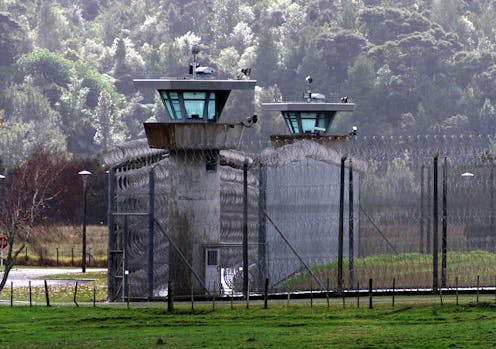
With the government’s Sentencing (Reform) Amendment Bill[1] about to become law within days, New Zealand’s already high incarceration rate will almost certainly climb even higher.
The new legislation essentially limits how much judges can reduce a prison sentence[2] for mitigating factors (such as a guilty plea, young age or mental ability). A regulatory impact statement[3] from the Ministry of Justice estimated it would result in 1,350 more people in prison.
This and other law changes are effectively putting more people in prison for longer. By 2035, imprisonment numbers are expected to increase by 40% from their current levels[4], with significant cost implications. Last year, the Corrections budget was NZ$1.94 billion[5], up $150 million from the previous year.
In sheer numbers, the Ministry of Justice projects[6] the prison population will increase from 9,900 to 11,500 prisoners over the next decade. But Minister of Corrections Mark Mitchell recently said government policies could see a peak of 13,900 prisoners over that period[7].
New Zealand’s imprisonment rate is already high at 187 per 100,000 people[8]. That’s double the rate of Canada (90 per 100,000), and well above Australia (163 per 100,000) and England (141 per 100,000).
Accounting for imprisonment and population projections[9], New Zealand’s prisoner ratio could be between 238 and 263 per 100,000 by 2035. That is higher than the current imprisonment rate in Iran (228 per 100,000).
The role of remand
Much of this increase is driven by the number of people awaiting trial or sentencing on remand[10]. This has risen substantially in the past ten years and is expected to keep rising[11].
Remand prisoner numbers are projected to nearly equal[12] sentenced prisoners in 2034. Among women and young people, remand numbers are already higher than for sentenced prisoners.
In October 2024, 89% of imprisoned youth[13] were on remand, a 15% increase in seven years. In December 2024, 53% of women prisoners[14] were on remand, more than double the 24% rate a decade ago[15]. Men on remand comprise 41% of prisoners[16], nearly double the 21% rate a decade ago[17].
Māori are affected most by these increases, making up 81% of imprisoned youth[18], 67% of imprisoned women and 53% of imprisoned men[19].
Some 30% of those on remand[20] are not convicted. Of those who are, data released to RNZ[21] last year showed 2,138 people (15% of remand prisoners) were not convicted of their most serious change, almost double the 2014 figure of 1,075 people.
Significant court delays can mean people are remanded for a long time. By 2034, it is projected the average remand time will be 99 days[22], compared with 83 days in February 2024. As well as being a human rights concern, this is very expensive.
Putting more people away for longer
Crime and imprisonment rates fluctuate independently of each other, as the former Chief Science Advisor acknowledged[24] in a 2018 report. Increasing imprisonment rates are the result of political decisions, not simple arithmetic.
The Bail Amendment Act 2013[25] reversed the onus of proof in certain cases, meaning the default rule is that an accused person will not be granted bail. This results in more people being sent to prison while awaiting a hearing, trial or sentencing.
When this week’s changes to the Sentencing Act[26] come into effect, they will further constrain judges’ discretion, capping sentence reductions for mitigating factors at 40% (unless it would be “manifestly unjust”).
At the same time, it has become more difficult for prisoners to return to the community. For example, some are kept in prison or recalled because they do not have stable housing[27]. (Dean Wickliffe, currently on a hunger strike[28] over an alleged assault by prison staff, was arrested for breaching parole by living in his car.)
Last year, Corrections received $1.94 billion[29] in operating and capital budget, a $150 million increase to account for rising imprisonment numbers and prison expansion. There was no meaningful increase in funding for rehabilitation programmes or investment in legal aid.
Imprisoning people is expensive. The cost of a person on custodial remand has almost doubled since 2015, from $239 a day[30] to $437[31]. For sentenced prisoners, it is $562 per day. This comes to between $159,505 and $205,130 per year to confine one person.
The Waikeria expansion and beyond
Corrections has developed a Long-Term Network Configuration Plan[32] to meet anticipated prison population growth. This year’s budget in May will fund 240 high-security beds and 52 health centre beds[33] at Christchurch men’s prison, at a cost of approximately $700-800 million.
Those 240 beds will fit within 160 cells, meaning “double-bunking”. This is known to have a significant impact to prisoner health and rehabilitation[34], and can also add to staffing costs.
Former corrections minister Kelvin Davis acknowledged this[35] before the first 600-bed expansion of Waikeria prison, costed at $750 million in 2018. By June 2023, that had increased by 22% to $916 million.
The second Waikeria expansion will deliver another 810 beds for an estimated $890 million[36], although the exact budget has been unclear[37]. These projects will involve public private partnership[38], a model known for not always delivering[39] the cost savings and service quality initially promised.
There will be other costs for facilities maintenance, asset management services and financing. And there can be unanticipated costs, too. For example, the government’s partner in the Waikeria expansion, Cornerstone, claimed $430 million[40] against Corrections in 2022 for “time and productivity losses” due to COVID-19.
These overall trends are happening while the government is also cutting funding for important social services[41]. Shifting resources to improve social supports would be a better option – and one that has worked in Finland[42] – than pouring more money into expanding prisons.
References
- ^ Sentencing (Reform) Amendment Bill (www.legislation.govt.nz)
- ^ limits how much judges can reduce a prison sentence (theconversation.com)
- ^ regulatory impact statement (www.justice.govt.nz)
- ^ current levels (www.corrections.govt.nz)
- ^ NZ$1.94 billion (budget.govt.nz)
- ^ Ministry of Justice projects (www.justice.govt.nz)
- ^ peak of 13,900 prisoners over that period (www.beehive.govt.nz)
- ^ 187 per 100,000 people (www.prisonstudies.org)
- ^ population projections (www.stats.govt.nz)
- ^ awaiting trial or sentencing on remand (www.corrections.govt.nz)
- ^ expected to keep rising (www.justice.govt.nz)
- ^ nearly equal (www.justice.govt.nz)
- ^ 89% of imprisoned youth (www.orangatamariki.govt.nz)
- ^ 53% of women prisoners (www.corrections.govt.nz)
- ^ 24% rate a decade ago (www.corrections.govt.nz)
- ^ 41% of prisoners (www.corrections.govt.nz)
- ^ 21% rate a decade ago (www.corrections.govt.nz)
- ^ 81% of imprisoned youth (www.orangatamariki.govt.nz)
- ^ 67% of imprisoned women and 53% of imprisoned men (consultations.justice.govt.nz)
- ^ 30% of those on remand (www.justice.govt.nz)
- ^ data released to RNZ (www.rnz.co.nz)
- ^ average remand time will be 99 days (www.justice.govt.nz)
- ^ Getty Images (www.gettyimages.co.nz)
- ^ former Chief Science Advisor acknowledged (www.dpmc.govt.nz)
- ^ Bail Amendment Act 2013 (www.legislation.govt.nz)
- ^ Sentencing Act (www.legislation.govt.nz)
- ^ do not have stable housing (cdn.auckland.ac.nz)
- ^ currently on a hunger strike (www.rnz.co.nz)
- ^ $1.94 billion (budget.govt.nz)
- ^ $239 a day (www.corrections.govt.nz)
- ^ $437 (www.corrections.govt.nz)
- ^ Long-Term Network Configuration Plan (www.corrections.govt.nz)
- ^ fund 240 high-security beds and 52 health centre beds (www.beehive.govt.nz)
- ^ significant impact to prisoner health and rehabilitation (www.ojp.gov)
- ^ Kelvin Davis acknowledged this (www.stuff.co.nz)
- ^ $890 million (www.nzherald.co.nz)
- ^ has been unclear (www.rnz.co.nz)
- ^ public private partnership (www.treasury.govt.nz)
- ^ model known for not always delivering (journals.sagepub.com)
- ^ claimed $430 million (www.rnz.co.nz)
- ^ cutting funding for important social services (www.nzherald.co.nz)
- ^ worked in Finland (impactjustice.org)
Authors: Linda Mussell, Senior Lecturer, Political Science and International Relations, University of Canterbury