end of a propaganda machine or void for China and Russia to fill?
- Written by: Valerie A. Cooper, Lecturer in Media and Communication, Te Herenga Waka — Victoria University of Wellington
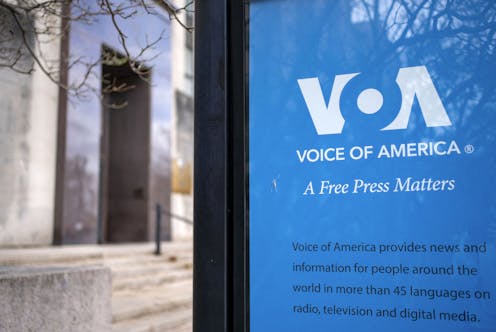
Of all the contradictions and ironies of Donald Trump’s second presidency so far, perhaps the most surprising has been his shutting down the US Agency for Global Media[1] (USAGM) for being “radical propaganda[2]”.
Critics have long accused the agency – and its affiliated outlets such as Voice of America, Radio Free Europe and Radio Free Asia – of being a propaganda arm of US foreign policy.
But to the current president, the USAGM has become a promoter of anti-American ideas and agendas – including allegedly suppressing stories critical of Iran, sympathetically covering the issue of “white privilege” and bowing to pressure from China.
Propaganda is clearly in the eye of the beholder. The Moscow Times reported Russian officials were elated by the demise of the “purely propagandistic[3]” outlets, while China’s Global Times celebrated the closure of a “lie factory[4]”.
Meanwhile, the European Commission hailed USAGM outlets as a “beacon of truth, democracy and hope[5]”. All of which might have left the average person understandably confused: Voice of America? Wasn’t that the US propaganda outlet from World War II?
Well, yes. But the reality of USAGM and similar state-sponsored global media outlets is more complex – as are the implications of the US agency’s demise.
Public service or state propaganda?
The USAGM is one of several international public service media outlets based in western democracies. Others include Australia’s ABC International, the BBC World Service, CBC/Radio-Canada, France Médias Monde, NHK-World Japan, Deutsche Welle in Germany and SRG SSR in Switzerland.
Part of the Public Media Alliance[6], they are similar to national public service media, largely funded by taxpayers to uphold democratic ideals of universal access to news and information.
Unlike national public media, however, they might not be consumed – or even known – by domestic audiences. Rather, they typically provide news to countries without reliable independent media due to censorship or state-run media monopolies.
The USAGM, for example, provides news in 63 languages to more than 100 countries. It has been credited with bringing attention to issues such as protests against COVID-19 lockdowns in China[7] and women’s struggles for equal rights in Iran[8].
On the other hand, the independence of USAGM outlets has been questioned often, particularly as they are required to share government-mandated editorials[9].
Voice of America has been criticised for its focus on perceived ideological adversaries such as Russia and Iran[10]. And my own research has found it perpetuates stereotypes and the neglect of African nations[11] in its news coverage.
Leaving a void
Ultimately, these global media outlets wouldn’t exist if there weren’t benefits for the governments that fund them. Sharing stories and perspectives that support or promote certain values and policies is an effective form of “public diplomacy”.
Yet these international media outlets differ from state-controlled media models because of editorial systems that protect them from government interference.
The Voice of America’s “firewall[12]”, for instance, “prohibits interference by any US government official in the objective, independent reporting of news”. Such protections allow journalists to report on their own governments more objectively.
In contrast, outlets such as China Media Group (CMG), RT from Russia, and PressTV from Iran also reach a global audience in a range of languages. But they do this through direct government involvement. CMG subsidiary CCTV+, for example, states it is “committed to telling China’s story to the rest of the world[13]”.
Though RT states it is an autonomous media outlet, research has found[14] the Russian government oversees hiring editors, imposing narrative angles, and rejecting stories.
Other voices get louder
The biggest concern for western democracies is that these other state-run media outlets will fill the void the USAGM leaves behind – including in the Pacific.
Russia, China and Iran are increasing funding for their state-run news outlets[16], with China having spent more than US$6.6 billion[17] over 13 years on its global media outlets. China Media Group is already one of the largest media conglomerates in the world, providing news content to more than 130 countries in 44 languages[18].
And China has already filled media gaps left by western democracies: after the ABC stopped broadcasting Radio Australia in the Pacific, China Radio International took over its frequencies[19].
Worryingly, the differences between outlets such as Voice of America and more overtly state-run outlets aren’t immediately clear to audiences, as government ownership isn’t advertised.
An Australian senator even had to apologise recently after speaking with PressTV, saying she didn’t know the news outlet was affiliated with the Iranian government, or that it had been sanctioned in Australia[20].
Switched off
Trump’s move to dismantle the USAGM doesn’t come as a complete surprise, however. As the authors of Capturing News, Capturing Democracy: Trump and the Voice of America[21] described, the first Trump administration failed in its attempts to remove the firewall and install loyalists.
This perhaps explains why Trump has resorted to more drastic measures this time. And, as with many of the current administration’s legally dubious actions, there has been resistance.
The American Foreign Service Association says it will challenge the dismantling of the USAGM[22], while the Czech Republic is seeking EU support[23] to keep Radio Free Europe and Radio Liberty on the air.
But for many of the agency’s journalists, contractors, broadcasting partners and audiences, it may be too late. Last week the New York Times reported[24] some Voice of America broadcasts had already been replaced by music.
References
- ^ shutting down the US Agency for Global Media (www.whitehouse.gov)
- ^ radical propaganda (www.whitehouse.gov)
- ^ purely propagandistic (www.themoscowtimes.com)
- ^ lie factory (www.globaltimes.cn)
- ^ beacon of truth, democracy and hope (www.politico.eu)
- ^ Public Media Alliance (www.publicmediaalliance.org)
- ^ protests against COVID-19 lockdowns in China (www.bbc.com)
- ^ women’s struggles for equal rights in Iran (www.usagm.gov)
- ^ government-mandated editorials (editorials.voa.gov)
- ^ ideological adversaries such as Russia and Iran (link.springer.com)
- ^ perpetuates stereotypes and the neglect of African nations (journals.sagepub.com)
- ^ firewall (www.insidevoa.com)
- ^ committed to telling China’s story to the rest of the world (www.cctvplus.com)
- ^ research has found (academic.oup.com)
- ^ Getty Images (www.gettyimages.co.nz)
- ^ increasing funding for their state-run news outlets (www.bbc.com)
- ^ having spent more than US$6.6 billion (www.aspistrategist.org.au)
- ^ more than 130 countries in 44 languages (www.abu.org.my)
- ^ China Radio International took over its frequencies (www.abc.net.au)
- ^ sanctioned in Australia (www.abc.net.au)
- ^ Capturing News, Capturing Democracy: Trump and the Voice of America (academic.oup.com)
- ^ challenge the dismantling of the USAGM (afsa.org)
- ^ Czech Republic is seeking EU support (www.bbc.com)
- ^ New York Times reported (www.nytimes.com)
Authors: Valerie A. Cooper, Lecturer in Media and Communication, Te Herenga Waka — Victoria University of Wellington