Police are seizing 3D-printed guns across Australia, but our laws aren’t keeping up
- Written by: Andrew Hemming, Associate Professor of Law, School of Law and Justice, University of Southern Queensland
After Martin Bryant killed 35 people and wounded 23 others at Port Arthur[1] in 1996, Australia made fundamental changes to its gun laws. The use of automatic and semi-automatic weapons became restricted and a national gun registry was established.
As a result, unlike the situation in the United States where automatic weapons can be readily obtained[2], mass shootings are a rarity[3] in Australia.
However, a new and pressing danger in the form of 3D guns, or “ghost guns”, threatens to undermine Australia’s strict gun control laws.
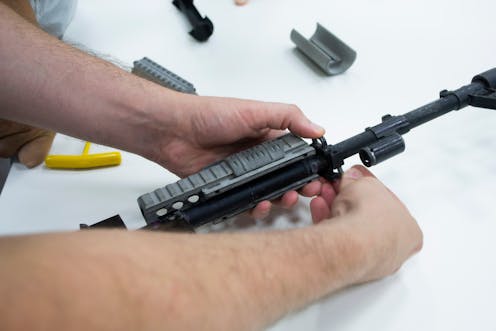
The reason is simple: 3D guns can be manufactured in a suburban garage. In a process like making a dress from a pattern, a digital blueprint for the manufacture of a firearm can be downloaded from the internet. Then, instead of a sewing machine, you need a 3D printer or an electronic milling machine.
The emergence of these types of firearms reveal big loopholes in many of our gun laws. These need urgent attention.
How are these guns made?
A 3D gun is manufactured in stages, with each part of the gun printed separately and assembled manually.
Think of yourself as making a toy LEGO gun, but instead of taking the parts from the LEGO box, you make the parts on your 3D printer based on your digital blueprint and you then assemble your gun. Your raw materials are thermoplastic polymers and metal for the barrel and firing pin.
High-end, industrial-grade 3D printers are priced between $2,000 and $10,000, and are readily available.
This technology has been around for more than a decade.
The first 3D printed handgun was designed by Cody Wilson in 2013, which he christened The Liberator[4]. It was made of 15 parts of plastic and a nail for the ring pin.

Also in 2013, reporters from the Daily Mail newspaper[6] in London 3D-printed a Liberator pistol and smuggled the disassembled gun onto a Eurostar train. They reassembled the gun in the toilet.
As the gun was made of plastic, metal detectors were not activated, demonstrating the danger these weapons pose even in high-security locations such as airports and public transport.
In the recent high-profile murder in New York of Brian Thompson, chief executive of the US health insurance company United Healthcare, the suspect, Luigi Mangione, when arrested was found to be in possession[7] of a similar 3D-printed gun[8] and 3D-printed suppressor to those allegedly used in the shooting.
Leaps forward in technology
In the 12 years since the designs for The Liberator were posted on the internet, the quality and range of 3D guns have greatly improved and expanded.
According to[9] Detective Inspector Brad Phelps from Queensland’s Crime and Intelligence Command Drug Squad, the technology has advanced sufficiently that:
now you wouldn’t be able to tell the difference between a privately manufactured firearm and a traditional firearm in many instances […] every jurisdiction in Australia has reported an increase, particularly in the last 18 months to two years.
As 3D guns are untraceable, the actual prevalence of 3D guns is unknown, other than the growing number of 3D guns seized in police raids. According to gun safety groups[10], 3D guns can now fire up to 40 rounds and use standard gauge ammunition.
Police predict[11] homemade guns will soon overtake illicit weapon imports.
In October 2024, Western Australian police seized[12] 21 privately made 3D-printed firearms from a home in Perth.
Fixing the legal loopholes
So, with all these alarm bells ringing in the ears of law enforcement agencies, what steps have authorities taken to meet the threat 3D guns pose to community safety?
Indeed, what effective steps are being taken to prevent further advances in the technology and thwart any efforts to produce these guns en masse?
The answer would appear to be that little attention has been directed towards the dangers 3D guns represent. Legislation across Australian jurisdictions is inconsistent.
At present, only New South Wales[13] and Tasmania[14] have legislated to make it an offence to possess a digital blueprint for the manufacture of a firearm on a 3D printer or electronic milling machine. The maximum penalties are imprisonment for 14 years and 21 years, respectively.
In 2022, WA took a step in the right direction by making unauthorised possession of firearms technology an offence[15]. This included possession of a 3D printer or milling device.
The slow progress on this issue is well illustrated by South Australia. There have been 23 incidents in which police have seized 3D-printed firearms and firearm parts between 2020 and 2023.
But the drafting of proposed legal amendments to address these incidents started[16] in 2024 and are still to be introduced into the SA parliament.
There needs to be a national sense of urgency similar to the federal government’s response to the Port Arthur massacre in 1996. Existing laws are inadequate as there is no uniformity in the legislation covering 3D-printed firearms and their digital blueprints.
There was a senate inquiry[17] into gun violence in 2014, which found 3D printers “were by no means integral to the illegal manufacture of firearms”. This is no longer accurate.
Ironically, the senate committee recommended[18] “Australian governments investigate the requirement for uniform regulations in all jurisdictions covering the manufacture of 3D-printed firearms and firearm parts”. A decade on, little progress has been made.
New laws could distinguish between possessing of a digital blueprint for a 3D gun and actually manufacturing a firearm. This could look like a scale of penalties, such as those imposed for the possession and manufacture of illegal drugs, which are based on the category of drug and the quantity seized.
References
- ^ at Port Arthur (www.nma.gov.au)
- ^ readily obtained (thegunzone.com)
- ^ rarity (www.sydney.edu.au)
- ^ The Liberator (www.vam.ac.uk)
- ^ Eric Gay/AP (photos.aap.com.au)
- ^ Daily Mail newspaper (www.dailymail.co.uk)
- ^ in possession (www.news.com.au)
- ^ 3D-printed gun (www.wired.com)
- ^ According to (www.abc.net.au)
- ^ gun safety groups (www.abc.net.au)
- ^ Police predict (www.abc.net.au)
- ^ Western Australian police seized (www.wa.gov.au)
- ^ New South Wales (classic.austlii.edu.au)
- ^ Tasmania (www8.austlii.edu.au)
- ^ an offence (www.legislation.wa.gov.au)
- ^ started (www.premier.sa.gov.au)
- ^ senate inquiry (www.aph.gov.au)
- ^ recommended (www.aph.gov.au)
Authors: Andrew Hemming, Associate Professor of Law, School of Law and Justice, University of Southern Queensland