‘A relentlessly dull world’ – the case for adding more colour to NZ’s grey prisons
- Written by: Christine McCarthy, Senior Lecturer in Interior Architecture, Te Herenga Waka — Victoria University of Wellington
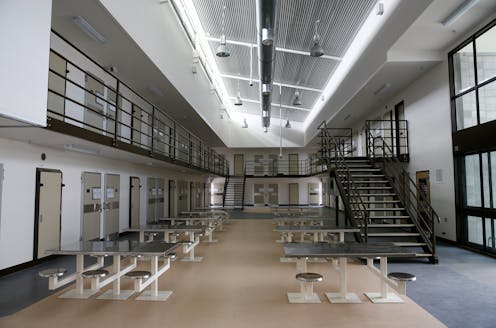
Prisons are not colourful places. Typically, they are grey or some variation of a monochrome colour scheme. But increasingly, such a limited palette is being questioned for its impact on health and rehabilitation.
As the US journalist and broadcaster Michael Montgomery once wrote of the supermax unit of Pelican Bay prison[1] in California:
I saw a relentlessly dull world; just concrete and steel […] The monochrome landscape seemed to permeate even the faces of the inmates here; men […] had a pasty, ghostly pallor. It was difficult to imagine any kind of sustained life here.
Prison greyness is partly due to the predominance of steel and concrete, especially in high- and maximum-security units. But the furniture and fixtures – tables, seats and toilets – are also often stainless-steel grey. In New Zealand, even sentenced prisoners’ clothing[2] is grey.
One reason for this is the Department of Corrections’ concern about gang colours. New Zealand prisoners cannot keep any item of property with gang-related colours[3]. These prohibitions can be zealously but inconsistently enforced.
As a prisoner once explained to me (when I was president of the Wellington Howard League[4]), a calculator he used for correspondence classes was allowed in one unit but banned in another, simply because it had a blue strip on it.
Something similar was reported by the Prison Inspectorate in a 2019 report[5]. In that case, staff withheld “black underwear containing small amounts of blue stitching. Staff confirmed this was their approach.”
Worlds without colour
Does colour matter in human environments? The answer appears to be yes. Examples include red increasing heart rates, blue and green creating calm, and yellow evoking hope. According to Australian researcher Thomas Edwards[6]:
yellow may be appropriate in contexts where high motivation and a future-focus are required. By contrast, green and blue may be relevant to settings where low motivation, a present focus, and prosocial behaviours are favoured.
Colour can also help with legibility and way-finding, and differentiate surfaces to prevent trip hazards – an increasingly important factor as the prison population ages[7].
Other over-represented groups in prison can also benefit. For example, Israeli research[8] published in 2022 concluded that soft natural colours and low contrast can improve environments for people with autism spectrum disorder.
Ultimately, a colourless world is not a good one. Grey and neutral colours reduce visual stimulation, demotivate, increase boredom and can lead to depression. Colour takes on particular importance for people who spend most or all of the day indoors, such as the prisoners in high- and maximum-security units.
The need for variety
Colour has a graduated spectrum – there isn’t only one blue, for example. Tints, tones and shades[10] add another level of complexity. Coloured surfaces are affected by their material and degree of sheen. Different combinations of colours and different light sources also affect how a colour looks and its likely impact on people.
This means there are many possible variants to consider. But most research is highly specific and the findings are rarely universally applicable. The impact of context, cultural differences, our personal preferences and colour associations can also be difficult to measure.
But this theoretical complexity shouldn’t prevent the use of more colour in prison architecture. Variety in colour, rather than the use of specific colours, is the fundamental change that is needed. Likewise, concerns about gang colours can be mitigated if pattern and colour combinations are astutely used.
In 2019, Edinburgh College of Art researchers led a project involving dementia patients, adding colour to corridors at the Royal Edinburgh Hospital[11]. Multicoloured strips of block colours were painted on the white corridor walls to relieve the monotony of these spaces.
Fewer aggressive incidents between patients or with staff were reported after the project. The specific reason is unclear, but it appears better demarcation of spaces led to fewer patients congregating and causing conflict in circulation areas.
Another example at a semi-open prison in Bosnia saw prisoners painting diagonal lines on walls[12], creating triangles painted in different colours. Researchers concluded that “bright colours are recommended in the prison, with green and blue […] being the best rated because people perceive them as soothing, stimulating, pleasant and safe”.
Brighter futures
There are many other instances in healthcare settings throughout New Zealand where decals of photographic or other images have transformed walls[13], lifting the atmosphere of a space.
Increasing the amount of colour on a wall is an inexpensive way to improve prison environments for both staff and prisoners. It can easily create variety and relieve the tedium of otherwise indistinguishable spaces.
Housing prisoners in a dreary architecture of grey walls, grey furniture and people in grey jumpsuits must make it difficult for them to imagine and prepare for a positive future in the community.
This can be inferred from studies of prisoners in solitary confinement[14] which have established that living in extremely monotonous environments can cause depression, paranoia, anxiety, aggression and self-harm.
The new expansion to Waikeria Prison[15], and its 100-bed mental health unit Hikitia, is an opportunity to significantly shift this attitude to prison interior architecture – but it shouldn’t stop there.
All prisons would benefit from replacing the typically monochromatic palette of prison architecture with something more colourful.
References
- ^ supermax unit of Pelican Bay prison (americanradioworks.publicradio.org)
- ^ sentenced prisoners’ clothing (www.corrections.govt.nz)
- ^ cannot keep any item of property with gang-related colours (www.corrections.govt.nz)
- ^ Howard League (howardleague.org.nz)
- ^ Prison Inspectorate in a 2019 report (inspectorate.corrections.govt.nz)
- ^ Australian researcher Thomas Edwards (journals.sagepub.com)
- ^ the prison population ages (inspectorate.corrections.govt.nz)
- ^ Israeli research (pubmed.ncbi.nlm.nih.gov)
- ^ Getty Images (www.gettyimages.co.nz)
- ^ Tints, tones and shades (www.bbc.co.uk)
- ^ adding colour to corridors at the Royal Edinburgh Hospital (www.research.ed.ac.uk)
- ^ prisoners painting diagonal lines on walls (www.researchgate.net)
- ^ decals of photographic or other images have transformed walls (yourdecalshop.co.nz)
- ^ studies of prisoners in solitary confinement (www.jstor.org)
- ^ Waikeria Prison (www.rnz.co.nz)
Authors: Christine McCarthy, Senior Lecturer in Interior Architecture, Te Herenga Waka — Victoria University of Wellington