Before Trump, there was a long history of race-baiting, fear-mongering and building walls on the US-Mexico border
- Written by: Marie-Eve Loiselle, Lecturer in Law, Macquarie University
Last month, Republican presidential candidate Donald Trump delivered[1] a one-hour address on the danger of illegal immigration to the United States. His stage was the US-Mexico border in Arizona and the set piece of his performance was the border wall.
The message was simple: with their border policy[2], Democrats have “unleashed a deadly plague of migrant crime”. Trump has ratcheted up the tensions on immigration further since then, repeating[3] wild conspiracy theories about Haitian immigrants eating pets and, more recently, claiming migrants are “attacking villages and cities all throughout the Midwest[4]”.
What the US needs, Trump has repeatedly stressed, is a closed border, a walled border.
A long history of wall-building advocacy
The US-Mexico border wall, which is currently around 700 miles in length in various stretches, has loomed large in American politics in recent decades, especially since the 2016 US presidential campaign. Yet, current stories about the wall mostly overlook its history.
Most importantly, the media ignore the long-standing appeal of the wall as a tool of spatial and cultural division in the making of the US-Mexico border.
In my forthcoming book[5], I trace the origin of the border wall to the early 1900s, when the US Immigration Service and other federal agencies called for the construction of barriers at the border.
Congress answered their appeal by adopting[6] an act in 1935 that authorised the secretary of state to construct and maintain fences between the US and Mexico. For decades following its adoption, US officials stood before Congress almost yearly, asking for funding for the construction of border fences.
This trend culminated in the 1940s with two parallel projects: the Western Land Boundary Fence Project (576 miles or 926 kilometres of fencing from El Paso, Texas, to the west) and the Rio Grande Border Fence Project (415 miles or 668 kilometres of fencing along the Mexico-Texas border).
Neither one of these projects was ever fully realised. But if they had been built, they would have surpassed the length of the current border wall.
Immigration, disease and crime
What is telling when looking at the history is how similar the arguments supporting such fences in the early 1900s were to those deployed today. Immigration, disease and crime have been recurring justifications for the wall, both then and now.
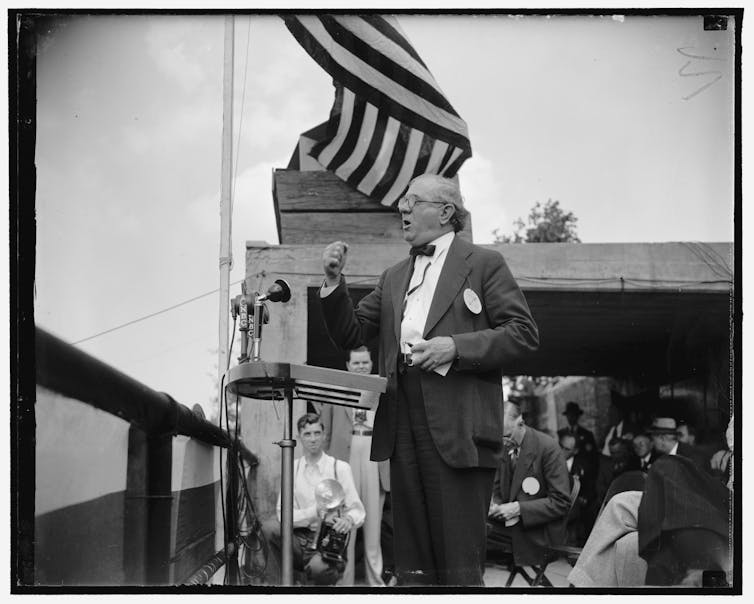
Indeed, there is an uncanny likeness to Trump’s rhetoric surrounding the US-Mexico border — including during his August speech in Arizona — and the narratives justifying a border wall in the mid-20th century.
High on the list of justifications was the need to deter “juvenile delinquents”, “thieves”, “beggars”, undocumented workers, narcotic smugglers, “wetbacks” (a derogatory term for Mexicans), and Mexican nationals seeking medical care in the US at public expense.
These arguments appeared regularly in government reports and during congressional hearings from the 1930s to the late 1950s.
A 1934 report by the Immigration Services on the feasibility of a short border fence between El Paso and Ciudad Juárez, for example, said it would stifle illegal immigration that took employment opportunities from American workers, while lowering wages in the borderland area.
Reminiscent of recent analogies[7] between the borderland and a “war zone”, the report noted that sending agents to patrol the border without proper equipment was pointless. It was akin to:
put[ting] a body of troops in the field in an enemy’s theatre of operation without artillery, observation planes, trucks, ammunition and other weapons.
The fence was “the correct solution to the problem.”
At times, the fear of the undocumented merged with the fear of contagion. A foot and mouth disease outbreak[8] in Mexico in 1946, for example, provided additional rhetorical support for the wall. As Texas Senator Tom Connally said when the Committee on Foreign Relations considered the issue:
It has been a dream of the Department of State for many years to have this fence, not because of the hoof and mouth disease, but for immigration and customs and smuggling and all of that sort of thing.
Persistent racial faultlines
The 1935 act has long been forgotten. In fact, by the end of the 1950s, only a few hundred miles of fencing had actually been built.
These earlier walling plans failed for a range of reasons, including opposition by Texan landowners and industries relying on illegal Mexican labour. Perhaps most importantly, there were serious reservations back then about the efficiency of fences in curbing immigration.
Yet, these doubts have not weighed in to the same extent in contemporary debates about the border wall. This underscores the performative role of the wall in today’s politics.
In fact, close to 700 hundred miles (1,126 kilometres) of fencing has been built under the Secure Fence Act of 2006[9]. This includes large portions of the wall built under the presidency of Barack Obama and, to a lesser extent, Trump’s.
What has filtered through, however, is the racialised narrative that paints Mexicans nationals in a disparaging way.
This rhetoric relied on generalisations and stereotypes on themes such as criminality, licentiousness and disease. It transformed Mexico into a threat to be curtailed and became a frame of reference that has permeated politics for decades – and is now a defining issue in the upcoming presidential election.
References
- ^ delivered (www.pbs.org)
- ^ border policy (www.bbc.com)
- ^ repeating (theconversation.com)
- ^ attacking villages and cities all throughout the Midwest (www.forbes.com)
- ^ forthcoming book (www.sup.org)
- ^ adopting (uscode.house.gov)
- ^ recent analogies (thehill.com)
- ^ foot and mouth disease outbreak (www.nal.usda.gov)
- ^ Secure Fence Act of 2006 (georgewbush-whitehouse.archives.gov)
Authors: Marie-Eve Loiselle, Lecturer in Law, Macquarie University