We asked Melburnians about shared e-scooters. Their responses point to alternatives to the city council’s ban
- Written by: Hiruni Nuwanthika Kegalle, PhD Candidate in Computer Science, RMIT University
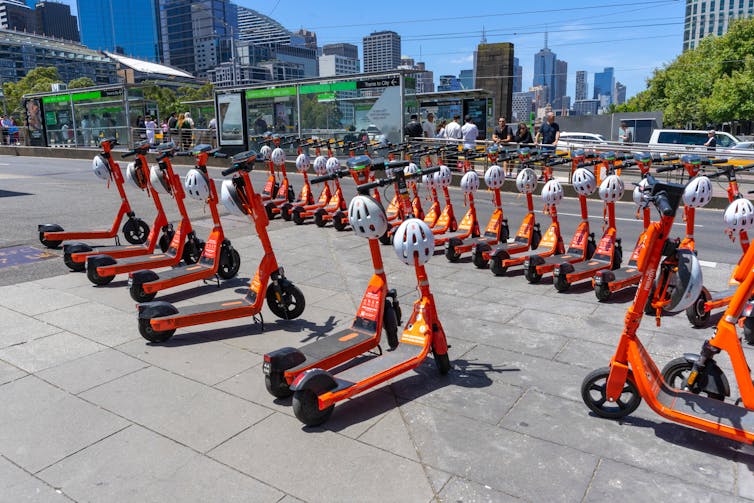
Melbourne City Council recently decided to ban shared e‑scooters[1]. The council cited concerns for the safety of e‑scooter riders, other road users and pedestrians. The city still permits private e‑scooters.
However, another major concern for many has been where riders park the scooters, often blocking the footpath. Our recent analytical study[2] in Melbourne showed a large proportion of e‑scooter trips start and end on footpaths, which pedestrians also use.
Research[3] on e‑scooter trip data in two US cities found a strong link between e‑scooter use and busier urban areas, particularly in commercial districts.
In our ongoing research, we have interviewed e‑scooter riders, pedestrians, cyclists, the service provider Lime and local council members from four councils that are part of the e‑scooter trial with commercial operators. (These interviews were conducted before the ban was announced.) We wanted to gather their opinions and experiences – including about where e‑scooters should be parked.
This article explores these responses. Based on what the study participants told us, we recommend designated parking points as a condition of permitting shared e‑scooters to operate. The allocation of parking zones should be dynamic, so locations can change as local conditions and needs change.
Pedestrians want clear footpaths
Keeping footpaths clear is the priority for pedestrians.
When e‑scooters are abandoned on footpaths, they become obstacles. This makes it difficult for people to move freely. The problem particularly affects children, the elderly, vision-impaired and those who walk while looking at their phones.
It may be surprising that pedestrians also recognised that if parking zones for e‑scooters were too far away, it could make them less practical for riders and harder to find.
Riders value ease and convenience
Riders prefer to park e‑scooters close to their destinations.
Our analysis of trip data[4] indicates e‑scooters are often used for morning commutes. A higher percentage of trips start in residential areas and end in office zones during peak commuting times. This trend also suggests riders are using e‑scooters as a first-mile/last-mile solution at either end of their commute.
Further analysis of e‑scooter parking patterns across different path types —footpaths, cycle lanes and shared paths — reveals footpaths are the most heavily used for parking.
E‑scooter companies driven by data
E‑scooter companies want to make it convenient and easy for potential riders to find and use their e‑scooters. That makes sense, as more uses mean more profit.
Guided by data analysis of past patterns of use, the companies deploy their e‑scooters in areas of high demand to ensure they’re available where trips most commonly start. They also work with local event organisers, such as those hosting sporting matches, to position e‑scooters at key locations when needed and ensure they are safely parked.
The operators accept that rider behaviour presents a major challenge. They run programs[5] to educate riders on local rules and encourage them to obey these rules.
They have also proposed the use of designated parking areas. This would mean riders are allowed to park only at certain locations. Preferably, these would be places with enough space such as wide street corners, near public transport stops and close to existing bike racks.
According to service providers, a trial of designated parking zones[6] over eight streets in Melbourne was successful.
A Lime employee told us:
The trial, we’ve had 98% compliance and 78% of people on their first try trying to end the ride on the pin, which is huge compared to the rest of the world. So, Melbourne riders are definitely very compliant and they’re willing to do that.
Local councils concerned about parking
Local council employees, responding to pedestrian complaints, suggest using underutilised urban spaces for e‑scooter parking. They propose these areas should be easy to access but carefully positioned to avoid causing new congestion issues.
A City of Port Philip employee told us:
Parking is something that we will need to consider – how we allocate space for proper parking for these devices going forward. And that will help resolve a lot of issues for pedestrians using that footpaths space, [including] persons with a disability that may be finding some difficulties. We may have geofenced an area and said that this is a no‑parking or this is a no‑riding zone. So we try to adapt and learn from our community as well as just from our own instinct.
They added:
We are all learning; this is new. It’s all about finding the right balance.
Cyclists see the parallels
Cyclists suggested setting up designated parking zones similar to bike racks.
Overseas cities, such as Mitte[8] in Germany, Vancouver[9] in Canada and San Francisco[10] in the United States, have introduced designated parking points for e‑scooters. These cities insist on a docking system as a condition of permitting shared e‑scooters.
Finding a balance
It is important to strike a balance between having parking zones close to popular destinations and keeping footpaths and public spaces clear.
To achieve this, we need to look beyond just patterns of e‑scooter use. There’s a need to investigate factors like how people and vehicles move, nearby attractions and public transport links. By considering all these elements, we can choose parking spots that are both convenient and safe for everyone.
We also recommend allocated parking zones be changeable in response to factors like the time of day, weekdays, special events and seasonal changes. A dynamic system can better respond to riders’ varying needs, providers’ operational requirements and pedestrians’ safety concerns.
The mobile app could then guide riders to these designated parking zones. This will ensure e‑scooter parking remains both convenient and safe for everyone.
References
- ^ decided to ban shared e‑scooters (www.melbourne.vic.gov.au)
- ^ analytical study (ieeexplore.ieee.org)
- ^ Research (www.sciencedirect.com)
- ^ analysis of trip data (ieeexplore.ieee.org)
- ^ run programs (www.ridebeam.com)
- ^ trial of designated parking zones (www.melbourne.vic.gov.au)
- ^ ben bryant/Shutterstock (www.shutterstock.com)
- ^ Mitte (www.berlin.de)
- ^ Vancouver (electricautonomy.ca)
- ^ San Francisco (www.bloomberg.com)
- ^ Daniel L. Locke/Shutterstock (www.shutterstock.com)
Authors: Hiruni Nuwanthika Kegalle, PhD Candidate in Computer Science, RMIT University